Showing posts with label 2 Stars. Show all posts

Friday, March 25, 2016

Batman v Superman: Dawn of Justice

This essay review is about the frustratingly-titled Batman v Superman: Dawn of Justice. It reaches for higher concepts than most foreign dramas despite being “just a comic book movie,” it does things to my favourite comic book hero that made me angry, it held me in suspense for two years before disappointing me in two hours, but it still managed to do things that made me give it three stars. It was many things; suspenseful, scary, bombastic, and original, but it forgot that none of those things matter if it fails to be entertaining.

The philosophy of Batman or Superman, the philosophy of any fictional world or character, is fun to think about, write about, and debate among like-minded geeks. But that writing, where we analyze the reasons Batman doesn’t kill and the impacts that a real Superman would have on the real world, should not be adapted into a summer blockbuster. At best they could make good documentaries.

Summer blockbusters - particularly this decade’s comic book blockbuster - are built out of a need for entertainment. There is huge range in the genre because of this. If entertainment is the bare minimum requirement for a blockbuster then there are no real limits. That is why we can have the conspiracy thriller Captain America: The Winter Soldier next to the quirky adventure Guardians of the Galaxy. And outside the comic book world we get the giddy nostalgia of Star Wars: The Force Awakens, the oh-so-serious literary epic The Lord of the Rings, and everything else successful under the summer sun going back to Jaws.

If Batman v Superman has one failing (and it doesn’t, it has many), it’s that for most of its two-and-a-half hour run-time it fails to be entertaining. It’s challenging, it’s suspenseful, it’s stressful, it’s action-packed, it’s ambitious, it’s even clever, but it is never simply entertaining. I was interested in the journeys these characters went on, and in the references to the comics and films that have come before. It kept my attention for many reasons. But it did not let me be simply entertained.

It did this in many ways, which is why it warrants such a long review.

The music was, from the very beginning, operating at the level of a climax. Gothic choirs like something out of a Lord of the Rings battle were ringing out over every fight or wide angle. The only shift or elevation I noticed in the soundtrack to amplify the content of the screen instead of over-rule it was at the big reveal of Wonder Woman. She received a unique tune that did aide the visual storytelling. Everyone else got the musical equivalent of a stress dream: unrelenting and inescapably “epic”.

The span of the story means that no scene could be wasted on character moments; everything had to drive the plot forward, which suffocates the performances under exposition. Only Alfred escapes sometimes, but he does so in the quickly worn-out pattern of saying something philosophical and then following it with a snide comment under his breath that is still clearly directed at Bruce Wayne. At least Michael Caine’s snide comments were after Wayne left the room, and were directed more at us, the audience, to get a laugh. Here, the laughs are scattered and short-lived.

As a comic book film, there is no escaping it’s roots and the fans that come with it. Tim Burton got away with altering Batman’s origins in 1989. He even sort of got away with having Batman murder a guy in 1992. I think it was because his films had the clear mark of a non-comic book fan who thought the arguments that comic book readers get into about the picky details to be stupid. But Zack Snyder and his team are not snidely looking down their noses at comic book fans, daring them to argue that this thing they love is anything more than entertainment for children; they are fans. They do diligent research and it shows. There is a reference in this film to The Mask of the Phantasm, a great animated Batman film from 1993. The background of the Bat-cave is littered with references, and ever since they announced this film by quoting Frank Miller’s The Dark Knight Returns they have made it clear that the fans come first in the imaginary audience they made this film for.

So one day they will have to explain why Batman kills people. There were a few close calls that I thought about and said, no, they survived, some of the camera angles didn’t make it clear, but surely they didn’t just show him kill a guy, and that other scene was a dream sequence so that doesn’t count. But eventually they run over every possible explanation I had to offer and showed Batman blowing up a truck with two guys in it, and crushing one car of bad guys with another car of bad guys. There’s no getting out of that one.

For now, Ben Affleck is still set to do a solo Batman film, which rumour has it will be a prequel for his Batman. And this I am still looking forward to. Despite this film’s flaws, Ben Affleck is not one of them. He is a solid Bruce Wayne and a promising Batman, and a good director. If he can tell me what happened to Robin (whose suit is seen defaced in the Bat-cave), and explain what happened to change Batman’s moral code, I will throw him my full support. Bring on Suicide Squad and more from The Man Who Wasn't Daredevil.

Same goes for Wonder Woman. Nothing much about her small part in this film raises red flags for Patty Jenkins’ production. Wonder Woman is the character that comes out of this gladiator match with the cleanest hands.

(Another note for the comic book fans: the brief appearances of Flash, Aquaman, and Cyborg give me, in order: a good feeling, cautious skepticism, and a shrug of disinterest. But those are essentially my feelings about the original comic characters, so nothing much has changed.)

And poor Superman can’t catch a break. He gets his big comeback film in Man of Steel and then the moody guy from Gotham steals his spotlight (and top billing). The weight of Batman on this film pulls it too far to his side for the blue boy scout to remain the main character. Since Ben Affleck’s Batman has not been seen before it ends up feeling more like Superman is cameoing in Batman’s origin film, and not starring in his own sequel.

In the end I find myself latching on to a sad idea. Buried in this film, slotted between a dream sequence and a training montage, is a cameo that gives me a different kind of hope. There is, it seems to me, a small possibility that in a future film this entire experience will be rewritten, Days of Future Past-style, and this frustrating film will be pushed out of canon like X-Men 3 and Wolverine. Some time-travel could do some good, and that is the real tragedy of this whole thing. All this work and build-up and the best hope I have for this film is that it will be written off as a discarded timeline in some future Justice League story. That is a sad place for a film to end up.

I said I had complex feelings about this film, and I don’t think this essay review scratches the surface, but the short answer I would have given the customers at the movie rental counter is this: it’s worth seeing if you’re a fan, the same way the Star Wars prequels are worth seeing, but if you want to be entertained by a serious, non-Marvel, superhero film, rent Batman Begins.


Friday, March 22, 2013

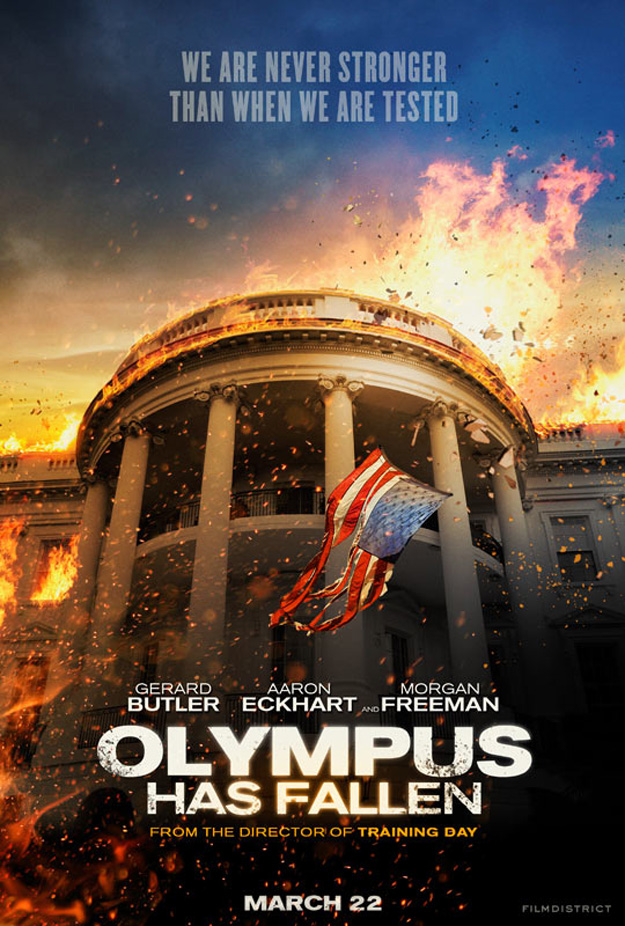
OLYMPUS HAS FALLEN


So here’s the thing about action movies: ever since Die Hard, Hollywood has been trying to make another Die Hard. They’ve done every variation of hostage situation including several more office buildings, they’ve done every type of non-American villain except Canadian, and they’ve given every macho leading man from Harrison Ford to Alec Baldwin (in 1990) a shot at the title. But even Bruce Willis as John McClane fighting Russian terrorists in A Good Day to Die Hard couldn’t recapture the magic. Now it’s Antoine Fuqua’s chance to direct, and Gerard Butler’s chance to play the hero. Are the elements that make up the bones of Die Hard present? Yes. Do they work? No.

Secret Service agent Mike Banning (Butler) is kicked off the President’s detail when he fails to save the First Lady from a car crash. Eighteen months later and he is working at the Treasury Department on the day that the South Korean delegation is visiting President Asher (Aaron Eckhart). Then a gunship bomber flies over DC and starts shooting at anything and anyone, tourist groups turn out to be heavily armed infantry, and part of the South Korean delegation turn out to be the bad guys. The fact that one of them is played by the diamond-faced villain from Die Another Day could have been a clue.

With the President and VP taken hostage and the White House occupied, the government is handed over to Speaker of the House Morgan Freeman. He has a character name, but all you need to know is he’s Morgan Freeman, which is good because that’s all the filmmakers give you. Party affiliations and character development have no place in action movies.

Something I hadn’t considered in my excitement to see Die Hard at the White House was that the whole “lone hero” scenario requires removing the other heroes. Washington DC has a lot of possible heroes to remove, and this means that the debut siege is a bloodbath. This sequence is one of the most original in the film, and it feels like the part that got the script the green light, but it resembles Saving Private Ryan more than anything from the Nakatomi Building.

It may be unfair for me to constantly compare this film to Die Hard, but I can easily see Gerard Butler’s character going home to watch the Bruce Willis classic and saying, “Why doesn’t he just shoot them in the head? He should just shoot them in the head. Do you think he considered just shooting them in the head?” I didn’t even try to count how many Full Metal Jacket brain splatters were the result of Butler firing a perfectly-aimed shot.

An essential part of the lone hero action film is the hero’s motivation. It’s not good enough that he wants to be a good guy and save everyone. John McClane would have left the building if his wife weren’t in the hostages. The same goes for Harrison Ford in Air Force One. Gerard Butler’s only motivation seems to be doing his job, which is fairly weak as far as action movies go.

But, at the halfway point, the film did not deserve much scorn. It succeeded in delivering what the trailers promised, which was a lot of action in the relatively new setting of the White House. However, in the second half, there is a device introduced that rises to Dr. Strangelove levels of stupidity solely for the purpose of raising the stakes higher than they needed to go. Nothing is easier to mock than a ticking clock, and a couple of plot contrivances leading up to it doesn’t help the believability.

As far as action movies go, there have been plenty worse, and if you don’t mind blood this was a worthy popcorn flick. It’s not challenging or particularly well-crafted, but it does what it set out to do.
By the way, if Olympus Has Fallen sounds interesting, but the theaters drop it before you get a chance to go, don’t worry. Roland Emmerich is remaking it with Channing Tatum and Jamie Foxx. White House Down opens June 28.


Friday, March 8, 2013

OZ: THE GREAT AND POWERFUL


The great debate over 3D rages on, and Oz the Great and Powerful is the latest battleground. The critics are split; some say 3D should be innocuous and intended to build on quality storytelling, but some say that 3D should remember its roots as a 1950s novelty and throw things out of the screen. Oz falls into the second category with spears, flying monkeys, carnivorous trees, and bubbling fog all flying out to the audience. I decided to save a few bucks and went to the 2D, which may have been a mistake. From the animated credits it was clear that Sam Raimi was playing to the 3D crowd next door. Also it was an afternoon show, so my seat was being kicked and a small blonde child was practicing the hundred meter dash in the aisle (I thought I should mention that in case my review sounds bitter).

The movie opens in black and white Kansas with the frame cut off at the old 4:3 ratio. Oz (James Franco) is a magician working in a traveling circus. He is selfish, deceitful, and as much of a womanizer as children’s films allow. Plenty of great films have sleazy leading men who see the error of their ways, but this opening sequence is missing any kind of villain to contrast with the charming hero. When Rick first appears in Casablanca we like him not because he’s a sharp-tongued rogue, but because he’s a sharp-tongued rogue outwitting Nazis. Here, Franco is just the least honest man in a room of nice country people, and the intro sequence suffers as a result.

When Oz’s hot air balloon is tossed around by a tornado the visuals kick in. Broken fence posts stab at Oz through the floor and wagons crash into the screen as the noise rages on. Finally calm air returns and the screen transforms into panoramic colour. One thing that cannot be faulted is the film’s production design. The look of the original 1939 film is recreated and expanded very effectively. Although the movie is claimed to be based on the books, it is clearly inspired most by the original musical.

References to The Wizard of Oz imagery are everywhere. Rainbow arcs appear in clouds and tree branches through the whole film to the point of overkill. In one respect Raimi did hold back, which is referring to the original film’s trio of characters. A lion makes a fun appearance, and we meet a man who makes scarecrows, but other than these little nods the film is mostly concerned with the love triangle (or square?) of Oz and the three witches.

Michelle Williams is the bubble-powered Glinda, Rachel Weisz is the uncomplicated evil witch Evanora, and Mila Kunis is the naive Theodora. The relationships of these three with Oz appear a little one-sided, and are only marginally better than Twilight in terms of inspiring female role models. Also, since this is essentially a prequel, the original film’s ending is given a depressing new twist with Oz abandoning Glinda to return to Kansas with a younger woman. But, all that aside, the three leading women are all great actors and they are performing in the slightly exaggerated style that classic Hollywood and children’s films demand.

When Glinda brings Oz into her protected kingdom there is a sequence where a bunch of townspeople explain exactly what they do; someone sews, someone makes bread, someone builds scarecrows, etc. Unfortunately this is not the only scene where people voluntarily say exactly what they do. The script is filled with exposition where characters simple state their intentions. If this weren’t aimed at children I’d say it was criminally lazy writing, but I have to remind myself again that this is targeted at kids who have recently hit the age where The Wizard of Oz is first experienced. Clarity is expected.

Without the dazzle of 3D I was left to look at the quality of the story, the script, and the acting, none of which are the film’s strength. It’s worth looking at for the visuals of the production design. I wouldn’t say that it is a terrible otherwise, since it easily outdoes other revisitations of children’s classics (Charlie and the Chocolate Factory comes to mind), but it isn’t great, and unless you’re under 10 it isn’t powerful.


Friday, February 10, 2012

SAFE HOUSE


The traditional action movie is a much-maligned category of film. For the last decade filmmakers have been trying to find a way to combine modern, globalized society with the bullets and explosions of a previous era. Gone are John McClane and Indiana Jonese (except in nostalgic sequels); action has been handed off to the superheroes. The lone gunman or rogue CIA agent or heart-of-gold rough cop are forced to  resort to bigger set pieces (such as in the new Mission: Impossible) or louder noises and what we get are Jason Bourne and Daniel Craig’s James Bond. Usually both of those heroes handle the shaky camera and loud noises well, but they are unique. Safe House, the new thriller starring Denzel Washington and Ryan Reynolds is not unique. It is loud and full of shaking cameras.

Reynolds is Matt Weston, the bored “housekeeper” of a Cape Town CIA safe house. Washington is Tobin Frost, a long-lost rogue agent who escapes assassination by dodging into a US embassy. What follows is a long series of surprise gunshots, surprise car crashes, and surprise betrayals as everyone tries to kill Denzel Washington to get the MacGuffin he carries.

I’ll warn you right now that if you think you know how this movie ends you are probably right. This is director Daniel Espinosa’s first Hollywood feature and it looks like he and writer David Guggenheim watched all the major action films of the last decade as preperation. Some lame films are saved by being worthy of scorn and a riff track, but Safe House isn’t horrible enough for that; in general it is just not engaging.

With the December 31 Oscar deadline the studios release all their best material before the new year. The biggest box office earners are released in the summer blockbuster season, which kicks off at the start of May with a major SFX picture. This pattern has been in place since Star Wars in 1977, and Marvel’s The Avengers is continuing the tradition this year. This release schedule leaves a dead space between January and April that is filled with wide releases of Oscar nominees and the leftover pictures the studios didn’t have confidence in. Although there isn’t an article on the Oscars for me to go into further details, it should be clear which category Safe House is in. Don’t expect to see this at next year’s award ceremony.