Showing posts with label 4 Stars. Show all posts

Saturday, February 8, 2014

THE COOK, THE THIEF, HIS WIFE & HER LOVER

Dinner. Sex. Murder. Dessert. Stabbing. Abuse. Singing. Rape. Cannibalism. Cooking. This is the world of Peter Greenaway’s graphic, rhythmic and haunting film starring Helen Mirren and Michael Gambon.

Albert Spica (future Dumbledore Michael Gambon) returns each night to the same restaurant with his unflappable wife, Georgina (Helen Mirren), and his gang of thugs. He boisterously announces every thought in his head, punctuated by profanity and verbal abuse of everyone around him. Meanwhile, his wife begins an affair with the bookish Michael sitting at a nearby table.

The cook, French chef Richard Borst, is the arbiter of Georgina and Michael’s affair, hiding them in pantries and meat lockers to protect them from her gangster husband. He and his eclectic staff of cooks, dishwashers and servers suffer the brunt of Albert’s verbal abuse, but soon witness the escalating violence that this so-called marriage has brought down on them.

It’s difficult to say which is more unearthly or evocative: the set design or Michael Nyman’s orchestral score. The restaurant, kitchen and loading dock are where 90% of the film takes place, and the vaulted ceilings, broad corridors and colourful lights are like sets out of “Blade Runner” or “Brazil”. At the same time, the music is as epic and overbearing for a climactic fight as it is for the serving of desert.

Extreme elements, from the words and actions of the villain to the alienating score and sweeping movement of the camera, boil over and drown the audience in ways that few films dare to do. The emotional impact of this film could be compared to “Requiem for a Dream” or “A Clockwork Orange”. Extreme adult content in a powerful narrative can leave the right audience stunned and fascinated.


It is likely the film’s X rating that kept it from gaining wider acclaim in the way that Stanley Kubrick’s film have (and this is a very Kubrickian film), and the same can be written for Michael Gambon’s character. Albert Spica may have missed out on the AFI’s Top Villains list, but when he makes appearances on similar lists, he’s at the top.


As published on Examiner.com 

Thursday, January 9, 2014

Killing the Point

If there is a purpose to film, a single reason to continue making them, then that has to be their ability to reflect life as we wish to see it. Making a film reflect reality is actually more difficult, as any documentarian will tell you, but the reflection of life as we would like to see it is - in my opinion - far more important. Films can provide dreams to those who would otherwise wollow in pain and poverty, and they can illustrate goals for where we want to go as a society, where the next technological break should come, or just what part of the world we would like to explore if we get the chance to go on vacation. Therefore, I it as a dangerous and horrible pattern how many short films dealing with youth and LGBT issues end in suicide.

There isn't much value in listing all the offenders, but they are not hard to find. In this argument I will look at the prototypical story points of a gay coming-of-age drama:
1. Straight-minded character has a moment of same sex attraction
2. Breaking away from core, "straight" friends the character acts on the attraction
3. No matter what reaction is, it results in the character being "outed" to one or all other characters
4. Distraught and bullied, character is faced with immediate choice
5. Character choses death

First of all, no one North of 2 on the Kinsey scale is completely unaware of same sex attraction until their mid teens. There is a case to be made that films on this subject are rarely able to get younger actors to participate because of child pornography issues, and the age of sexual awakening is usually increased in films as a result. But the dependence on "love at first sight" is an overused trope in this case on par with its overuse in Hollywood romantic comedies.

The next issue with this outline is point 3. The first, secretive sexual act, the kiss in the doorway or under the bleachers or under the freeway overpass, is established as an event that the character does not want anyone to know about. Teens are particularly focused on keeping things secret, from their parents or friends or school authorities, so for this first kiss to immediately result in getting caught is a drastic oversimplification of the lives of teens.

Next, point 4, is the climactic choice. Despite other situations that can preceed it, the choice is usually the same by the end of the film: live or die. This is not an unreasonable choice to wish upon a character at the end of a film since if the final choice was between which colour shirt to wear the next day it would have less immediate urgency for the audience. But the fact that this choice usually comes within hours of the character being outed only shows that the writer believes teens have absolutely no impulse control.

Now, I do remember being a teen and having poor impulse control, but when it comes to a choice of life or death, I know it takes longer than an hour to decide.

But the film ends with the character stepping off a roof, bleeding out behind a locked bathroom door, or any other horrible scenario that is supposed to show the characters who bullied, who disowned, who lashed out that their actions were wrong and they have lead to this. It also shows the audience that life is not worth fighting for, and if you find yourself being ostracized by your family and peers there is nothing you can do so you might as well kill yourself.

This is why I dislike Romeo and Juliet. If Romeo had not been such a drama queen and just waited, thought things through, then Juliet would have woken up and the aweful plan would have actually worked. But it seems, to the mind of the angsty modern dramatist, that Romeo's quick purchase of poison was made rationally, and we get to witness the endless repeatitions.

Ironically, the gay-inversion of Romeo and Juliet, Private Romeo (4 stars), replaces "death" with "expelled from military school". The film actually blends the modern story with an English class reading the play, but the implication is that the real love story does occur and it is just being presented to us with higher language on top. So instead of killing himself over his dead love, Private Romeo "commits suicide" by getting caught with his lover, and they are, we assume, expelled and live happily ever after. To my mind this is the only form of suicide acceptable at the end of a gay teen film.

If the suicide occurs earlier to a supporting character then the film is a legitimate exploration of the effects of suicide, but if it is tagged on as the character's last choice it is a bullshit cop out that disrespects the characters and only manages to affect the questioning teen who finds it on YouTube and becomes just a little bit more discouraged with life. Unacceptable.


Sunday, August 25, 2013

THE WORLD'S END

Few cult classics of the last decade managed to be as popular as Shaun of the Dead, and I'd say no zombie film has been as entertaining. When Hot Fuzz came along from the same crazy team it managed to upend the action cop genre just as well as Shaun had upended zombie horror. Both films walk a very thin line between satirizing the genre and being a part of it, and both succeed brilliantly. Now comes sci-fi/alien/apocalypse comedy The World's End.

The film’s aliens are actually robots that have replaced most of the town in a mix of Invasion of the Body Snatchers and The Stepford Wives. Party guy Gary (Simon Pegg) convinces his four high school friends (Nick Frost, Martin Freeman, Eddie Marsan, and Paddy Considine) to go back to their home town to finish the twelve-pub crawl that they never completed 23 years before. Soon the robot alien secret is revealed, and the guys have to fight for their lives and try to save the world.

Unlike most recent comedies, The World's End manages to include real character development, conflict, and drama without sacrificing laughs. Anyone who has had a few close drinking buddies in their life, and perhaps have gone too far some nights, will relate to these five old friends. They have their ups and downs, and still carry some old scars, but they are there for each other when the blue alien robot blood hits the fan.

Revered Polish director Krzysztof KieÅ›lowski made the famous "Three Colours Trilogy" with Blue, White, and Red. Film geeks Simon Pegg and Edgar Wright have now completed their "Three Flavours Cornetto Trilogy”. Strawberry red was in the gory rom-zom-com Shaun of the Dead, original blue is in the police-centered Hot Fuzz, and alien mint green is in The World's End. Along with a recurring set of actors and a few recurring jokes, the trilogy is mostly held together by Pegg and Wright's quintessentially British humour and Wright’s love of fast editing, which is on full display in The World's End.

I hesitate to mention, but if I had one complaint with the film it would be, ironically, the end. Although the story wrapped up and climaxed in a wonderfully entertaining way, the last few minutes saw a sudden tone shift that I felt halted the momentum. In a way it was the perfect way to end the film, and it marked a clear difference from the other two Cornetto films, but it still didn't feel right.

Despite the minor issues I had with the ending, or with the somewhat underused appearance of Pierce Brosnan (with Timothy Dalton in Hot Fuzz, I’m sad that Connery or Moore weren’t in Shaun of the Dead for a James Bond hat trick), The World’s End was a wonderfully entertaining film.

Apparently Cornetto is releasing new flavours in the UK, so if the stars align and find themselves with some free time, perhaps the trilogy will expand. For now you can expect to see Simon Pegg expanding into drama with Hector and the Search for Happiness as well as more Star Trek, Nick Frost will be acting without Pegg for the first time in salsa dancing comedy Cuban Fury, and director Edgar Wright is finally working on Ant-Man for Marvel’s Phase Two films leading to The Avengers 2.


Wednesday, June 19, 2013

MAN OF STEEL

The undeniably great Christopher Reeve ushered in the first generation of superhero blockbusters with 1979's Superman: The Movie. That generation brought us the Tim Burton Batman and little else of any success. The second generation kicked off with Bryan Singer's X-Men and Sam Raimi's Spider-Man. With the reboot of The Amazing Spiderman, the re-invention of the epic blockbuster in The Avengers, the critical and commercial success of The Dark Knight trilogy, and a new team in X-Men: First Class, we have entered a third generation of superhero films.

Man of Steel is Superman's return to relevance, and his first truly great screen appearance since 1979.

An extended look at a much more realistic Krypton opens Man of Steel, and successfully sets the tone in a much darker way. Despite being Zack Snyder's film, the impact of Christopher Nolan is felt throughout; and although this sacrifices some of the light charm that Reeve's films were known for, it is a firm statement of independence that works in the film's favor.

Unlike previous incarnations, the backstory of Krypton is key to the entire film, and true motivation is developed for Superman's Kryptonian parents and the film's big bad, General Zod (Michael Shannon). Slight alterations to the technology, physics, and explanations of Superman's Kryptonian DNA are brilliant manipulations of the classic story that bring it up to date for a modern superhero blockbuster. Batman Begins started the reset where audiences would not accept a superhero without logic and reason. Man of Steel's creative team, including David S. Goyer and Christopher Nolan, have brought the same respect for the character that rebuilt Batman so effectively.

Henry Cavill, the man who was almost cast as Aragorn then Batman and then James Bond, has finally found his blockbuster franchise. He fits the suit that few mere mortals are physically qualified for, and he manages to pull off the reluctant hero without appearing mopey or frigid. A downside to the origin story that this film tells is that we don't get much of his human alter ego. Part of what made Christopher Reeve's Superman so likeable was his bumbling Clark Kent, but we'll have to wait until the next film to see if Cavill's awkward journalist is as good as his bulletproof hero.

Even though the film revolves around Krypton's destruction, Clark Kent's childhood development in Kansas, and General Zod's escape from the phantom zone for revenge, Man of Steel carves a very original path from the first two Christopher Reeve films. By the credits it has established a new Superman in the same way that JJ Abrams established a new Star Trek. All the characters and elements are present, but they have not been dropped in front of us for no reason. By the end of the film we believe in them, and we see the connections that make them cohesive.

If rumours are true and Man of Steel is the first step towards a larger DC Universe, then it is my hope that the end of the sequel to Man of Steel will tease a new Batman. Then, in The Dark Knight Rises of this franchise, a dual Superman/Batman story can be told. If Warner Brothers is intent to copy Marvel's success, they would be smart to not front-load their franchise. There will be time to introduce Wonder Woman, The Flash, Green Lantern (again), and even Aquaman, but the world they have built here is delicate. Realism and logic were put front and center in The Dark Knight trilogy, and now the same has been done for Superman, which many people (including me) did not expect. Hopefully good writing and forward thinking will win out over immediate greed.


Saturday, May 18, 2013

STAR TREK INTO DARKNESS

This is the long-awaited sequel to a blockbuster science fiction franchise that has seen highs and lows over the past few decades. It is probably the best indicator of what JJ Abrams will bring to a Star Wars sequel, and I'd say things are looking very good.

After a thrilling James Bond-like opening mission, Kirk and the Enterprise return to Earth. In London, rogue agent John Harrison (Benedict Cumberbatch) has bombed a Starfleet archive, and Kirk gets permission from Admiral Marcus (Peter Weller) to hunt him down.

From the opening scenario involving primitive aliens, cliff diving, and exploding volcanoes, the film keeps a pace going that would give the original series whiplash. William Shatner's crew may have had time for philosophy and contemplation, but with Chris Pine on the bridge the philosophy must be discussed between phaser blasts. Action fans can rejoice at this. Sometimes the speed and clutter of the frame was overwhelming, but JJ has proved to be a more than capable action director with a clear hold on his audience.

A superficial improvement in the sequel is the reduction of lens flares. It doesn't bother me, but many people complain that the first film includes too many. Happy for you then that JJ is such a nice guy because he has bowed to the people's will and given you what you asked for. Giving the audience what they want, however, is exactly what causes trouble in the film. Not a lot of trouble, but enough to make this sequel not quite as good as its predecessor.

Where the first film had a streamlined plot that spiraled around it's time-travel premise, Into Darkness has an element of chaos that is both good and bad. As the plot unfolds and the villain surprises Kirk, the chaos plays to the danger and suspense that comes with such an unpredictable opponent. But in gaining mystery and suspense the film sacrifices tidy storytelling, which shuffles emotional scenes and action scenes in jarring ways. As far as criticisms go that one is pretty weak, but it's the best description I can give for the slight disappointment I felt.

The writers have picked up the alternate-timeline characters where they were left and have followed them forward with the understanding that even on a new timeline, they could encounter elements of the original series. At times, references to the original series get in the way of good storytelling. This is a problem that only Trek fans will have to deal with, however, since the film as science fiction, as action, as adventure, and as a fun ensemble is solid. Even if references to the original do get in the way, they are such good elements that it would have been a shame to lose them just because Spock Prime (Leonard Nimoy) messed up the timeline.

When sequels like The Dark Knight come along they are met with astonishment because good sequels have been so difficult and rare. Before Nolan returned to Gotham there was only The Godfather Part 2 and The Empire Strikes Back to cited as undeniably great successors. Though I won't place Into Darkness in their league, it is still a fantastic sequel. With JJ doing Star Wars it is unlikely we will see another Star Trek for 3-4 years unless a new director is found, but when the next film comes it will have a lot to live up to in both of its predecessors.


Friday, November 16, 2012

CLOUD ATLAS


“Remarkable,” “Convoluted,” “Entertaining,” “Sprawling,” “Masterful,” “Transcendant,” and “Guaranteed to divide.” Those are the words the critics have been using about Cloud Atlas. I prefer what was said by the film’s three directors, Tom Tykwer, Lana Wachoswki, and Andy Wachowski, when they premiered the six-minute first trailer: “It’s hard to sell, hard to describe, because it’s hard to reduce.”

Based on the highly-acclaimed (and highly-recommended) novel by David Mitchell, Cloud Atlas is not one 3-hour movie much like the novel is not one 500-page book. It is actually a collection of six 30-minute movies spread across time, space, and genre. These short films have been chopped up and spliced together with interruptions and mid-sentence stops, with voice-overs carrying across multiple stories, and with connections both explicit and implicit. It is an ambitous and unusual film, but unlike other attempts to create grand scope and provoke philosophical debate, Cloud Atlas is also wonderfully fun and entertaining. Tree of Life is an attempt to interweave different eras and themes, but for all its artistic quality it is still a cure for insomnia. But Cloud Atlas’ directors (creators of The Matrix and Run Lola Run) are eager to entertain, and for all the ambition driving the film it never forgets to tell a good narrative.

The ambition of the project is only clearer when the cast is considered. Tom Hanks, Halle Berry, Jim Broadbent, Hugo Weaving, Jim Sturgess, Ben Whishaw, Susan Sarandon, and Hugh Grant are among the main cast, and every one plays at least three parts. Several of the actors, including Tom Hanks, actually play six parts; one role for each section of Cloud Atlas, playing different personalities, different races, and even different genders.

In these six sections the film covers all the major genres and time periods: a dying doctor on a pacific voyage in 1849, letters from a composer to his lover in pre-war Europe, a conspiracy thriller in the 1970s, a modern-day comedy of a publisher committed to a nursing home, the future rebellion of a clone in Korea, and the post-apocalyptic survival story of a tribe living on Hawaii. Taken alone any of these stories would be worthy films, but taken together they become part of a larger work that is offered up to the audience for their interpretation.

Unlike in the book, one of my favorite sections is the earliest, the 1849 travel of Adam Ewing (Jim Sturgess) as he is being cared for by Dr. Henry Goose. The eccentric doctor is brought to life by Tom Hanks, and is one of the best examples in the film of how the casting adds new levels of enjoyment to the stories. Like a blockbuster adaptation of “Where’s Waldo?” it is a lot of fun trying to spot all the famous faces hidden under the make-up. At the end of the film the credits include the answer-key with all the actors’ characters showing up alongside their name, and its likely that several will come as a surprise.

Cloud Atlas is a film like The Avengers in that the people who like it and the people who don’t like it will probably be saying the same thing; “So massive,” and “Too massive,” are reviews from personal taste. I’ve met people who hate Casablanca or The Fighter, but praise Valentine’s Day for its originality, and I think those people are idiots. But that’s my personal opinion. It’s impossible to make a film that everyone likes, and Cloud Atlas is not for everyone. It is 3-hours, after all, and there is violence and romance alongside foul language and futuristic slang. Fans of Hugh Grant may find it difficult to see the rom-com leading man in the same light after seeing him play the warrior chief of a tribe of cannibals. But, for the other side of the audience, this film includes Hugh Grant playing the warrior chief of a tribe of cannibals! Depending on how you approach that line (exclamation point or period) might tell you if Cloud Atlas is a film you will enjoy.

The best I can say is that I enjoyed it. When I wasn’t enjoying the characters and their stories, I enjoyed the filmmaking. When I wasn’t enjoying the filmmaking, I enjoyed the music. There was never a moment where I felt the film was dragging too long, skipping over something important, or failing to hold my attention. It is a sprawling epic in the best way, and I highly recommend giving it the opportunity to surprise you.


Friday, March 23, 2012

THE HUNGER GAMES

By spending nearly as much on advertising as they did on the actual film, the studio behind The Hunger Games has done a good job imbedding the concept into people’s minds. But if you don’t know, it is the story of Katniss Everdeen (Jennifer Lawrence) from “District 12” in the nation of Panem, which is North America at some unidentified time in the future. The twelve Districts are subserviant, poor areas that work for the rich Capitol, and as punishment for a previous rebellion against the Capitol the Districts must offer one boy and one girl to fight to the death in the “Hunger Games”.

As with many dystopian science fiction stories there is a certain amount of backstory that must be taken on faith. As long as you accept that this world exists, that the games are seen as necessary, and that the Capitol really does have the power to enforce everything, then you will be fine to enjoy the thrilling action. If, like me, you have trouble with the idea of children fighting to the death then you might be less enthusiastic about the story’s value as social commentary.

Class divisions, corrupt politicians, reality television, desensitizing violence, and child soldiers are all worthy topics of this genre, and The Hunger Games does a fairly good job in commenting on all of them. I haven’t read the books, but I assume those themes are explored further in the novel and its sequels.

Writer Suzanne Collins wrote her books in a strict three act structure, and it is clear that this story is simply act one. I look forward to seeing the finished trilogy, which should give better context for the child-on-child slaughter and the society that runs it.

The production design of the film is quite effective. A stark contrast between the concentration camp-like Districts with the Willy Wonka Capitol makes the decadent society appear extra despicable. Every time Caesar Flickerman (Stanley Tucci) grinned and spoke like he was watching a rugby match I felt like taking a shower.

The Hunger Games is exhilarating, shocking, suspensful, engaging, and creepy. It works as both action entertainment and sci-fi drama. I don’t think the PG rating (PG-13 in the States) is quite appropriate, but ratings rarely are.


Friday, February 3, 2012

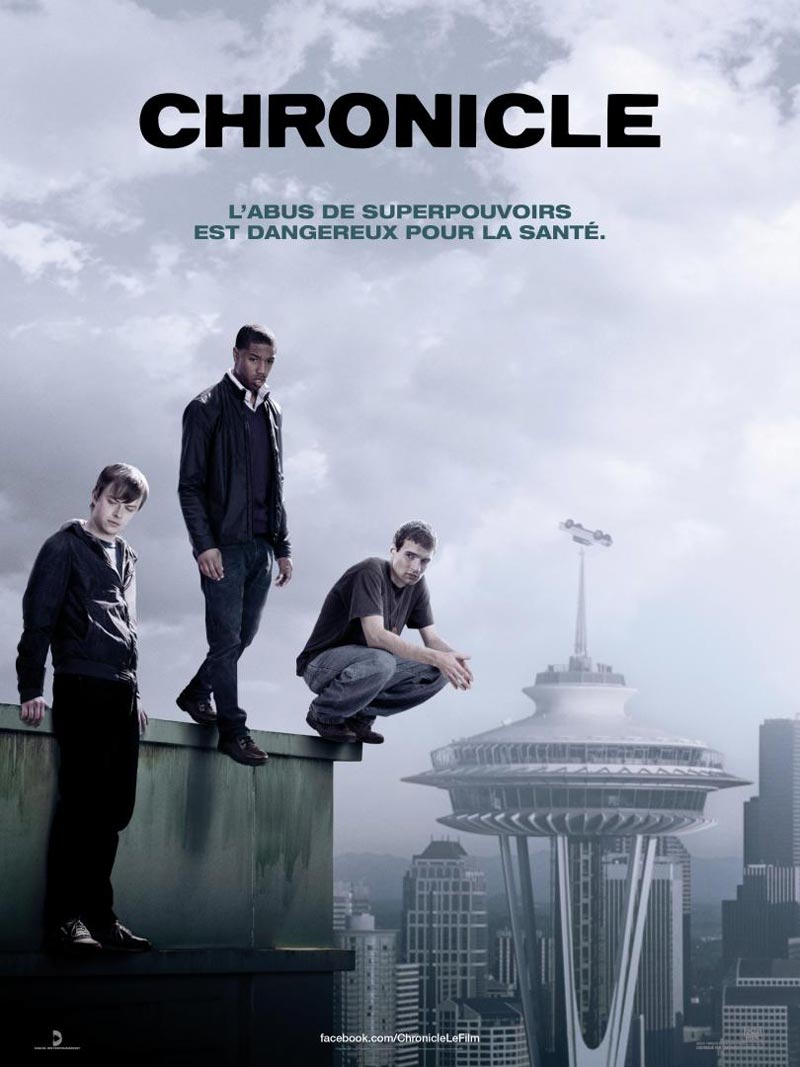
CHRONICLE


The found-footage style seemed to be on the way out after Cloverfield’s shaky camera made people sick and films like Quarantine and Paranormal Activity 3 failed to find the same audiences of their predecessors. However, just when I thought it was gone, Chronicle arrives. This film combines the found-footage trend with the “real” superhero trend, and the result is a pleasingly original film.

Andrew (played by In Treatment actor Dane DeHaan) is a young Dicaprio look-a-like who is bullied at school and abused at home by his alcoholic father. To distance himself from his unhappy life, Andrew starts filming everything. At a party Andrew’s cousin Matt (Alex Russell) and the most popular kid in school (The Wire actor Michael B. Jordan) show Andrew to a strange tunnel in the forrest. Deep underground the three boys discover something unknown. Cut to a few weeks later and the boys have developed telekinetic powers.

It is an odd comparison, but Chronicle is successful for many of the same reasons as the animated penguin film Surf’s Up. Both take what could have been a basic variation of stories that have already been told and used the documentary film style to bring a new perspective. Parts of this film, mostly scenes involving Matt’s love interest Casey, are included via her camera. Those scenes twist the narrative to fit the filming style instead of the other way around, and the result is inelegant. But any moments of contrivance are overshadowed by the film’s brutally effective climax.

Spoilers have no place in a review, so it is enough to say that the escalation suggested by the film’s tagline (“Boys Will Be Boys”) is very present. Give teenagers telekinetic powers and a lot will happen. The filmmakers cover up their dependence on stock high school characters, such as the bullies and jocks, with a steady flow of clever moments and effective emotional beats. Overall, the original parts of this film outweigh the unoriginal, and the last half-hour is very original.

Rather than using the found-footage format just to have cheap cinematography, the filmmakers have crafted a story that is emotionally engaged by the presence of the camera. The character’s relationships to each other and to the camera are the unique result of Chronicle’s format, which makes this more than a retread of Push or Carrie; Chronicle is a satisfying, modern, thriller.


Sunday, January 1, 2012

SHERLOCK: Series 2


Another series of the BBC’s Sherlock has concluded. This brings the grand total of all the episodes to six. For those of you who have not yet watched this brilliant show it is the modern retelling of Sir Arthur Conan Doyle’s famous detective stories. Martin Freeman (coming soon as Bilbo in The Hobbit) plays Dr. John Watson, a former army doctor, and Benedict Cumberbatch plays the immortal Sherlock Holmes. Robert Downey Jr’s performance in his two films is a terrific and entertaining Holmes, but it is Cumberbatch who best-walks the thin line between genius and smart-ass.

Episodes one and three were, as in season one, the best. Episode one is possibly the best episode of the whole series. A Scandal In Belgravia introduces a new take on Irene Adler. Played by Rachel McAdams in the feature films, Irene is played in the series by Lara Pulver who takes the role to new levels. Irene is a femme fatale in the best ways, and without her presence the rest of the season just cannot compete.

Episode two this time around is a variation on “The Hound of the Baskervilles”. It is a reasonably good mystery, but like its season one counterpart (The Blind Banker) it is heavy on plot and light on the Watson/Holmes dynamic that makes this series so brilliant.

Episode three is the terrific finale The Reichenbach Fall, which fans of Doyle will notice was based on a very important story in Holmes’ history. It gives lots of screen time to the wonderfully insane Jim Moriarty, Holmes is put into plenty of difficult situations, brilliant dialogue is said, mysteries are solved, and once again it leaves me wishing that the BBC made longer seasons.

The Holmes and Watson dynamic has been done so many times (IMDb lists 255 going back to 1900) that you would think it would be worn out. But Mark Gatiss and Steven Moffat have created a true original with Benedict Cumberbatch (best name ever)  and Martin Freeman as the best Sherlock Holmes and Dr. Watson we are likely to see for a long time.

If you have not seen this series I cannot recommend it enough.


Wednesday, December 21, 2011

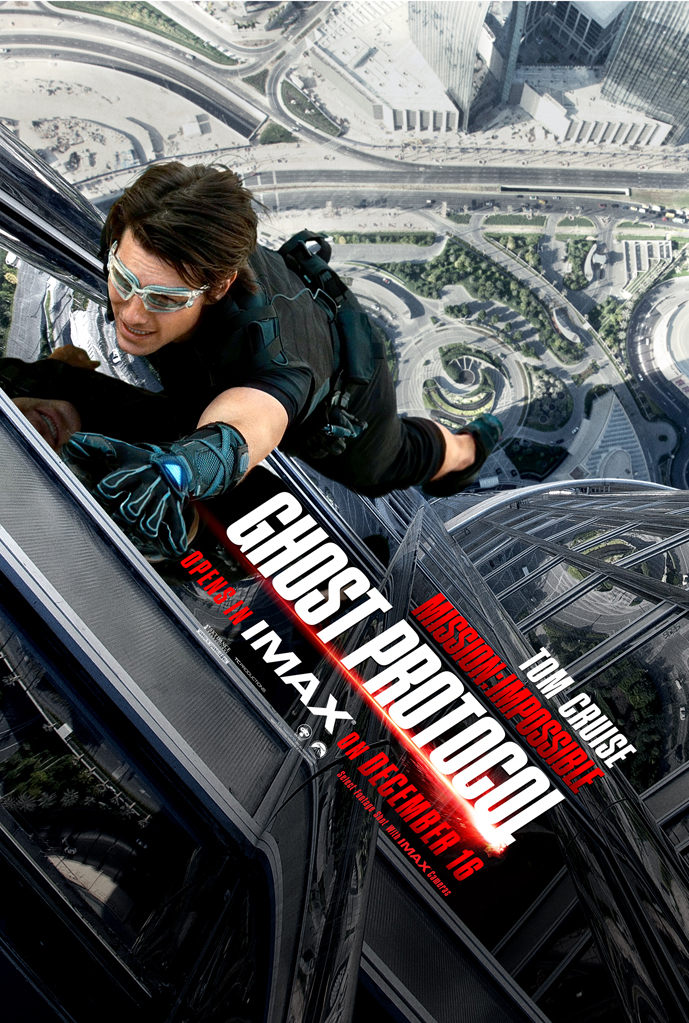
MISSION IMPOSSIBLE: GHOST PROTOCOL


The fourth film in a series is usually the one that signals a series as over-extended (Scary Movie 4, Jaws: The Revenge, Pirates of the Caribbean: On Stranger Tides, Alien: Resurrection, Shrek Forever After, Superman IV: The Quest For Peace), and even when the films are reasonably good they are always outside the “core trilogy” that the original fans will protect forever (Indiana Jones and the Kingdom of the Crystal Skull, Live Free or Die Hard, Terminator Salvation, and the Star Wars prequels).

The Mission: Impossible series is now an exception to the rule. M:I 3 is still the best in the series, but the newest entry has come very close to its quality. Director Brad Bird (The Incredibles) had never made a live-action film before, but the deft balance of SFX and cinematography in Ghost Protocol proves he is a top-of-the-line director. With producers Tom Cruise and J.J. Abrams the film is clearly a part of the same series, but the way Bird allows comedy and suspense to bounce off each other is a major boost to an action series that could have been trounced by Sherlock Holmes.

Tom Cruise is still at center stage, which might count against the film depending on your personal views, but more than previous films in the series Ghost Protocol feels like an ensemble. Simon Pegg gets many of the best moments, but Jeremy Renner and Paula Patton both hold their own with more character development than supporting action parts usually get. And Michael Nyqvist (from the original Girl With The Dragon Tattoo) is an effective but under-used villain who only gets to show off in the last half hour of the film.

The actual plot is as large as one of the more ridiculous Bond films, but the speed and constant movement distracts from making logical criticisms. Essentially, like the most ridiculous Bond films, if the audience is having fun it doesn’t matter if it makes any sense. Fun is what this movie has in spades, and even though the film drags in the final scene, Ghost Protocol is one of the best big-action popcorn flicks since Star Trek.