Friday, March 25, 2016

Batman v Superman: Dawn of Justice

This essay review is about the frustratingly-titled Batman v Superman: Dawn of Justice. It reaches for higher concepts than most foreign dramas despite being “just a comic book movie,” it does things to my favourite comic book hero that made me angry, it held me in suspense for two years before disappointing me in two hours, but it still managed to do things that made me give it three stars. It was many things; suspenseful, scary, bombastic, and original, but it forgot that none of those things matter if it fails to be entertaining.

The philosophy of Batman or Superman, the philosophy of any fictional world or character, is fun to think about, write about, and debate among like-minded geeks. But that writing, where we analyze the reasons Batman doesn’t kill and the impacts that a real Superman would have on the real world, should not be adapted into a summer blockbuster. At best they could make good documentaries.

Summer blockbusters - particularly this decade’s comic book blockbuster - are built out of a need for entertainment. There is huge range in the genre because of this. If entertainment is the bare minimum requirement for a blockbuster then there are no real limits. That is why we can have the conspiracy thriller Captain America: The Winter Soldier next to the quirky adventure Guardians of the Galaxy. And outside the comic book world we get the giddy nostalgia of Star Wars: The Force Awakens, the oh-so-serious literary epic The Lord of the Rings, and everything else successful under the summer sun going back to Jaws.

If Batman v Superman has one failing (and it doesn’t, it has many), it’s that for most of its two-and-a-half hour run-time it fails to be entertaining. It’s challenging, it’s suspenseful, it’s stressful, it’s action-packed, it’s ambitious, it’s even clever, but it is never simply entertaining. I was interested in the journeys these characters went on, and in the references to the comics and films that have come before. It kept my attention for many reasons. But it did not let me be simply entertained.

It did this in many ways, which is why it warrants such a long review.

The music was, from the very beginning, operating at the level of a climax. Gothic choirs like something out of a Lord of the Rings battle were ringing out over every fight or wide angle. The only shift or elevation I noticed in the soundtrack to amplify the content of the screen instead of over-rule it was at the big reveal of Wonder Woman. She received a unique tune that did aide the visual storytelling. Everyone else got the musical equivalent of a stress dream: unrelenting and inescapably “epic”.

The span of the story means that no scene could be wasted on character moments; everything had to drive the plot forward, which suffocates the performances under exposition. Only Alfred escapes sometimes, but he does so in the quickly worn-out pattern of saying something philosophical and then following it with a snide comment under his breath that is still clearly directed at Bruce Wayne. At least Michael Caine’s snide comments were after Wayne left the room, and were directed more at us, the audience, to get a laugh. Here, the laughs are scattered and short-lived.

As a comic book film, there is no escaping it’s roots and the fans that come with it. Tim Burton got away with altering Batman’s origins in 1989. He even sort of got away with having Batman murder a guy in 1992. I think it was because his films had the clear mark of a non-comic book fan who thought the arguments that comic book readers get into about the picky details to be stupid. But Zack Snyder and his team are not snidely looking down their noses at comic book fans, daring them to argue that this thing they love is anything more than entertainment for children; they are fans. They do diligent research and it shows. There is a reference in this film to The Mask of the Phantasm, a great animated Batman film from 1993. The background of the Bat-cave is littered with references, and ever since they announced this film by quoting Frank Miller’s The Dark Knight Returns they have made it clear that the fans come first in the imaginary audience they made this film for.

So one day they will have to explain why Batman kills people. There were a few close calls that I thought about and said, no, they survived, some of the camera angles didn’t make it clear, but surely they didn’t just show him kill a guy, and that other scene was a dream sequence so that doesn’t count. But eventually they run over every possible explanation I had to offer and showed Batman blowing up a truck with two guys in it, and crushing one car of bad guys with another car of bad guys. There’s no getting out of that one.

For now, Ben Affleck is still set to do a solo Batman film, which rumour has it will be a prequel for his Batman. And this I am still looking forward to. Despite this film’s flaws, Ben Affleck is not one of them. He is a solid Bruce Wayne and a promising Batman, and a good director. If he can tell me what happened to Robin (whose suit is seen defaced in the Bat-cave), and explain what happened to change Batman’s moral code, I will throw him my full support. Bring on Suicide Squad and more from The Man Who Wasn't Daredevil.

Same goes for Wonder Woman. Nothing much about her small part in this film raises red flags for Patty Jenkins’ production. Wonder Woman is the character that comes out of this gladiator match with the cleanest hands.

(Another note for the comic book fans: the brief appearances of Flash, Aquaman, and Cyborg give me, in order: a good feeling, cautious skepticism, and a shrug of disinterest. But those are essentially my feelings about the original comic characters, so nothing much has changed.)

And poor Superman can’t catch a break. He gets his big comeback film in Man of Steel and then the moody guy from Gotham steals his spotlight (and top billing). The weight of Batman on this film pulls it too far to his side for the blue boy scout to remain the main character. Since Ben Affleck’s Batman has not been seen before it ends up feeling more like Superman is cameoing in Batman’s origin film, and not starring in his own sequel.

In the end I find myself latching on to a sad idea. Buried in this film, slotted between a dream sequence and a training montage, is a cameo that gives me a different kind of hope. There is, it seems to me, a small possibility that in a future film this entire experience will be rewritten, Days of Future Past-style, and this frustrating film will be pushed out of canon like X-Men 3 and Wolverine. Some time-travel could do some good, and that is the real tragedy of this whole thing. All this work and build-up and the best hope I have for this film is that it will be written off as a discarded timeline in some future Justice League story. That is a sad place for a film to end up.

I said I had complex feelings about this film, and I don’t think this essay review scratches the surface, but the short answer I would have given the customers at the movie rental counter is this: it’s worth seeing if you’re a fan, the same way the Star Wars prequels are worth seeing, but if you want to be entertained by a serious, non-Marvel, superhero film, rent Batman Begins.


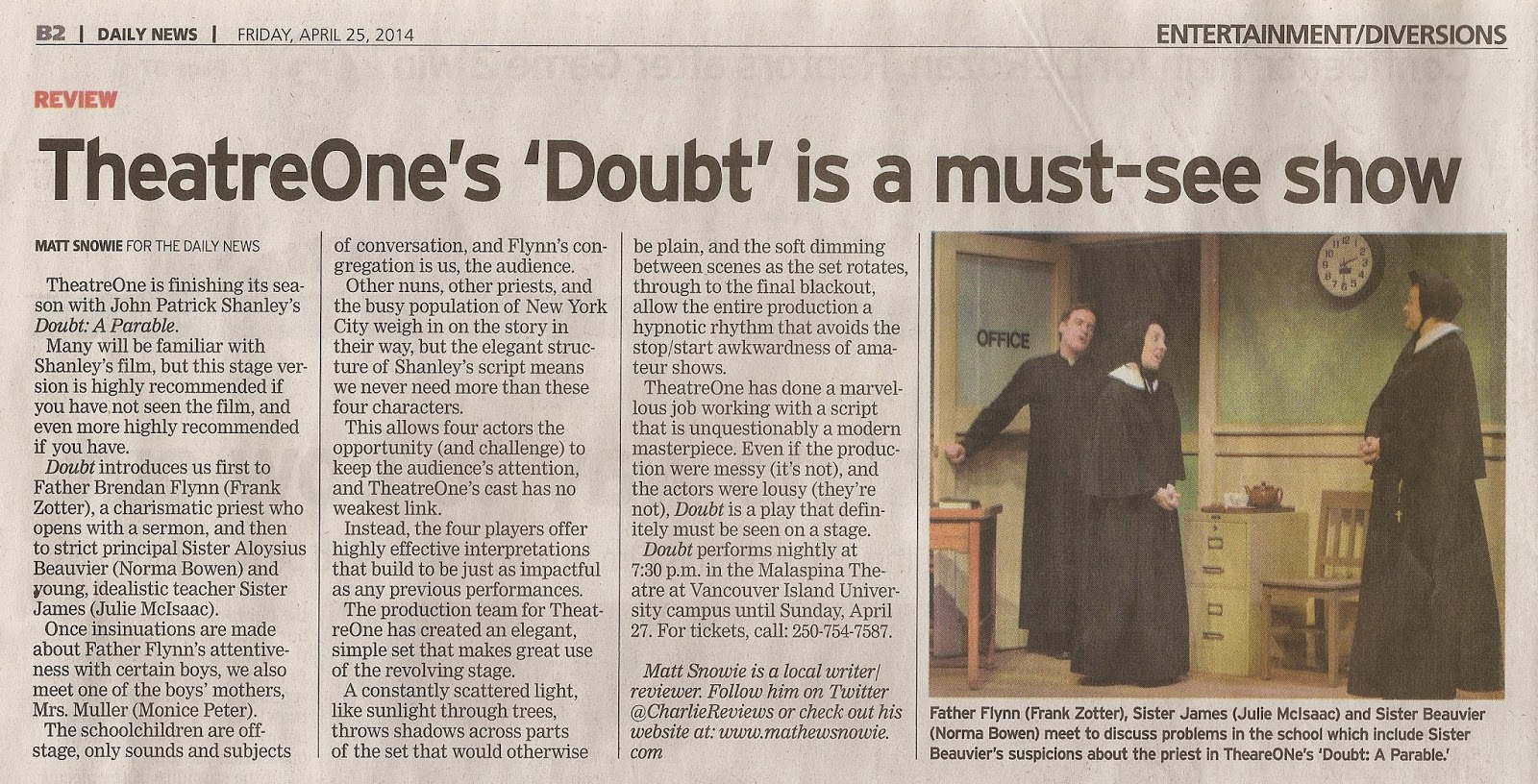
Friday, April 25, 2014

TheatreOne's Doubt: A Parable


TheatreOne is finishing its season with John Patrick Shanley’s Doubt: A Parable.

Many will be familiar with Shanley’s film, but this stage version is highly recommended if you have not seen the film, and even more highly recommended if you have.

Doubt introduces us first to Father Flynn (frank Zotter), a charismatic priest who opens with a sermon, and then to strict principal Sister Beauvier (Norma Bowen) and young, idealistic teacher Sister James (Julie McIsaac).

Once insinuations are made about Father Flynn’s attentiveness with certain boys, we also meet one of the boys’ mothers, Mrs. Muller (Monice Peter).

The schoolchildren are off-stage, only sounds and subjects of conversation, and Flynn’s congregation is us, the audience.

Other nuns, other priests, and the busy population of New York City weigh in on the story, but the elegant structure of Shanley’s script means we never need more than these four characters.
This allows four actors the opportunity (and challenge) to keep the audience’s attention, and TheatreOne’s cast has no weakest link.

Instead, the four players offer very effective interpretations that build to be just as impactful as any previous performances.

The production team for TheatreOne has created an elegant, simple set that makes great use of the revolving stage.

A constantly scattered light, like sunlight through trees, throws shadows across parts of the set that would otherwise be plain, and the soft dimming between scenes as the set rotates, through to the final blackout, allow the entire production a hypnotic rhythm that avoids the stop/start awkwardness of amateur shows.

TheatreOne has done a marvellous job working with a script that is unquestionably a modern masterpiece. Even if the production were messy (it’s not), and the actors were lousy (they’re not), Doubt is a play that must be seen on a stage.


Doubt performs nightly at 7:30 in the Malaspina Theatre at VIU until Sunday, April 27. For tickets, call: 250-754-7587.


Originally published in the Nanaimo Daily News and Harbour City Star

Tuesday, February 18, 2014

What if James Bond was American?

Inspired by BuzzFeed's clever What If "Doctor Who" Was American? column, I decided to consider that other 50-year-strong British franchise.

1. Paul Newman


The one and only original Bond, James Bond. Winning the part over Fleming-favorite Robert Redford, Newman made the role iconic and cemented his career as a leading man for decades to come. The elements that make the Bond films what they are were all established during Newman's tenure including the classic Ford Torino GT and Ernest Borgnine as Q.

2. Warren Beatty


Although he only played Bond in one film, Beatty managed to prove that the franchise didn't have to end with Newman's retirement. And with the tragic death of Tracy Bond (Faye Dunaway), 1969's On the People's Secret Service remains one of the series' most emotional films.

3. James Garner


Originally expected to take over after Newman, James Garner signed up for another season of Maverick and was unable to take the role until 1973's Live and Let Die. Garner's lighter persona proved popular, and he became the longest-running Bond with 7 films between 1973 and 1985.

4. Michael Keaton


Michael Keaton was a return to the darker, more violent Bond films of the Newman era, bringing back the physicality that had been lost with Garner's increasing age. After 1989's Licence to Kill, Keaton decided not to return.

5. Kevin Costner


In a post-Cold War world, Kevin Costner became known as the best Bond since Newman. He saw Bond into the modern era of computers and terrorism in 4 films between 1995 and 2002. Costner's Bond was under the command of the first female M (Meryl Streep), and he was the last Bond to work with Ernest Borgnine's Q before he retired in The World is Not Enough and replaced by Bill Murray.

6. Johnny Depp


For the 21st Bond film it was decided the franchise would reboot with a young Bond at the start of his career in Casino Royale. Skyfall, Depp's third film as Bond, saw a new Q (Joseph Gordon-Levitt), a new M (Bryan Cranston), and new Miss Moneypenny (Zoe Saldana) usher in a return to the classics.

Saturday, February 8, 2014

THE COOK, THE THIEF, HIS WIFE & HER LOVER

Dinner. Sex. Murder. Dessert. Stabbing. Abuse. Singing. Rape. Cannibalism. Cooking. This is the world of Peter Greenaway’s graphic, rhythmic and haunting film starring Helen Mirren and Michael Gambon.

Albert Spica (future Dumbledore Michael Gambon) returns each night to the same restaurant with his unflappable wife, Georgina (Helen Mirren), and his gang of thugs. He boisterously announces every thought in his head, punctuated by profanity and verbal abuse of everyone around him. Meanwhile, his wife begins an affair with the bookish Michael sitting at a nearby table.

The cook, French chef Richard Borst, is the arbiter of Georgina and Michael’s affair, hiding them in pantries and meat lockers to protect them from her gangster husband. He and his eclectic staff of cooks, dishwashers and servers suffer the brunt of Albert’s verbal abuse, but soon witness the escalating violence that this so-called marriage has brought down on them.

It’s difficult to say which is more unearthly or evocative: the set design or Michael Nyman’s orchestral score. The restaurant, kitchen and loading dock are where 90% of the film takes place, and the vaulted ceilings, broad corridors and colourful lights are like sets out of “Blade Runner” or “Brazil”. At the same time, the music is as epic and overbearing for a climactic fight as it is for the serving of desert.

Extreme elements, from the words and actions of the villain to the alienating score and sweeping movement of the camera, boil over and drown the audience in ways that few films dare to do. The emotional impact of this film could be compared to “Requiem for a Dream” or “A Clockwork Orange”. Extreme adult content in a powerful narrative can leave the right audience stunned and fascinated.


It is likely the film’s X rating that kept it from gaining wider acclaim in the way that Stanley Kubrick’s film have (and this is a very Kubrickian film), and the same can be written for Michael Gambon’s character. Albert Spica may have missed out on the AFI’s Top Villains list, but when he makes appearances on similar lists, he’s at the top.


As published on Examiner.com 

Thursday, January 9, 2014

Killing the Point

If there is a purpose to film, a single reason to continue making them, then that has to be their ability to reflect life as we wish to see it. Making a film reflect reality is actually more difficult, as any documentarian will tell you, but the reflection of life as we would like to see it is - in my opinion - far more important. Films can provide dreams to those who would otherwise wollow in pain and poverty, and they can illustrate goals for where we want to go as a society, where the next technological break should come, or just what part of the world we would like to explore if we get the chance to go on vacation. Therefore, I it as a dangerous and horrible pattern how many short films dealing with youth and LGBT issues end in suicide.

There isn't much value in listing all the offenders, but they are not hard to find. In this argument I will look at the prototypical story points of a gay coming-of-age drama:
1. Straight-minded character has a moment of same sex attraction
2. Breaking away from core, "straight" friends the character acts on the attraction
3. No matter what reaction is, it results in the character being "outed" to one or all other characters
4. Distraught and bullied, character is faced with immediate choice
5. Character choses death

First of all, no one North of 2 on the Kinsey scale is completely unaware of same sex attraction until their mid teens. There is a case to be made that films on this subject are rarely able to get younger actors to participate because of child pornography issues, and the age of sexual awakening is usually increased in films as a result. But the dependence on "love at first sight" is an overused trope in this case on par with its overuse in Hollywood romantic comedies.

The next issue with this outline is point 3. The first, secretive sexual act, the kiss in the doorway or under the bleachers or under the freeway overpass, is established as an event that the character does not want anyone to know about. Teens are particularly focused on keeping things secret, from their parents or friends or school authorities, so for this first kiss to immediately result in getting caught is a drastic oversimplification of the lives of teens.

Next, point 4, is the climactic choice. Despite other situations that can preceed it, the choice is usually the same by the end of the film: live or die. This is not an unreasonable choice to wish upon a character at the end of a film since if the final choice was between which colour shirt to wear the next day it would have less immediate urgency for the audience. But the fact that this choice usually comes within hours of the character being outed only shows that the writer believes teens have absolutely no impulse control.

Now, I do remember being a teen and having poor impulse control, but when it comes to a choice of life or death, I know it takes longer than an hour to decide.

But the film ends with the character stepping off a roof, bleeding out behind a locked bathroom door, or any other horrible scenario that is supposed to show the characters who bullied, who disowned, who lashed out that their actions were wrong and they have lead to this. It also shows the audience that life is not worth fighting for, and if you find yourself being ostracized by your family and peers there is nothing you can do so you might as well kill yourself.

This is why I dislike Romeo and Juliet. If Romeo had not been such a drama queen and just waited, thought things through, then Juliet would have woken up and the aweful plan would have actually worked. But it seems, to the mind of the angsty modern dramatist, that Romeo's quick purchase of poison was made rationally, and we get to witness the endless repeatitions.

Ironically, the gay-inversion of Romeo and Juliet, Private Romeo (4 stars), replaces "death" with "expelled from military school". The film actually blends the modern story with an English class reading the play, but the implication is that the real love story does occur and it is just being presented to us with higher language on top. So instead of killing himself over his dead love, Private Romeo "commits suicide" by getting caught with his lover, and they are, we assume, expelled and live happily ever after. To my mind this is the only form of suicide acceptable at the end of a gay teen film.

If the suicide occurs earlier to a supporting character then the film is a legitimate exploration of the effects of suicide, but if it is tagged on as the character's last choice it is a bullshit cop out that disrespects the characters and only manages to affect the questioning teen who finds it on YouTube and becomes just a little bit more discouraged with life. Unacceptable.


Sunday, August 25, 2013

THE WORLD'S END

Few cult classics of the last decade managed to be as popular as Shaun of the Dead, and I'd say no zombie film has been as entertaining. When Hot Fuzz came along from the same crazy team it managed to upend the action cop genre just as well as Shaun had upended zombie horror. Both films walk a very thin line between satirizing the genre and being a part of it, and both succeed brilliantly. Now comes sci-fi/alien/apocalypse comedy The World's End.

The film’s aliens are actually robots that have replaced most of the town in a mix of Invasion of the Body Snatchers and The Stepford Wives. Party guy Gary (Simon Pegg) convinces his four high school friends (Nick Frost, Martin Freeman, Eddie Marsan, and Paddy Considine) to go back to their home town to finish the twelve-pub crawl that they never completed 23 years before. Soon the robot alien secret is revealed, and the guys have to fight for their lives and try to save the world.

Unlike most recent comedies, The World's End manages to include real character development, conflict, and drama without sacrificing laughs. Anyone who has had a few close drinking buddies in their life, and perhaps have gone too far some nights, will relate to these five old friends. They have their ups and downs, and still carry some old scars, but they are there for each other when the blue alien robot blood hits the fan.

Revered Polish director Krzysztof KieÅ›lowski made the famous "Three Colours Trilogy" with Blue, White, and Red. Film geeks Simon Pegg and Edgar Wright have now completed their "Three Flavours Cornetto Trilogy”. Strawberry red was in the gory rom-zom-com Shaun of the Dead, original blue is in the police-centered Hot Fuzz, and alien mint green is in The World's End. Along with a recurring set of actors and a few recurring jokes, the trilogy is mostly held together by Pegg and Wright's quintessentially British humour and Wright’s love of fast editing, which is on full display in The World's End.

I hesitate to mention, but if I had one complaint with the film it would be, ironically, the end. Although the story wrapped up and climaxed in a wonderfully entertaining way, the last few minutes saw a sudden tone shift that I felt halted the momentum. In a way it was the perfect way to end the film, and it marked a clear difference from the other two Cornetto films, but it still didn't feel right.

Despite the minor issues I had with the ending, or with the somewhat underused appearance of Pierce Brosnan (with Timothy Dalton in Hot Fuzz, I’m sad that Connery or Moore weren’t in Shaun of the Dead for a James Bond hat trick), The World’s End was a wonderfully entertaining film.

Apparently Cornetto is releasing new flavours in the UK, so if the stars align and find themselves with some free time, perhaps the trilogy will expand. For now you can expect to see Simon Pegg expanding into drama with Hector and the Search for Happiness as well as more Star Trek, Nick Frost will be acting without Pegg for the first time in salsa dancing comedy Cuban Fury, and director Edgar Wright is finally working on Ant-Man for Marvel’s Phase Two films leading to The Avengers 2.


Friday, August 2, 2013

The New Pixar Theory

I hadn't planned on writing this as a post because it seemed like the sort of strange thought experiment better left in my own head. But then Jon Negroni's Pixar Theory exploded over the internet. It kept popping up everywhere, and by the time the mainstream news sites had grabbed it the theory was being moulded in response to the thousands who read it in order to iron out all the plot holes. It was a lot of fun seeing that there are other people who think like me out there because the fact is that I've been thinking Pixar's films belong in the same universe for a while.


But since I never wrote it down, Jon Negroni got there first. Also, since I saw Toy Story when I was 6, there is a good chance that he thought of it first. I'm not writing this to lay claim to his success. But I am writing this in response to his theory because I think it is a very clever, very convoluted theory.

My Pixar theory is much closer to the Unified Tarantino Theory, which suggests that all of Tarantino's films are connected. Unlike Pixar, Tarantino has confirmed parts of this theory, which posits that all of the films are in the same violence and pop-culture-obsessed universe except for Kill Bill, which is a movie within that universe. That is what Negroni's theory is missing.

Let's start with Toy Story, as Pixar did. The Toy Story trilogy can be the baseline. They are essentially set in the real world, but the real world seen from the magical side that is hidden to the rest of us. I find it is successful in the same way as Harry Potter because of this "it could be real" factor that makes it easier to believe in the unbelievable.

Most of the films can be related directly to this "real" world. There is nothing that suggests A Bug's Life is set anywhere but reality, and could be contemporaneous with Toy Story's modern North America. The same can be said of Finding Nemo (only it happens in the south Pacific), Ratatouille (in Paris), Up (possibly very close to Toy Story), and Pixar's upcoming films Inside Out (which is partially set inside the head of a child), and Finding Dory.

Still set in the "real" world established by Toy Story are WALL-E (just set in the distant future), and Brave (set in the medieval past).

WALL-E's BnL corporate logo seen in Toy Story 3
Monsters, Inc. and Monsters University were a problem for Negroni's theory because it required a full cycle of evolution on Earth to establish a new world of Monsters who travel back in time via closet doors to collect screams of children in the present. But the movie establishes the connection from the very beginning, which is that the monster world is just that: another world.

Randall ended up near to the events of A Bug's Life,
and at the home of the terrible driver of the Pizza Planet truck
The Incredibles was a major style shift for Pixar. It presented a retro future, and a whole world and alternate history touched by the existence of superheroes. But, in Finding Nemo, the little boy in the waiting room is reading an Incredibles comic book. With Warner Brothers announcing a Batman/Superman film, and Marvel planning two pictures a year til the end of time, this is hardly the time to be surprised by the existence of a film adaptation of a comic book.


And this leads to the final connection, the one that made Negroni twist his theory into knots to explain, which is the presence of Cars. Partially because they are more for kids than any other Pixar films, Cars and Cars 2 are generally not counted amongst people's favorites. It might sound like a copout, but I would argue that the feature-length toy advertisements that are Cars and Cars 2 might just be feature-length toy advertisements in the Pixar world as well. If The Incredibles is a film, why not Cars?

There is also an interesting pattern in the logo designs. The Incredibles and both Cars films are the only Pixar features (so far) that have red backgrounds in their theatrical releases. All of the "real world" films have blue, green, brown, or black. It will be interesting to see what happens when we learn more about The Good Dinosaur.

The one thing that will poke a hole in my theory is the blooper reel from Cars. If it is a movie within the universe of the other movies, how is Mac watching Cars versions of Toy Story, A Bug's Life, and Monsters, Inc.? The only excuse I have for this is to say, "Don't count the bloopers." Toy Story had bloopers, which would suggest that they are just real characters in a movie that has been secretly made in our world. Same with all the early films and their blooper reels. But if this collapses my theory, it collapses any unification theory, and then we're just film geeks talking about meaningless easter eggs. And what's the fun in that?


Thursday, June 27, 2013

Could a new type of movie theatre survive?

There is a fairly well known story about Alfred Hitchcock and the release of Psycho. With little studio support and his personal finances at stake, Hitchcock made a spectacle of the release by ordering theatre owners to close the doors when the film started and not allow late arrivals admittance. All for the buzz created around the film's shocking ending. People had, up until that point, been used to walking into films half way through. The film and the new structure was embraced and theatres have never looked back.

When cinema's dominance for people's attention was threatened by television in the 50s, the industry responded by pushing for widescreen technicolor cinemascope extravaganzas. It was an attempt to woo audiences back with the one major asset that television couldn't offer: big screens. Also colour, but television had that within a decade. The current trend of 3D has been seen as a similar move. Better television options with HBO and Netflix, bigger televisions, surround sound systems, and blu-ray interactive features have pushed the industry to go bigger and broader to keep the box office running.


I've read several articles in the last few months predicting the end of the current age of Hollywood. Some are predicting the collapse of the Superhero bubble while others predict the implosion of the entire system, or at least a chaotic paradigm shift. It would be foolish to say that the status quo will remain, but I'm not as confident in my predictions of the future as Spielberg and Lucas are, so I've been refraining from too much prognosticating.

Something that I would like to see is a new theatrical experience. Industry giants like Spielberg and Lucas predict the movie theatre will go the way of the classical theatre; higher ticket costs for a more elite form of entertainment. No longer for the masses, the movie theatre will be a blockbuster evening out on special occasions. That, to me, would be tragic.

But I have an idea. And I have hope for that idea. Currently the Cineplex theatres are offering semi-regular screenings of classic films. For two nights they play Some Like It Hot, The Shining, Lawrence of Arabia, or Alien on a big screen for $6. I've gone a few times now and there are never more than ten people in the audience, but the films have all been surprisingly improved by the theatrical experience. I jumped when Jack slammed his axe into the bathroom door. I cringed when John Hurt's chest burst open. And I recoiled from the screen when Norma Desmond reached out to me at the end of Sunset Boulevard.

What if a theatre were designed to operate like in the days before Psycho? It would have a lounge/cafe atmosphere in the lobby, quiet doors hidden around the corner so people in the theatre aren't disturbed by late arrivals, and an all-day stream of films, cartoons, news headlines, shorts, and even television series on a big screen. And the whole schedule would be available through an app on your phone, which could even remind you when something interesting is coming up.

You could pay a single admission, something comparable to a cheap ticket to any movie today, but you could stay in the theatre as long as you'd like. Come and go as you please. And if the experience was agreeable, perhaps you'd like to buy a one-month pass for $20? A full year for $60? Depending on the economics of licensing old films and operating a cafe, the subscriber prices could end up being a cheaper option than most cable packages.

Several revival theatres exist in NYC. But these places still operate on the one-ticket-one-movie format. I'd like to see a theatre that takes advantage of the new go-to entertainment option of binge-watching seasons of Mad Men or Breaking Bad. Give film students a place to have their shorts seen by real audiences on the big screen. Make a theatre that is free of the car commercials, cell phone commercials, and commercial blockbusters that have desecrated the sublime experience of sitting in a darkened theatre with strangers to watch a silver screen.


This is unlikely to happen, of course. It is the sort of thing that would only come about because of an eccentric millionaire deciding to take a risk. And it would only survive in a metropolitan location with lots of independent hipster-like film buffs to support it. But it doesn't seem unreasonable to consider alternative, retro businesses being able to survive in the modern world. As soon as CDs supplanted tapes and records, a new niche market of "purists" who prefer LPs popped up. As long as popular culture goes one way there will be stubborn people going the other. Should I one day find myself as an eccentric millionaire, I hope to join those stubborn people in my theatre.

Friday, June 21, 2013

WORLD WAR Z

Max Brooks' book "World War Z" is a masterwork thriller. It drips information about the zombie apocalypse to the reader through short stories, so that as you read the survivors' accounts you piece together a much bigger story. It would make a brilliant anthology series on HBO. They could hand chapters off to individual filmmakers to adapt into hour-long episodes.

But that is not what happened. Rumour is that there was an earlier script that would have made this film 3+ hours and hewn much closer to the book's structure. The rumour also says that it would have been the first Oscar-worthy zombie film.

But that is not what happened. Instead, the filmmakers behind World War Z, including producer Brad Pitt, have looked at the macro-political story that Max Brooks wrote and wrote a Hollywood hero into it. Brad Pitt plays Gerry Lane, a former UN agent who is drafted to find a cure. Forced away from his family to globe-trot the apocalypse, he deals with a variety of situations borrowed equally from zombie films and apocalypse disaster movies.

Plenty of fans of the novel will be disappointed by this. But the fact that the movie follows a new character while (roughly) following the bigger story of the book means that the characters of the novel are out there. They are facing their own apocalypses. They just didn't cross paths with Brad Pitt. Sequels or (hopefully) an HBO series could give them their time on screen, but for now we have this film starring Brad Pitt.

As far as films starring Brad Pitt go, this one is quite good. It didn't try to be funny, which most zombie films do, and the resulting tone was closer to Contagion than Dawn of the Dead. Brad Pitt is a solid leading man as usual. Mireille Enos (The Killing) is his wife, and in her short time on screen she manages to be a competent survivor.

Something that often sinks apocalypse films is a transparently manipulative character. The screaming blond in Jaws 2 should have been the first one eaten, but she stubbornly survives to annoy the audience to the end. Fred Astaire's part in The Towering Inferno was specifically designed to break your heart. 2012 was hemorrhaging selfish and annoying characters to hate. These cheap emotional manipulations reveal bad scripts more often than bad actors, so it was nice to see World War Z did not burden its good cast with cheap tricks.

Perhaps we will see a WWZ adaptation some day, but for now there is a solid zombie thriller starring Brad Pitt that happens to use the same title.


Wednesday, June 19, 2013

MAN OF STEEL

The undeniably great Christopher Reeve ushered in the first generation of superhero blockbusters with 1979's Superman: The Movie. That generation brought us the Tim Burton Batman and little else of any success. The second generation kicked off with Bryan Singer's X-Men and Sam Raimi's Spider-Man. With the reboot of The Amazing Spiderman, the re-invention of the epic blockbuster in The Avengers, the critical and commercial success of The Dark Knight trilogy, and a new team in X-Men: First Class, we have entered a third generation of superhero films.

Man of Steel is Superman's return to relevance, and his first truly great screen appearance since 1979.

An extended look at a much more realistic Krypton opens Man of Steel, and successfully sets the tone in a much darker way. Despite being Zack Snyder's film, the impact of Christopher Nolan is felt throughout; and although this sacrifices some of the light charm that Reeve's films were known for, it is a firm statement of independence that works in the film's favor.

Unlike previous incarnations, the backstory of Krypton is key to the entire film, and true motivation is developed for Superman's Kryptonian parents and the film's big bad, General Zod (Michael Shannon). Slight alterations to the technology, physics, and explanations of Superman's Kryptonian DNA are brilliant manipulations of the classic story that bring it up to date for a modern superhero blockbuster. Batman Begins started the reset where audiences would not accept a superhero without logic and reason. Man of Steel's creative team, including David S. Goyer and Christopher Nolan, have brought the same respect for the character that rebuilt Batman so effectively.

Henry Cavill, the man who was almost cast as Aragorn then Batman and then James Bond, has finally found his blockbuster franchise. He fits the suit that few mere mortals are physically qualified for, and he manages to pull off the reluctant hero without appearing mopey or frigid. A downside to the origin story that this film tells is that we don't get much of his human alter ego. Part of what made Christopher Reeve's Superman so likeable was his bumbling Clark Kent, but we'll have to wait until the next film to see if Cavill's awkward journalist is as good as his bulletproof hero.

Even though the film revolves around Krypton's destruction, Clark Kent's childhood development in Kansas, and General Zod's escape from the phantom zone for revenge, Man of Steel carves a very original path from the first two Christopher Reeve films. By the credits it has established a new Superman in the same way that JJ Abrams established a new Star Trek. All the characters and elements are present, but they have not been dropped in front of us for no reason. By the end of the film we believe in them, and we see the connections that make them cohesive.

If rumours are true and Man of Steel is the first step towards a larger DC Universe, then it is my hope that the end of the sequel to Man of Steel will tease a new Batman. Then, in The Dark Knight Rises of this franchise, a dual Superman/Batman story can be told. If Warner Brothers is intent to copy Marvel's success, they would be smart to not front-load their franchise. There will be time to introduce Wonder Woman, The Flash, Green Lantern (again), and even Aquaman, but the world they have built here is delicate. Realism and logic were put front and center in The Dark Knight trilogy, and now the same has been done for Superman, which many people (including me) did not expect. Hopefully good writing and forward thinking will win out over immediate greed.


Thursday, June 13, 2013

Hollywood Meltdown?

Predicting the future is like sex; everyone wants to do it, lots of people think they are good at it, but nothing is certain until you can examine it in the past at which point it turns out Nostradamus was weak in the sack. I may have stretched that simile too far, but my point is that predicting the future is a tricky business. It always helps to be well-researched and in a position of expertise talking about what you are predicting.

That is why the recent E3 Q&A with Steven Spielberg and George Lucas was a bit concerning. Here are some of the highlights:

Spielberg: "The big danger is that there's eventually going to be a big meltdown where three or four, maybe even a half a dozen of these mega-budgeted movies are going to go crashing into the ground. That's going to change the paradigm again."

The "again" that Spielberg mentions is likely the late-80s blockbuster crash where films like Waterworld and Michael Camino's Heaven's Gate (which is returning to theatres curiously enough) sent some of the big production houses into bankruptcy and sent Hollywood scrambling for the next new thing. This resulted in careers for people like Quentin Tarantino, Christopher Nolan, and John Lasseter, and made the 90s an art house response to the 80s blockbuster mania.

Spielberg: "You're at the point right now where a studio would rather invest $250 million in one film for a real shot at the brass ring than make a whole bunch of really interesting, deeply personal projects that may get lost in the shuffle."

Sad but true, the budgets of some of the upcoming films are staggeringly huge. $180 million for Pacific Rim or $225 for Man of Steel. Compare that to the $8 million it cost to make Pulp Fiction or even $63 million for SFX-heavy film The Matrix. And Life of Pi was proof that if you are willing to screw over the SFX artists who make the movie so good, you can cut costs even more, but that is a rant for a different article.

The point Spielberg and Lucas are trying to make is that the bubble will soon burst, just like it did before, but they also cite VOD streaming services like Netflix and specialty programming channels like HBO as being a new factor in the paradigm shift.

When the blockbuster bubble broke in the 80s there were small film studios, emerging artists, and opening foreign markets to build the Hollywood system back up. They were starting to see the beginning of digital filmmaking, but the technology to replace celluloid wouldn't arrive until the next decade. This meant that for film-like entertainment the public still had only one option. This is no longer the case with thousands of specialty channels, multiple streaming services, and endemic piracy. If Hollywood were to stop operating tomorrow there would still be the last season of Breaking Bad, the next HBO biopic movie, and whatever Netflix decides to release next as exclusive content. I'd also point out there are films made in countries all around the world, but getting North American audiences to watch something with subtitles is something only Quentin Tarantino can manage.

These giants of Hollywood, the men who literally invented the summer blockbuster, are predicting doom for the industry where movie theatres will be reduced to expensive special occasions and the dominant cinema screen will be the TV in your living room. It's a sad thought, but they seem to be underestimating the next generation of artists and rebels. A common problem for men their age.

The reason Spielberg and Lucas got to be the titans of industry they are today is because they were both extremely motivated and inventive artists. Spielberg overcame the adversity of shooting with a robotic shark on the ocean to make the first real summer blockbuster. And Lucas overcame decades of stigma towards science fiction to make a Best Picture-nominated classic. There are still people like them around. Young artists who have a vision and stick to it are able to overcome miraculous odds. And as long as some of them still love the 2-hour, 3-act Hollywood-style film, they will continue to make them.

Lucas: "The Lincolns are going to be on television."

What Lucas is referring to are the "passion projects" like Spielberg's Lincoln or his own Red Tails. These are the films that don't necessarily fit the pattern of A-list actors, big effects, and happy endings. Personally, I think they are underestimating what could qualify as a passion project, but both films were mired by distribution difficulties. Lincoln was nearly an HBO miniseries, but Spielberg, the man behind Band of Brothers, shouldn't be so negative about what a miniseries can be. I would argue that Band of Brothers qualifies as one of the greatest WWII movies ever made. It just happens to be 10 hours long. But that doesn't reduce the artistic value and storytelling power; it only redirects it.


Anyone who is a fan of Game of Thrones, Breaking Bad, or The Wire will understand that being on a smaller screen does not reduce the potential impact. It changes it, of course. A powerful theatrical experience like The Lord of the Rings is not the same as a powerful television experience like The Wire. But there are markets for both, and people like me who will seek out equal amounts.

As long as people have technology to distract them from going outside (and I pray we always do), there will be a market for narrative content. The access routes will change; for every movie theatre that closes there are new channels, new streaming services, and new video hosts like Vimeo. The content will change too. New forms like the webisode emerge and write new rules for length and cinematography and editing, but old forms will continue to be reworked by the artists who love them. Michel Hazanavicius' silent cinema tribute, The Artist may have been seen by very few people, but it is proof that no artform dies as long as someone still cares about it.

Saturday, May 18, 2013

STAR TREK INTO DARKNESS

This is the long-awaited sequel to a blockbuster science fiction franchise that has seen highs and lows over the past few decades. It is probably the best indicator of what JJ Abrams will bring to a Star Wars sequel, and I'd say things are looking very good.

After a thrilling James Bond-like opening mission, Kirk and the Enterprise return to Earth. In London, rogue agent John Harrison (Benedict Cumberbatch) has bombed a Starfleet archive, and Kirk gets permission from Admiral Marcus (Peter Weller) to hunt him down.

From the opening scenario involving primitive aliens, cliff diving, and exploding volcanoes, the film keeps a pace going that would give the original series whiplash. William Shatner's crew may have had time for philosophy and contemplation, but with Chris Pine on the bridge the philosophy must be discussed between phaser blasts. Action fans can rejoice at this. Sometimes the speed and clutter of the frame was overwhelming, but JJ has proved to be a more than capable action director with a clear hold on his audience.

A superficial improvement in the sequel is the reduction of lens flares. It doesn't bother me, but many people complain that the first film includes too many. Happy for you then that JJ is such a nice guy because he has bowed to the people's will and given you what you asked for. Giving the audience what they want, however, is exactly what causes trouble in the film. Not a lot of trouble, but enough to make this sequel not quite as good as its predecessor.

Where the first film had a streamlined plot that spiraled around it's time-travel premise, Into Darkness has an element of chaos that is both good and bad. As the plot unfolds and the villain surprises Kirk, the chaos plays to the danger and suspense that comes with such an unpredictable opponent. But in gaining mystery and suspense the film sacrifices tidy storytelling, which shuffles emotional scenes and action scenes in jarring ways. As far as criticisms go that one is pretty weak, but it's the best description I can give for the slight disappointment I felt.

The writers have picked up the alternate-timeline characters where they were left and have followed them forward with the understanding that even on a new timeline, they could encounter elements of the original series. At times, references to the original series get in the way of good storytelling. This is a problem that only Trek fans will have to deal with, however, since the film as science fiction, as action, as adventure, and as a fun ensemble is solid. Even if references to the original do get in the way, they are such good elements that it would have been a shame to lose them just because Spock Prime (Leonard Nimoy) messed up the timeline.

When sequels like The Dark Knight come along they are met with astonishment because good sequels have been so difficult and rare. Before Nolan returned to Gotham there was only The Godfather Part 2 and The Empire Strikes Back to cited as undeniably great successors. Though I won't place Into Darkness in their league, it is still a fantastic sequel. With JJ doing Star Wars it is unlikely we will see another Star Trek for 3-4 years unless a new director is found, but when the next film comes it will have a lot to live up to in both of its predecessors.