Showing posts with label Article. Show all posts

Friday, April 25, 2014

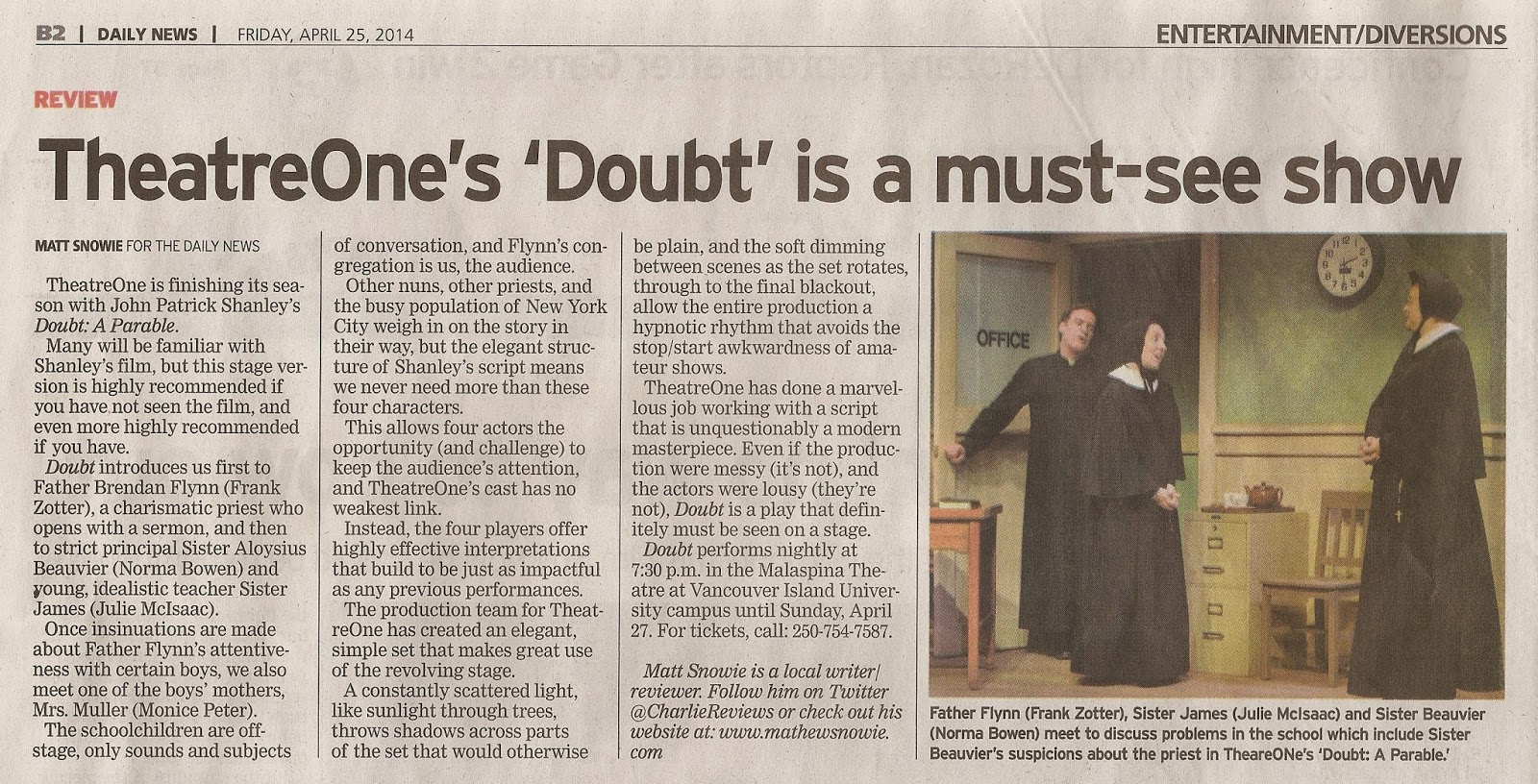
TheatreOne's Doubt: A Parable


TheatreOne is finishing its season with John Patrick Shanley’s Doubt: A Parable.

Many will be familiar with Shanley’s film, but this stage version is highly recommended if you have not seen the film, and even more highly recommended if you have.

Doubt introduces us first to Father Flynn (frank Zotter), a charismatic priest who opens with a sermon, and then to strict principal Sister Beauvier (Norma Bowen) and young, idealistic teacher Sister James (Julie McIsaac).

Once insinuations are made about Father Flynn’s attentiveness with certain boys, we also meet one of the boys’ mothers, Mrs. Muller (Monice Peter).

The schoolchildren are off-stage, only sounds and subjects of conversation, and Flynn’s congregation is us, the audience.

Other nuns, other priests, and the busy population of New York City weigh in on the story, but the elegant structure of Shanley’s script means we never need more than these four characters.
This allows four actors the opportunity (and challenge) to keep the audience’s attention, and TheatreOne’s cast has no weakest link.

Instead, the four players offer very effective interpretations that build to be just as impactful as any previous performances.

The production team for TheatreOne has created an elegant, simple set that makes great use of the revolving stage.

A constantly scattered light, like sunlight through trees, throws shadows across parts of the set that would otherwise be plain, and the soft dimming between scenes as the set rotates, through to the final blackout, allow the entire production a hypnotic rhythm that avoids the stop/start awkwardness of amateur shows.

TheatreOne has done a marvellous job working with a script that is unquestionably a modern masterpiece. Even if the production were messy (it’s not), and the actors were lousy (they’re not), Doubt is a play that must be seen on a stage.


Doubt performs nightly at 7:30 in the Malaspina Theatre at VIU until Sunday, April 27. For tickets, call: 250-754-7587.


Originally published in the Nanaimo Daily News and Harbour City Star

Thursday, January 9, 2014

Killing the Point

If there is a purpose to film, a single reason to continue making them, then that has to be their ability to reflect life as we wish to see it. Making a film reflect reality is actually more difficult, as any documentarian will tell you, but the reflection of life as we would like to see it is - in my opinion - far more important. Films can provide dreams to those who would otherwise wollow in pain and poverty, and they can illustrate goals for where we want to go as a society, where the next technological break should come, or just what part of the world we would like to explore if we get the chance to go on vacation. Therefore, I it as a dangerous and horrible pattern how many short films dealing with youth and LGBT issues end in suicide.

There isn't much value in listing all the offenders, but they are not hard to find. In this argument I will look at the prototypical story points of a gay coming-of-age drama:
1. Straight-minded character has a moment of same sex attraction
2. Breaking away from core, "straight" friends the character acts on the attraction
3. No matter what reaction is, it results in the character being "outed" to one or all other characters
4. Distraught and bullied, character is faced with immediate choice
5. Character choses death

First of all, no one North of 2 on the Kinsey scale is completely unaware of same sex attraction until their mid teens. There is a case to be made that films on this subject are rarely able to get younger actors to participate because of child pornography issues, and the age of sexual awakening is usually increased in films as a result. But the dependence on "love at first sight" is an overused trope in this case on par with its overuse in Hollywood romantic comedies.

The next issue with this outline is point 3. The first, secretive sexual act, the kiss in the doorway or under the bleachers or under the freeway overpass, is established as an event that the character does not want anyone to know about. Teens are particularly focused on keeping things secret, from their parents or friends or school authorities, so for this first kiss to immediately result in getting caught is a drastic oversimplification of the lives of teens.

Next, point 4, is the climactic choice. Despite other situations that can preceed it, the choice is usually the same by the end of the film: live or die. This is not an unreasonable choice to wish upon a character at the end of a film since if the final choice was between which colour shirt to wear the next day it would have less immediate urgency for the audience. But the fact that this choice usually comes within hours of the character being outed only shows that the writer believes teens have absolutely no impulse control.

Now, I do remember being a teen and having poor impulse control, but when it comes to a choice of life or death, I know it takes longer than an hour to decide.

But the film ends with the character stepping off a roof, bleeding out behind a locked bathroom door, or any other horrible scenario that is supposed to show the characters who bullied, who disowned, who lashed out that their actions were wrong and they have lead to this. It also shows the audience that life is not worth fighting for, and if you find yourself being ostracized by your family and peers there is nothing you can do so you might as well kill yourself.

This is why I dislike Romeo and Juliet. If Romeo had not been such a drama queen and just waited, thought things through, then Juliet would have woken up and the aweful plan would have actually worked. But it seems, to the mind of the angsty modern dramatist, that Romeo's quick purchase of poison was made rationally, and we get to witness the endless repeatitions.

Ironically, the gay-inversion of Romeo and Juliet, Private Romeo (4 stars), replaces "death" with "expelled from military school". The film actually blends the modern story with an English class reading the play, but the implication is that the real love story does occur and it is just being presented to us with higher language on top. So instead of killing himself over his dead love, Private Romeo "commits suicide" by getting caught with his lover, and they are, we assume, expelled and live happily ever after. To my mind this is the only form of suicide acceptable at the end of a gay teen film.

If the suicide occurs earlier to a supporting character then the film is a legitimate exploration of the effects of suicide, but if it is tagged on as the character's last choice it is a bullshit cop out that disrespects the characters and only manages to affect the questioning teen who finds it on YouTube and becomes just a little bit more discouraged with life. Unacceptable.


Friday, August 2, 2013

The New Pixar Theory

I hadn't planned on writing this as a post because it seemed like the sort of strange thought experiment better left in my own head. But then Jon Negroni's Pixar Theory exploded over the internet. It kept popping up everywhere, and by the time the mainstream news sites had grabbed it the theory was being moulded in response to the thousands who read it in order to iron out all the plot holes. It was a lot of fun seeing that there are other people who think like me out there because the fact is that I've been thinking Pixar's films belong in the same universe for a while.


But since I never wrote it down, Jon Negroni got there first. Also, since I saw Toy Story when I was 6, there is a good chance that he thought of it first. I'm not writing this to lay claim to his success. But I am writing this in response to his theory because I think it is a very clever, very convoluted theory.

My Pixar theory is much closer to the Unified Tarantino Theory, which suggests that all of Tarantino's films are connected. Unlike Pixar, Tarantino has confirmed parts of this theory, which posits that all of the films are in the same violence and pop-culture-obsessed universe except for Kill Bill, which is a movie within that universe. That is what Negroni's theory is missing.

Let's start with Toy Story, as Pixar did. The Toy Story trilogy can be the baseline. They are essentially set in the real world, but the real world seen from the magical side that is hidden to the rest of us. I find it is successful in the same way as Harry Potter because of this "it could be real" factor that makes it easier to believe in the unbelievable.

Most of the films can be related directly to this "real" world. There is nothing that suggests A Bug's Life is set anywhere but reality, and could be contemporaneous with Toy Story's modern North America. The same can be said of Finding Nemo (only it happens in the south Pacific), Ratatouille (in Paris), Up (possibly very close to Toy Story), and Pixar's upcoming films Inside Out (which is partially set inside the head of a child), and Finding Dory.

Still set in the "real" world established by Toy Story are WALL-E (just set in the distant future), and Brave (set in the medieval past).

WALL-E's BnL corporate logo seen in Toy Story 3
Monsters, Inc. and Monsters University were a problem for Negroni's theory because it required a full cycle of evolution on Earth to establish a new world of Monsters who travel back in time via closet doors to collect screams of children in the present. But the movie establishes the connection from the very beginning, which is that the monster world is just that: another world.

Randall ended up near to the events of A Bug's Life,
and at the home of the terrible driver of the Pizza Planet truck
The Incredibles was a major style shift for Pixar. It presented a retro future, and a whole world and alternate history touched by the existence of superheroes. But, in Finding Nemo, the little boy in the waiting room is reading an Incredibles comic book. With Warner Brothers announcing a Batman/Superman film, and Marvel planning two pictures a year til the end of time, this is hardly the time to be surprised by the existence of a film adaptation of a comic book.


And this leads to the final connection, the one that made Negroni twist his theory into knots to explain, which is the presence of Cars. Partially because they are more for kids than any other Pixar films, Cars and Cars 2 are generally not counted amongst people's favorites. It might sound like a copout, but I would argue that the feature-length toy advertisements that are Cars and Cars 2 might just be feature-length toy advertisements in the Pixar world as well. If The Incredibles is a film, why not Cars?

There is also an interesting pattern in the logo designs. The Incredibles and both Cars films are the only Pixar features (so far) that have red backgrounds in their theatrical releases. All of the "real world" films have blue, green, brown, or black. It will be interesting to see what happens when we learn more about The Good Dinosaur.

The one thing that will poke a hole in my theory is the blooper reel from Cars. If it is a movie within the universe of the other movies, how is Mac watching Cars versions of Toy Story, A Bug's Life, and Monsters, Inc.? The only excuse I have for this is to say, "Don't count the bloopers." Toy Story had bloopers, which would suggest that they are just real characters in a movie that has been secretly made in our world. Same with all the early films and their blooper reels. But if this collapses my theory, it collapses any unification theory, and then we're just film geeks talking about meaningless easter eggs. And what's the fun in that?


Thursday, June 27, 2013

Could a new type of movie theatre survive?

There is a fairly well known story about Alfred Hitchcock and the release of Psycho. With little studio support and his personal finances at stake, Hitchcock made a spectacle of the release by ordering theatre owners to close the doors when the film started and not allow late arrivals admittance. All for the buzz created around the film's shocking ending. People had, up until that point, been used to walking into films half way through. The film and the new structure was embraced and theatres have never looked back.

When cinema's dominance for people's attention was threatened by television in the 50s, the industry responded by pushing for widescreen technicolor cinemascope extravaganzas. It was an attempt to woo audiences back with the one major asset that television couldn't offer: big screens. Also colour, but television had that within a decade. The current trend of 3D has been seen as a similar move. Better television options with HBO and Netflix, bigger televisions, surround sound systems, and blu-ray interactive features have pushed the industry to go bigger and broader to keep the box office running.


I've read several articles in the last few months predicting the end of the current age of Hollywood. Some are predicting the collapse of the Superhero bubble while others predict the implosion of the entire system, or at least a chaotic paradigm shift. It would be foolish to say that the status quo will remain, but I'm not as confident in my predictions of the future as Spielberg and Lucas are, so I've been refraining from too much prognosticating.

Something that I would like to see is a new theatrical experience. Industry giants like Spielberg and Lucas predict the movie theatre will go the way of the classical theatre; higher ticket costs for a more elite form of entertainment. No longer for the masses, the movie theatre will be a blockbuster evening out on special occasions. That, to me, would be tragic.

But I have an idea. And I have hope for that idea. Currently the Cineplex theatres are offering semi-regular screenings of classic films. For two nights they play Some Like It Hot, The Shining, Lawrence of Arabia, or Alien on a big screen for $6. I've gone a few times now and there are never more than ten people in the audience, but the films have all been surprisingly improved by the theatrical experience. I jumped when Jack slammed his axe into the bathroom door. I cringed when John Hurt's chest burst open. And I recoiled from the screen when Norma Desmond reached out to me at the end of Sunset Boulevard.

What if a theatre were designed to operate like in the days before Psycho? It would have a lounge/cafe atmosphere in the lobby, quiet doors hidden around the corner so people in the theatre aren't disturbed by late arrivals, and an all-day stream of films, cartoons, news headlines, shorts, and even television series on a big screen. And the whole schedule would be available through an app on your phone, which could even remind you when something interesting is coming up.

You could pay a single admission, something comparable to a cheap ticket to any movie today, but you could stay in the theatre as long as you'd like. Come and go as you please. And if the experience was agreeable, perhaps you'd like to buy a one-month pass for $20? A full year for $60? Depending on the economics of licensing old films and operating a cafe, the subscriber prices could end up being a cheaper option than most cable packages.

Several revival theatres exist in NYC. But these places still operate on the one-ticket-one-movie format. I'd like to see a theatre that takes advantage of the new go-to entertainment option of binge-watching seasons of Mad Men or Breaking Bad. Give film students a place to have their shorts seen by real audiences on the big screen. Make a theatre that is free of the car commercials, cell phone commercials, and commercial blockbusters that have desecrated the sublime experience of sitting in a darkened theatre with strangers to watch a silver screen.


This is unlikely to happen, of course. It is the sort of thing that would only come about because of an eccentric millionaire deciding to take a risk. And it would only survive in a metropolitan location with lots of independent hipster-like film buffs to support it. But it doesn't seem unreasonable to consider alternative, retro businesses being able to survive in the modern world. As soon as CDs supplanted tapes and records, a new niche market of "purists" who prefer LPs popped up. As long as popular culture goes one way there will be stubborn people going the other. Should I one day find myself as an eccentric millionaire, I hope to join those stubborn people in my theatre.

Thursday, June 13, 2013

Hollywood Meltdown?

Predicting the future is like sex; everyone wants to do it, lots of people think they are good at it, but nothing is certain until you can examine it in the past at which point it turns out Nostradamus was weak in the sack. I may have stretched that simile too far, but my point is that predicting the future is a tricky business. It always helps to be well-researched and in a position of expertise talking about what you are predicting.

That is why the recent E3 Q&A with Steven Spielberg and George Lucas was a bit concerning. Here are some of the highlights:

Spielberg: "The big danger is that there's eventually going to be a big meltdown where three or four, maybe even a half a dozen of these mega-budgeted movies are going to go crashing into the ground. That's going to change the paradigm again."

The "again" that Spielberg mentions is likely the late-80s blockbuster crash where films like Waterworld and Michael Camino's Heaven's Gate (which is returning to theatres curiously enough) sent some of the big production houses into bankruptcy and sent Hollywood scrambling for the next new thing. This resulted in careers for people like Quentin Tarantino, Christopher Nolan, and John Lasseter, and made the 90s an art house response to the 80s blockbuster mania.

Spielberg: "You're at the point right now where a studio would rather invest $250 million in one film for a real shot at the brass ring than make a whole bunch of really interesting, deeply personal projects that may get lost in the shuffle."

Sad but true, the budgets of some of the upcoming films are staggeringly huge. $180 million for Pacific Rim or $225 for Man of Steel. Compare that to the $8 million it cost to make Pulp Fiction or even $63 million for SFX-heavy film The Matrix. And Life of Pi was proof that if you are willing to screw over the SFX artists who make the movie so good, you can cut costs even more, but that is a rant for a different article.

The point Spielberg and Lucas are trying to make is that the bubble will soon burst, just like it did before, but they also cite VOD streaming services like Netflix and specialty programming channels like HBO as being a new factor in the paradigm shift.

When the blockbuster bubble broke in the 80s there were small film studios, emerging artists, and opening foreign markets to build the Hollywood system back up. They were starting to see the beginning of digital filmmaking, but the technology to replace celluloid wouldn't arrive until the next decade. This meant that for film-like entertainment the public still had only one option. This is no longer the case with thousands of specialty channels, multiple streaming services, and endemic piracy. If Hollywood were to stop operating tomorrow there would still be the last season of Breaking Bad, the next HBO biopic movie, and whatever Netflix decides to release next as exclusive content. I'd also point out there are films made in countries all around the world, but getting North American audiences to watch something with subtitles is something only Quentin Tarantino can manage.

These giants of Hollywood, the men who literally invented the summer blockbuster, are predicting doom for the industry where movie theatres will be reduced to expensive special occasions and the dominant cinema screen will be the TV in your living room. It's a sad thought, but they seem to be underestimating the next generation of artists and rebels. A common problem for men their age.

The reason Spielberg and Lucas got to be the titans of industry they are today is because they were both extremely motivated and inventive artists. Spielberg overcame the adversity of shooting with a robotic shark on the ocean to make the first real summer blockbuster. And Lucas overcame decades of stigma towards science fiction to make a Best Picture-nominated classic. There are still people like them around. Young artists who have a vision and stick to it are able to overcome miraculous odds. And as long as some of them still love the 2-hour, 3-act Hollywood-style film, they will continue to make them.

Lucas: "The Lincolns are going to be on television."

What Lucas is referring to are the "passion projects" like Spielberg's Lincoln or his own Red Tails. These are the films that don't necessarily fit the pattern of A-list actors, big effects, and happy endings. Personally, I think they are underestimating what could qualify as a passion project, but both films were mired by distribution difficulties. Lincoln was nearly an HBO miniseries, but Spielberg, the man behind Band of Brothers, shouldn't be so negative about what a miniseries can be. I would argue that Band of Brothers qualifies as one of the greatest WWII movies ever made. It just happens to be 10 hours long. But that doesn't reduce the artistic value and storytelling power; it only redirects it.


Anyone who is a fan of Game of Thrones, Breaking Bad, or The Wire will understand that being on a smaller screen does not reduce the potential impact. It changes it, of course. A powerful theatrical experience like The Lord of the Rings is not the same as a powerful television experience like The Wire. But there are markets for both, and people like me who will seek out equal amounts.

As long as people have technology to distract them from going outside (and I pray we always do), there will be a market for narrative content. The access routes will change; for every movie theatre that closes there are new channels, new streaming services, and new video hosts like Vimeo. The content will change too. New forms like the webisode emerge and write new rules for length and cinematography and editing, but old forms will continue to be reworked by the artists who love them. Michel Hazanavicius' silent cinema tribute, The Artist may have been seen by very few people, but it is proof that no artform dies as long as someone still cares about it.

Wednesday, March 6, 2013

Thinking Inside the Box


When film studios introduced the larger Cinemascope screen, artist Jean Cocteau said, “The next time I write a poem I’ll use a big sheet of paper.” Lately it seems filmmakers have forgotten that bigger is not always better, and that Cocteau was being sarcastic.

Clear and concise stories told in a limited space have, it seems, gone out of fashion. At least for the big names. I love the work that Christopher Nolan is doing, but every film he makes is bigger in every way it is possible to be. He uses more characters in more settings, and he even uses IMAX cameras. It is a perfectly acceptable storytelling form (one that Hollywood will continue using as blockbusters become their main income), but it should not be the only one. Storytellers should remember the power of the confined setting.

Die Hard. The Shining. Jaws. These are classic blockbusters, and each one includes drastically confined settings. An office building. A hotel. A three-man boat. To expand beyond these settings would spell doom for the narrative impact. In the Die Hard sequels the filmmakers face diminishing quality as the single building was traded in for an airport, a city, and then a state.

Take for example one of the finest directors in history, Alfred Hitchcock. In Rear Window he confines the main character, a photographer, to a wheel chair and points him out his apartment window. Dial M For Murder also takes place within a single apartment, and so does Rope, which Hitchcock filmed with only 11 shots to create the illusion of a single take. Hitchcock’s masterpiece of confined setting is Lifeboat, which he convinced John Steinbeck to write the story for. After a German U-Boat sinks an Allied ship in WWII, survivors in a lifeboat rescue one of the German crew and must decide his fate. These confined settings build tension and drama in the same way as many stage plays. Hitchcock understood conflict is stronger when characters are unable to avoid it.

Most of my examples have been thrillers, but the power of a confined space to drive people crazy can be funny as well as horrifying. It just depends where the writer takes things. Consider The Odd Couple, Arsenic and Old Lace, Oscar, or Noises Off, which are very funny films based on very funny plays. Film has the same opportunities for comedy as the stage, and sometimes more because of the opportunity to do a second take. Non-play adaptations like The Breakfast Club, The Terminal, Clue, and The Ref use the confined spaces of a school, an airport, a mansion, and a suburban home to take conflict to hilarious new levels.

Filmmakers have not forgotten this entirely, and many young filmmakers (working with limited budgets) have taken advantage of this. Kevin Smith began a very successful career with Clerks, which spends most of its time in and around a convenience store. Duncan Jones made Moon, which focuses almost exclusively on Sam Rockwell and Sam Rockwell in a lunar mining facility. Director Rodrigo Cortés and writer Chris Sparling made an impressive debut when they convinced Ryan Reynolds to spend the 95 minute runtime of Buried inside a coffin.

Buried is an interesting example of how limited space can be taken too far. They should have considered the power of 12 Angry Men, where the limited space builds tension as director Sidney Lumet moves the cameras lower and closer to the characters stuck together in the hot jury room. When the claustrophobia reaches unbearable heights the film hits its climax, and then, in the final shot, the audience is treated to the relief of the wide open streets outside the courthouse. This was where the makers of Buried failed to take advantage of their hard-earned claustrophobia; instead of building to an exhilarating release, they bury the audience along with the main character. Part of the power of a limited space comes from contrasting it with its opposite.

Perhaps the best recent example of limited space is Life of Pi. The film’s most powerful sequences involve the isolation of Pi and Richard Parker in the middle of a mirror-smooth ocean. The contrast of the infinite space with the rigid confines of the boat makes us feel Pi’s isolation, and the tiny set allows for an examination of detail that would be missed in a larger location. We come to know the physical world that Pi is confined to in far more detail than we will ever know Pandora from Avatar, no matter how many sequels James Cameron makes. As a result of our detailed understanding, we are more connected to the characters and their struggle.

In terms of film narratives, bigger is not always better. As long as film is limited to the four corners of the frame, no grand worlds can be shown in full. But, if focus is brought down to the level of small things in small places, it is possible to see something in its entirety, which can have powerful results.

Wednesday, February 20, 2013

The Oscar Challenge


Originally published in The Navigator 20 February 2013

Some people run marathons. Some people write novels. A few people even read all of Finnegans Wake. My point is that everyone has some goal in mind that is both ambitious yet achievable, and this year I set out to finally achieved my goal of seeing all the Best Picture nominees before the Oscar ceremony. I know, it’s formidable.

This ambition formed a few years ago; it seemed very possible once I turned eighteen, but the Academy was not going to make things easy. In 2009, after forgetting The Dark Knight, the category was doubled to ten films. Challenge accepted.

During the fall releases, as studios release their best bets, the term “Oscar bait” gets tossed around. It means the film is serious, possibly distressing, and most likely relates to a specific social issue. I have trouble motivating myself to see these films, and in 2009 the Academy nominated The Blind Side, Precious, and An Education. I have still not seen any of them. This probably damages my film buff reputation, but I’d like to think my time was better spent watching District 9, The Hurt Locker, Inglourious Basterds, and the not-nominated Star Trek (three times).

2009: fail.

I persisted, and when Oscar season returned, I was fully committed. I had a job working for a video store, so I had advance (and free) access to every new release. The list came in and most of the films were already available. I watched Black Swan and swore to never take ballet. I watched The Kids Are All Right and decided more movies should start with Vampire Weekend songs. I watched Winter’s Bone and found something to replace the Fargo wood chipper in my nightmares. Buried under Toy Story 3, Inception, The King’s Speech, and The Social Network, however, was 127 Hours. I had a month to see it, but when the director of 28 Days Later makes a film about a guy who has to cut off his own arm, the squeamish agoraphobe inside of me takes over.

2010: fail.

Third time lucky, right? Only nine films this time. I saw The Artist the day it opened, which exceeded expectations and relight my love of silent films. I saw Hugo, which made me see the potential value in 3D for more than sci-fi spectacle; I saw Midnight in Paris, which reassured me that Woody Allen could still write a film without a narrator intruding every three minutes, but the Academy had fallen into that Oscar bait trap again. Despite it’s good script and a cast highlighted by Viola Davis and Octavia Spencer, The Help was advertised like it was the story of white people ending racism, so I could not bring myself to watch it until months later when it was released on DVD.

2011: fail.

Nine films were announced on January 10 by Emma Stone and this year’s host Seth MacFarlane. I had seen Argo because I like true stories. I had seen Django Unchained because I like Tarantino and don’t like John Ford westerns. I had seen Beasts of the Southern Wild because I like indie films with giant metaphoric pigs. And I had seen Les Miserables because I had a date, and he didn’t want to see Navy SEALs shooting Bin Laden in Zero Dark Thirty.

First seen after the announcement was Lincoln. Steven Spielberg’s look at the last months of the President’s life received twelve nominations, and when I left the theatre I was thinking it deserved to win every one. Then my friends and I went to a late show of Zero Dark Thirty, and I was forced to reexamine my thoughts on torture and murder and James Gandolfini. I also had to rethink my predictions. Suddenly Lincoln didn’t seem like such a clear frontrunner.

Then came Silver Linings Playbook. Mental illness has been a part of my family, although not my immediate family, for as long as I can remember, so the subject matter was both familiar and foreign. The film is a perfect example of good writing supporting good acting supporting good direction. It’s also easily the best film featuring Chris Tucker ever made.

Amour occupied my BC Family Day afternoon, and I am surprised to say that I found it much more fascinating than I had expected. The reviews prepared me for a slow, tragic, depressing film, but even though it was all of those things it managed to draw me in. There are two reasons for this, I think. First is Emmanuelle Riva, now the oldest Oscar nominee, who gives a stunning and exposed performance as Anne, a woman suffering from the effects of a stroke, and the second is the script, particularly two moments where Anne’s husband Georges tells stories from his past. Combined with the film’s simplicity, the script and performances make Amour the inevitable sequel to every great happy-ending romance.

Eight down, and only Life of Pi remained. I’m glad I saved it for last because while all the other nominees are great films, Life of Pi is a great film in a new way. For the first time since Hugo, a director has refrained from using 3D to bring the screen to the audience, and instead allows the audience to fall into the screen. Ang Lee keeps the camera wide and steady, allows shots to linger, and uses classic transitional effects from the era of Citizen Kane to give the audience a chance to absorb the extra dimension. It is the perfect showcase of how technology can push storytelling in powerful new ways, and heading into the final days before the ceremony, my non-existent vote goes to Life of Pi.

2012: win.

I could end by listing my predictions, giving everyone a chance to see how many I get wrong, but there are more than enough predictions out there already (and most of them say Argo). I’d rather point out that every year Hollywood hosts an expensive live TV event, something George C. Scott called a “meat parade,” with the goal of getting me to buy more tickets. By watching, I participate in a cycle of film consumerism that has been going on for 85 years. For this reason, some people turn up their noses, but I love it. This century-old industry is constantly reinventing itself, as these nine unique nominees prove, and after spending millions on films it costs ten dollars for me to enjoy, they are putting on an annual event that includes all my favorite filmmakers, hosted by Seth MacFarlane, with an award presented by the cast of The Avengers. What’s not to like?

Friday, February 1, 2013

The Hollywood Calendar: 2013 Preview

In mid-summer 2012 I was joking about the so-called apocalypse that the Mayan calendar predicted for December, and I said, “It’s okay if the world ends, I’ve already seen The Dark Knight Rises.”
You see, I’d been following the production of Nolan’s film since the premier of The Dark Knight, and I’d been following The Dark Knight production since I saw Batman Begins. It was a cycle of permanent anticipation that influenced me whenever I walked past the Batman section in Curious Comics, or wanted to debate some film trivialities with my friends. It didn’t consume my life, but it meant there was always something to look forward to and think about, no matter what happened to me personally. I imagine this is the sort of comfort that religion holds for spiritual people, which I suppose would make Christopher Nolan my God.

But, now that The Dark Knight Trilogy is completed, is there nothing left to look forward to? Well, Nolan is considering a full-on science fiction film written by his brother Jonathan called Interstellar. Steven Spielberg and Tom Hanks just announced they are working on a third WWII mini-series for HBO called Masters of the Air. Jurassic Park 4 was just announced for 2014. Joss Whedon is currently preparing a post-Avengers TV series called S.H.I.E.L.D., which will include fan-favorite Agent Coulson (Clark Gregg). And for the five of you who haven’t heard, Disney bought Lucasfilm and has Star Wars Episode VII scheduled for 2015. Star Trek director J.J. Abrams has just signed to direct, which will surely re-ignite the “Trek vs. Wars” debate.

My point is that by the time the apocalypse came and went I had new things to look forward to, and there is a very good reason for this. The film industry is a perpetual motion movie machine, and it has fallen into a predictable pattern over the last thirty to forty years with the goal of making film geeks like me give free word-of-mouth promotion. I’m not going to fight it, so let’s see how 2013 fits the pattern:
The year starts in February-March (I’ll explain why later) with a spread of action films (Good Day to Die Hard, Snitch), genre films (Oz the Great and Powerful), and delayed holdovers from 2012 (GI Joe: Retaliation) that have mid-range ad campaigns and mid-range expectations.

May is the start of blockbuster season, which, like the last few years, opens with a Marvel film (Iron Man 3) and takes us to the summer and to the year’s biggest movies (Star Trek Into Darkness, Man of Steel, Monsters University, World War Z, Kick-Ass 2, Pacific Rim, The Wolverine, Elysium).
By September we are into the genre films and new franchises that are not sure things (Riddick, The Tomb, The Mortal Instruments: City of Bones).

October is where everything gets mixed. We have big sequels (Sin City: A Dame to Kill For), Award-seeking genre films (Gravity), remakes (Oldboy, Carrie), and some quirky originals (The World’s End, from the makers of Shaun of the Dead and Hot Fuzz).

November mostly gets crowd-pleasing blockbusters (Thor: The Dark World, The Hunger Games: Catching Fire, Frozen) with a few interesting early Oscar-contenders (Ender’s Game).

December has a final push of blockbusters (The Hobbit: The Desolation of Smaug, Jack Ryan, Anchorman: The Legend Continues), but this is also the time for all the currently unpublicized Oscar-contenders to make their bids.

The end of the year is January, which is where we are for the 2012 movie cycle, and this is where movies go to die. You may have noticed that your options at the theatre are limited, and the best films are the Oscar-contenders held over from December. The box office is the best evidence. Currently the highest-grossing film of the month is the Del Toro-produced horror film Mama. Past winners include Paul Blart: Mall Cop, Big Momma’s House 2, and Spice World. Essentially, January is a good time to catch up on your reading.

My point, if I have one, is this: if you enjoy movies but haven’t seen a good one in a while, don’t despair. The Hollywood calendar will reset after Seth MacFarlane hosts the Oscars on February 24, and this perpetual motion machine will continue to churn out good films, bad films, and ugly January films until a real apocalypse puts a stop to it.

Tuesday, December 25, 2012

THE SHINING and other Christmas Classics

Everyone knows about It's A Wonderful Life, Miracle on 34th Street, and A Christmas Carol. These are the traditional classics of a traditional holiday. Even A Christmas Story has become an oft-repeated favorite, and most families have their annual film choice already made.
But if you're looking to try something new, allow me to suggest that this season you take advantage of some of these less-traditional holiday films:

DIE HARD
Set on christmas eve, this heartwarming story follows John McClane as he comes to LA to visit his wife and prove his devotion to his family, but a grinch-like villain decides to steal the Nakatomi Corporation's Christmas presents. Only John stands in their way in this highly-traditional family film. Rated R.
See Also: Die Hard 2, Kiss Kiss Bang Bang, and Lethal Weapon

THE REF
Kevin Spacey and Judy Davis are an unhappily married couple, and Dennis Leary is the poor fugitive thief that has taken them hostage. The bickering banter is on full force in this comedy, which successfully displays holiday morals like love and understanding while having the characters scream insults at each other.
See Also: Christmas Vacation, Trading Places, and Love Actually

BAND OF BROTHERS (Episode #6: Bastogne)
If there is one episode that places this mini-series above other war classics, it's Bastogne. The sixth episode follows Eugene "Doc" Roe during the Battle of the Bulge. Stranded behind Nazi lines, the Allied forces are running low on all ammunition and provisions while fighting in some of the worst conditions seen on the Western Front.
See Also: Joyeux Noel and Stalag 17

BRAZIL
It's George Orwell's Nineteen Eighty-Four, but filtered through one of the comedy geniuses of Monty Python. Terry Gilliam follows a paper-pusher named Sam Lowry who is perfectly happy to remain a cog in the machine until an unusual series of events involving a fly and a typewriter lead him to come face-to-face with the girl of his dreams. What follows is an epic love story of bureaucratic proportions.
See Also: Batman Returns and Rare Exports
SCROOGED
This is the ultimate version of Charles Dickens' immortal classic, A Christmas Carol. The main reasons would be Bill Murray's heartfelt and hilarious performance, and the Ghost of Christmas Present's use of a toaster. Scrooge is now a callous TV executive, and the classic story arc is populated by dozens of oddball cameos including Lee Majors, Robert Mitchum, and Buddy Hackett.
See Also: Ghostbusters II

THE SHINING
What could say more about the holidays than a family spending the entire winter together in a distant hotel where ghosts and evil spirits infect the mind of the father and turn him into an axe-wielding... oh. Right. Well, at least it is still set during December.
See Also: Eyes Wide Shut, Psycho, and Gremlins

Friday, December 14, 2012

THE HOBBIT (at 48 FPS)


This isn't exactly a review of The Hobbit: An Unexpected Journey since fans will go see it no matter what is said, and Peter Jackson has offered up something far more interesting to talk about: High Frame Rate 3D. I plan to go back to see a 2D or regular 3D show so I can watch the movie and not the technology, but, as far as new technology goes, it is worth experiencing.

The new format took almost an hour for my mind to adjust, and until then the picture appeared to be on fast-forward. This was not helped by the film’s clunky prologue, but Martin Freeman soon arrived to save me from Ian Holm and Elijah Woods’ bizarrely bad performances.

The format allows for extremely detailed high-def images and it removes motion blur entirely. This leaves the action on screen looking as close to reality as is possible. This would be spectacular for a filmed stage play, or really for any film that doesn’t include giant wolves, orcs, and goblins. Every time a CG element appeared on screen it stuck out like a red flag. The doubled frame-rate doubled the standards for visual accuracy, and it felt like seeing something made in the early 90s.

The one saving grace of the film’s CG cast was Andy Serkis playing Gollum. This is likely a combination of a great actor and a familiar character. I know what Gollum looks like, so I didn’t feel myself analyzing his character design like I did for the Goblin King. I accepted his reality in the (brilliantly-scripted) scene. And this gave me hope for the new technology.

I think that the HFR Hobbit is a sacrificial lamb, a bit like The Dark Knight was with its use of IMAX. There was no way that Christopher Nolan’s blockbuster was going to fail to sell on Blu-ray, but the screen changes sizes between the different camera types, which is somewhat annoying. It still sold, though, because the technology cannot damage what is a great film. This has resulted in IMAX gaining wider use in Hollywood, which is good because IMAX offers unparalleled image quality. The Hobbit was going to make a lot of money even if it was horrible (it isn’t), so to introduce the HFR on a sure-thing means that the technology will proliferate sooner instead of dying on arrival. And despite how much I disliked it for this film (a lot) I think that the HFR format, just like IMAX, should be used again.
So what purpose does it have? I mentioned before that it would work for a filmed stage play, and I think that is a key scenario. But it can’t be filmed like a movie. Peter Jackson tried to have his cake and eat it too. He used his new technology to heighten the reality of his film, but he also framed his shots and edited his scenes like he did in The Lord of the Rings. All the 3D film directors have been doing the same thing, but the HFR has brought more attention to it.

No matter how innovative or edgy or Quentin Tarantino a director may be, there is a basic form of framing and editing that all films share. Dialogue scenes generally have establishing shots and move closer to the actors through a series of different angles cutting between the speakers. This is the language of film that audiences understand and follow best. When filmmakers start on an extreme close up or on an empty set with people talking off-camera they are playing with that language for a particular effect. This language exists to guide the audience’s thoughts and emotions into believing in a world that exists only as a flat image on the wall.

3D shares elements of 2D film language, but its ability to reach out into the audience or back into the depths of the image has altered what is possible. Fast cutting between close-ups is not as effective in 3D as having a pair of actors on screen, in focus, together. The director cannot point our eye exactly where he wants in the same way when, instead of a photograph, we are looking through a window. 3D’s similarity to reality means we are less willing to hand our eyes over to a director who wants us to focus on something specific, and our mind is slower to re-adjust when a cut takes us from one location to another.

It is understandable, therefore, that many critics writing about the HFR have praised the “Riddles in the Dark” sequence with Bilbo and Gollum. It is the best scene in the film in terms of performance, motion capture technology, script, and story. But it is also the best for 3D because it is an extended scene in a single location that uses long takes and shows most of the character in the frame. It is a stage play. And for this reason it feels more real than anything else in the movie.

Now imagine a feature film that is entirely made of scenes like this. No extravagant special effects to scrutinize and no fast-cutting action scenes. Just quality performances with a smart script, high story stakes, and an immersive HFR 3D picture offering absolutely realistic images. It could be the ultimate combination of film and live theatre.

3D is here to stay. That was clear the moment Avatar passed two billion dollars worldwide. But we are still in the experimental period where new language is being discovered. Like the 1930s adjusting to sound, the time is soon approaching when films like It Happened One Night, All Quiet on the Western Front, and M will show audiences how new technology can be used to tell a story instead of just showing off how new it is.


Wednesday, September 19, 2012

State of the Hollywood Rom-Com

Did you see The Back-Up Plan? How about The Five-Year Engagement? The Bounty Hunter? Anything Katherine Heigl did after Knocked Up? You have? Then let me ask, are you ever going to watch any of them again?

In any film genre I can usually find enough solace in the five-star classics to make up for the two-star clones that follow. This is becoming less and less the case with romantic comedies. Crazy, Stupid, Love. was terrific and surprising, and Friends With Benefits had Aaron Sorkin levels of witty dialogue, but there were a dozen films like The Switch in between.

The reason for this is the same reason that Universal made Battleship and Paramount has hired Michael Bay to do a fourth Transformers film. Hollywood executives are dealing with piracy and the threat of HBO and AMC in the only way they know how. Fewer films are being made each year, and the ones that are greenlit are broad-appeal PG-13 films with major star names attached for max marketability. These can make decent money in the US and then sweep up in the lucrative Asian market. I’m not joking when I say that this is why Dreamworks is planning five more Kung Fu Panda sequels.

The rom-com genre evolved out of the melodramas and slapstick comedies of the 1920s and came into mass popularity with screwball comedies like It Happened One Night. To qualify as rom-com a film needs two people to fall in love and for nothing (like death) to separate them at the end. That’s it. Everything else is up for creative interpretation. So why are there so many lousy boyfriends keeping the girl from the right guy until act three? Why does everybody work in advertising or publishing? Why is the right girl always the quirky one who resembles Zooey Deschanel?

This dilution of artistic integrity is obviously not limited to the romantic comedy genre, and independent producers continue to make critically-praised, good films in all genres, which go on to steal all the major awards from the major studios. But as long as major studios keep their advertising budgets on the level of a small country’s GDP, the general audience who doesn’t attend film festivals will be stuck with the movie that opens in four thousand theaters on Friday and is on Blu-ray three months later.

The good news is that change is coming. Hollywood always bounces back, which is why it has lasted over a century. When television stole their audience in the 50s, filmmakers stole it back with Technicolor and bigger screens. When VHS changed the market in the 70s, producers handed creative power to young directors like George Lucas, Steven Spielberg, and Martin Scorsese. The digital age has done it again, and Hollywood has already started to shift. Like before, they are fighting back with new technology (3D) and new talent. When Marvel hired Joss Whedon he was widely unknown. He had several cancelled TV shows and an eager, but small, fan base. Then he made The Avengers, which has become the third highest-grossing film of all time ($1.5 billion).

If a filmmaker like Joss Whedon, the man behind the no-budget web series Dr. Horrible’s Sing-A-Long Blog, can become the toast of Hollywood then there is plenty to hope for. Christopher Nolan is the clearest example of how a filmmaker who makes good films can gain independence, which gives him the freedom to make even better, bigger films. Directors like Nicholas Winding Refn and Duncan Jones are following in Nolan’s steps and gaining the credentials necessary to gain creative independence.

For those of you who suffered through Killers, Did You Hear About the Morgans?, and The Ugly Truth, I offer you this solution: while Hollywood sorts itself out and finds new talent take a look at the past for your romance needs. Four Weddings and a Funeral (1994), Sleepless in Seattle (1993), Groundhog Day (1993), Annie Hall (1977), The Apartment (1960), The Philadelphia Story (1940), His Girl Friday (1940), It Happened One Night (1934), and City Lights (1931) are called “classic” for very good reasons. Films like Made of Honor do not keep audiences coming back for eighty years.

This argument for rediscovering the classics is not meant to be just a list of recommendations. The fact is that until films like The Proposal stop making $300 million worldwide the studios will not stop making predictable, hit-and-miss, sometimes-funny films that rely on awkward situations and ad-lib from talented actors who deserve better. Stop picking the films that have all the advertising and 55% on Rotten Tomatoes. The internet is there for you. Use it. Let the critics watch bad films for free so that your ticket revenue can go to real filmmakers. Don’t call everything made before 2010 “old”, try watching a foreign film every once in a while, and don’t expect Katherine Heigl to pick a good script.

Sunday, July 22, 2012

Heroes, Trilogies and THE DARK KNIGHT RISES


WARNING: this contains spoilers for the end of all of Christopher Nolan’s films including The Dark Knight Rises. DO NOT READ if you have not seen The Dark Knight Rises. I cannot stress enough how much better it is to experience the film spoiler-free.
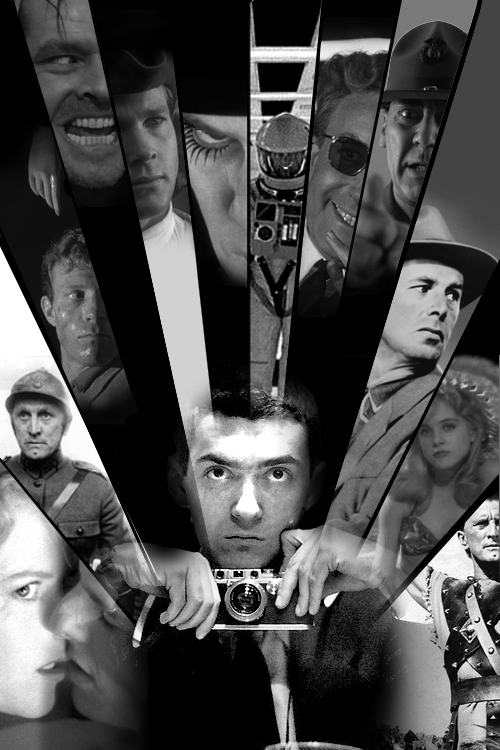

In a film like Stanley Kubrick’s Barry Lyndon the question, “Who is the main character?” is easily answered. He’s the one in the title. Stanley Kubrick used a character name for the title of four of his films. Two of them (Spartacus and Barry Lyndon) are clearly of the main character. Lolita is a slight variation since the main character is clearly Professor Humbert, but the driving force of the film is his focus on the girl, Lolita. The fourth is Dr. Strangelove: Or How I Learned to Stop Worrying and Love the Bomb. Ignoring the satirical subtitle, Dr. Strangelove, is a film about an ensemble of political and military characters facing nuclear armageddon. The title character in this case has no impact on the driving forces of the plot since he neither launches the attack nor makes the final decisions on how to remedy the situation. Dr. Strangelove is as much a concept as he is a character, which for a political satire makes sense; there is very little “character development” in Dr. Strangelove, and many of the parts are characatures or impersonations. Kubrick’s relationship through his films to the idea of a “main character” evolved as much as the subject matter of his films. He focused on a charismatic leading man (A Clockwork Orange), on the inner turmoil of a single person (Eyes Wide Shut), he told the story of an ensemble (Full Metal Jacket), a couple (Killer’s Kiss), and of the entirety of human existence (2001: A Space Odyssey). In the films that do feature an easily recognizable “main character” he is usually the one shown with the most to gain, to lose, to witness, or to grapple with emotionally.

Stanley Kubrick is not alone in this form. Most mainstream filmmakers choose a main character to follow and allow the story to revolve around that person. In cases where a main character is overshadowed it is usually a more talented actor stealing the spotlight, or a case of the writer making a mistake about who the main character is. There are also cases of main characters only appearing for a short time. Anthony Hopkins appears in The Silence of the Lambs for only 16 minutes, but he won an Oscar in the Best Actor in a Leading Role category because he is both integral to the plot and rediculously memorable.

Arguably the best contendor for the title of “this generation’s Stanley Kubrick” is Christopher Nolan. At this stage of his career he has directed 8 feature films, and, like Stanley Kubrick, he has exercised a high level of control over each. Among those 8 films is The Dark Knight, which holds a 94% fresh rating on Rotten Tomatoes and (as of July 21, 2012) is the fourth-highest all time US box office. Nolan has achieved a level of financial success that Kubrick never dreamed of. To be fair he has done it by creating wide-appeal blockbusters instead of the more “adult” films of Kubrick. Even still, the quality of Nolan’s filmmaking has easily placed him on the level of the greatest film directors.

There have been many great sequels, but very few great trilogies. This is because there is a transformation that occurs when the “trilogy” is defined, and often there is a weakest link that harms the other two entries. In the case of The Lord of the Rings, it was defined as a trilogy from the very beginning because of the source novels of J.R.R. Tolkien. The original Star Wars trilogy was defined in the scene of The Empire Strikes Back when Darth Vader tells Luke that he is his father; as the movie concludes it is clearly building to a conclusive third part. Other trilogies are only defined in the aftermath of the third film’s release; Toy Story 3, The Godfather Part III, and Back to the Future Part III were all sequels that ended in a more conclusive way than their predecessors. In cutting off clear sequel options these films defined themselves as being the end to their trilogies.


Newly released is Nolan’s 8th feature, The Dark Knight Rises, which concludes the newly-minted Dark Knight Trilogy. These three films are some of the best-reviewed films of the last decade and can be held up together as one of the greatest trilogies ever created. It is also a unique trilogy because the defining moment occurred outside of the films’ storylines, but after the second film. Christopher Nolan was the one who called The Dark Knight Rises the conclusion to his trilogy, and when he did there began a shift in how the films must be viewed.

Most trilogies, such as the original Star Wars films, are crafted with a clear main character. When George Lucas wrote Star Wars he was working from the Joseph Campbell theory of “The Hero’s Journey”, which has become the dominant storytelling structure in Hollywood. Campbell’s structure favours a single main character and a single villain. There are supporting parts, of course, but the focus of the story is on these two parts: Luke Skywalker and Darth Vader, and the journey that one takes to confront the other.

Despite being the title character in all three films (although I will discuss the third film’s title in more detail), Batman/Bruce Wayne is not, by the end of the trilogy, the only main character. This is the trick that Nolan has pulled off so well in his trilogy's conclusion. Much like how The Empire Strikes Back line, “Luke, I’m your father,” causes the audience to re-evaluate the character motivations in Star Wars, The Dark Knight Rises makes the audience re-evaluate who the main character really is.

Batman Begins is a very character-driven story that follows Bruce Wayne’s journey from child of fortune to Batman. He has important supporting players like Alfred and Lt. Gordon, but the events of the film are portrayed for how they impact Bruce’s journey. In the end, however, he has achieved his status as the Batman we already knew - albiet in a darker, more realistic way.

The Dark Knight is the Batman film that no one could have expected. Christopher Nolan took the character, pitted him against his greatest enemy, and then revealed an element of the character that was entirely new. At the end of the film the Joker has achieved his goal of driving Harvey Dent mad, which will break the spirit of the people of Gotham and undoe all the anti-crime work that Dent, Gordon and Batman had done. To save Gotham, Batman takes the blame for Dent’s crimes and allows himself to become an outcast, a villain, that the city can rally against. This concept of uniting in peace against a common foe is at the center of Watchmen, Alan Moore’s influential comic. To end the cold war the main characters agree to stay quiet about Ozymandias’ guilt and allow the world to believe that their common foe is really to blame. In this way the choice Batman makes at the end of the Dark Knight is similar to the one made by Dr. Manhattan at the end of the film version of Watchmen.

Batman, Bruce Wayne, is still the main character of The Dark Knight, and Comissioner Gordon’s final speech makes clear how he has become the title character. The Dark Knight, however, has more than one main character. James Gordon and Harvey Dent are given equal footing, and both are made to be characters (almost) as important to defeating the villain as Batman. By expanding the role of supporting characters Nolan began down a path that no film series had done before, but which is common storytelling practice in comic books. Batman: Year One is a comic by Frank Miller detailing the first year that Batman and James Gordon are in Gotham City. Although it was a source for Batman Begins, in the comic both men are main characters. Year One, like many comics, allows multiple character to share the spotlight. In larger stories, such as War Games or the stories of the Justice League, comics tell epic narratives with multiple main characters. This form of narrative goes slightly away from the structure established by Joseph Campbell and popularized by George Lucas. Wether intentionally or not, Christopher Nolan hinted at what was coming when he made The Dark Knight, and his statement that The Dark Knight Rises is “the biggest one anyone’s done since the silent era,” is true. (Empire Magazine #277)


The concept of an “epic” makes most people think of the massive sets and budgets of films like The Lord of the Rings, Ben-Hur, or Titanic; the films are longer, the explosions are bigger, and the awards are won in greater numbers. However, the Hollywood epic is more complex than that. Films like Spartacus, Lawrence of Arabia, Gone With The Wind, and 2001: A Space Odyssey are epics, and they hold this title because - beyond their big budgets, sets, and runtimes - they tell the stories of many people. Epics do not tell the story of a single Joseph Campbell hero, they tell the story of multiple Campbell heroes. The Dark Knight Rises is a Hollywood epic. It is also a Hollywood epic that is almost entirely unique because although it is based on established characters and parts of its story are lifted from specific comics, it is not based on an historical event or on a previously-published book.

The Dark Knight Rises delivers what Christopher Nolan promised it would: a conclusion to Bruce Wayne’s story that was started in Batman Begins. However, it is also the story of Commissioner Gordon, Selina Kyle, Alfred Pennyworth, Miranda Tate, John Blake, Lucius Fox, Bane, and Deputy Commissioner Foley. Each character is given a part of the story that involves personal stakes as high as those faced by Harvey Dent or James Gordon in The Dark Knight, and each character is important to the larger story of the city of Gotham.

It is possible to counter by arguing that these characters are all still supporting players to the story of Bruce Wayne. To a certain extent that is true. But the proof that Christopher Nolan’s Dark Knight trilogy is about more than just Bruce Wayne lies in the film’s title and in its final shot.

Nolan has a terrific history of leaving his films with a very important final shot, and sometimes a very important final line. Inception ends with Cobb’s top spinning and then cuts to black before the mystery can be conclusively solved. Memento ends at the beginning of the story as Leonard Shelby pulls up in front of the tattoo parlour, which starts everything in motion. The Prestige ends with the haunting image of dozens of dead Robert Angier clones floating in water traps. Batman Begins ends with the teasing image of a joker card and then Batman flying over the city. The Dark Knight ends with Gordon’s powerful monologue and the final explanation of the title, and how it relates to Batman and Bruce Wayne as the main character. The Dark Knight Rises ends with John Blake stepping into the Batcave and being raised on a hidden platform. The Dark Knight of the title is not Bruce Wayne, it is this former detective who’s birth name is Robin Blake.

In the end it is Gotham City and its citizens, the world in which this Batman exists, that is the main character. That might seem like a cop out answer, but the concept of Gotham City as a character has a deep tradition in the comic books. City of Crime, Year One, and the Knightfall series (which is a major influence on The Dark Knight Rises) all involve major characters considering the city itself and how it is like a living organism.

Christopher Nolan’s creative control over his films is nearly unprecedented for filmmakers dealing with such massive budgets. He exerts more power over the multi-million dollar films he makes than most indie directors have over the lowest budget films in production. Any writer-director who has Nolan’s level of creative control will be very careful to select the title of his film. The Dark Knight seemed to be an unusual choice because it was the first Batman film that did not say “Batman” in the title, but the end of the film made it clear why it was the perfect choise. The Dark Knight Rises, on the other hand, seemed like a very predictable title given the success of its predecessor. No one doubted that the “Dark Knight” of the title was Bruce Wayne, and everyone has been proven wrong.

Audiences are notoriously picky. They want to experience something new, but refuse to pay for anything other than a re-hash of the same material. Of the top 20 highest-grossing films worldwide (as of July 21, 2012), only 5 are not sequels: Avatar, Titanic, Alice in Wonderland, The Lion King, and Jurassic Park (Alice in Wonderland’s story is essentially a sequel, but it was not marketed as one). Only Avatar and The Lion King were written as original screenplays, and both owe large parts of their stories to the legend of Pocahontas and Shakespeare’s Hamlet, respectively.

The audience, therefore, will not willingly trade in Joseph Campbell’s Hero’s Journey that has been so satisfying on film since 1977. But by building to The Dark Knight Rises in a trilogy, by sneaking the traditional Hollywood epic back into the mainstream, and by making three of the greatest superhero films of all time, Christopher Nolan has achieved a new form of classic filmmaking. At a time when the biggest blockbusters are based on comic book heroes, and when the best of those films are escapist entertainment, he has created a trilogy of comic book films that are intellectual, emotional, philisophical, and challenging on levels that even the best non-superhero films fail to reach. His films, and The Dark Knight Trilogy in particular, will be worthy of study for centuries to come. Like the films of Stanley Kubrick, the films of Christopher Nolan are in a game of their own.