Showing posts with label Review. Show all posts

Friday, March 25, 2016

Batman v Superman: Dawn of Justice

This essay review is about the frustratingly-titled Batman v Superman: Dawn of Justice. It reaches for higher concepts than most foreign dramas despite being “just a comic book movie,” it does things to my favourite comic book hero that made me angry, it held me in suspense for two years before disappointing me in two hours, but it still managed to do things that made me give it three stars. It was many things; suspenseful, scary, bombastic, and original, but it forgot that none of those things matter if it fails to be entertaining.

The philosophy of Batman or Superman, the philosophy of any fictional world or character, is fun to think about, write about, and debate among like-minded geeks. But that writing, where we analyze the reasons Batman doesn’t kill and the impacts that a real Superman would have on the real world, should not be adapted into a summer blockbuster. At best they could make good documentaries.

Summer blockbusters - particularly this decade’s comic book blockbuster - are built out of a need for entertainment. There is huge range in the genre because of this. If entertainment is the bare minimum requirement for a blockbuster then there are no real limits. That is why we can have the conspiracy thriller Captain America: The Winter Soldier next to the quirky adventure Guardians of the Galaxy. And outside the comic book world we get the giddy nostalgia of Star Wars: The Force Awakens, the oh-so-serious literary epic The Lord of the Rings, and everything else successful under the summer sun going back to Jaws.

If Batman v Superman has one failing (and it doesn’t, it has many), it’s that for most of its two-and-a-half hour run-time it fails to be entertaining. It’s challenging, it’s suspenseful, it’s stressful, it’s action-packed, it’s ambitious, it’s even clever, but it is never simply entertaining. I was interested in the journeys these characters went on, and in the references to the comics and films that have come before. It kept my attention for many reasons. But it did not let me be simply entertained.

It did this in many ways, which is why it warrants such a long review.

The music was, from the very beginning, operating at the level of a climax. Gothic choirs like something out of a Lord of the Rings battle were ringing out over every fight or wide angle. The only shift or elevation I noticed in the soundtrack to amplify the content of the screen instead of over-rule it was at the big reveal of Wonder Woman. She received a unique tune that did aide the visual storytelling. Everyone else got the musical equivalent of a stress dream: unrelenting and inescapably “epic”.

The span of the story means that no scene could be wasted on character moments; everything had to drive the plot forward, which suffocates the performances under exposition. Only Alfred escapes sometimes, but he does so in the quickly worn-out pattern of saying something philosophical and then following it with a snide comment under his breath that is still clearly directed at Bruce Wayne. At least Michael Caine’s snide comments were after Wayne left the room, and were directed more at us, the audience, to get a laugh. Here, the laughs are scattered and short-lived.

As a comic book film, there is no escaping it’s roots and the fans that come with it. Tim Burton got away with altering Batman’s origins in 1989. He even sort of got away with having Batman murder a guy in 1992. I think it was because his films had the clear mark of a non-comic book fan who thought the arguments that comic book readers get into about the picky details to be stupid. But Zack Snyder and his team are not snidely looking down their noses at comic book fans, daring them to argue that this thing they love is anything more than entertainment for children; they are fans. They do diligent research and it shows. There is a reference in this film to The Mask of the Phantasm, a great animated Batman film from 1993. The background of the Bat-cave is littered with references, and ever since they announced this film by quoting Frank Miller’s The Dark Knight Returns they have made it clear that the fans come first in the imaginary audience they made this film for.

So one day they will have to explain why Batman kills people. There were a few close calls that I thought about and said, no, they survived, some of the camera angles didn’t make it clear, but surely they didn’t just show him kill a guy, and that other scene was a dream sequence so that doesn’t count. But eventually they run over every possible explanation I had to offer and showed Batman blowing up a truck with two guys in it, and crushing one car of bad guys with another car of bad guys. There’s no getting out of that one.

For now, Ben Affleck is still set to do a solo Batman film, which rumour has it will be a prequel for his Batman. And this I am still looking forward to. Despite this film’s flaws, Ben Affleck is not one of them. He is a solid Bruce Wayne and a promising Batman, and a good director. If he can tell me what happened to Robin (whose suit is seen defaced in the Bat-cave), and explain what happened to change Batman’s moral code, I will throw him my full support. Bring on Suicide Squad and more from The Man Who Wasn't Daredevil.

Same goes for Wonder Woman. Nothing much about her small part in this film raises red flags for Patty Jenkins’ production. Wonder Woman is the character that comes out of this gladiator match with the cleanest hands.

(Another note for the comic book fans: the brief appearances of Flash, Aquaman, and Cyborg give me, in order: a good feeling, cautious skepticism, and a shrug of disinterest. But those are essentially my feelings about the original comic characters, so nothing much has changed.)

And poor Superman can’t catch a break. He gets his big comeback film in Man of Steel and then the moody guy from Gotham steals his spotlight (and top billing). The weight of Batman on this film pulls it too far to his side for the blue boy scout to remain the main character. Since Ben Affleck’s Batman has not been seen before it ends up feeling more like Superman is cameoing in Batman’s origin film, and not starring in his own sequel.

In the end I find myself latching on to a sad idea. Buried in this film, slotted between a dream sequence and a training montage, is a cameo that gives me a different kind of hope. There is, it seems to me, a small possibility that in a future film this entire experience will be rewritten, Days of Future Past-style, and this frustrating film will be pushed out of canon like X-Men 3 and Wolverine. Some time-travel could do some good, and that is the real tragedy of this whole thing. All this work and build-up and the best hope I have for this film is that it will be written off as a discarded timeline in some future Justice League story. That is a sad place for a film to end up.

I said I had complex feelings about this film, and I don’t think this essay review scratches the surface, but the short answer I would have given the customers at the movie rental counter is this: it’s worth seeing if you’re a fan, the same way the Star Wars prequels are worth seeing, but if you want to be entertained by a serious, non-Marvel, superhero film, rent Batman Begins.


Friday, April 25, 2014

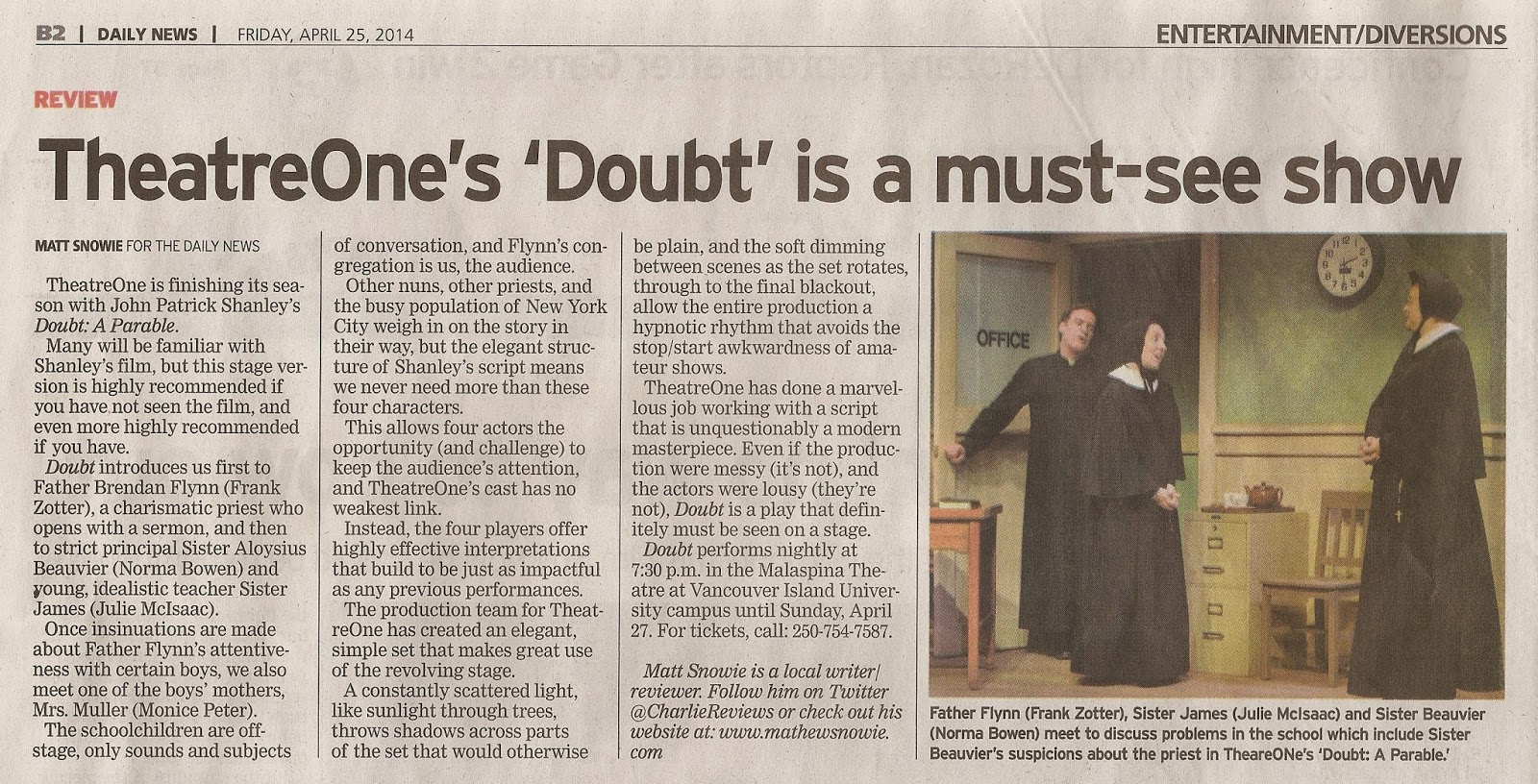
TheatreOne's Doubt: A Parable


TheatreOne is finishing its season with John Patrick Shanley’s Doubt: A Parable.

Many will be familiar with Shanley’s film, but this stage version is highly recommended if you have not seen the film, and even more highly recommended if you have.

Doubt introduces us first to Father Flynn (frank Zotter), a charismatic priest who opens with a sermon, and then to strict principal Sister Beauvier (Norma Bowen) and young, idealistic teacher Sister James (Julie McIsaac).

Once insinuations are made about Father Flynn’s attentiveness with certain boys, we also meet one of the boys’ mothers, Mrs. Muller (Monice Peter).

The schoolchildren are off-stage, only sounds and subjects of conversation, and Flynn’s congregation is us, the audience.

Other nuns, other priests, and the busy population of New York City weigh in on the story, but the elegant structure of Shanley’s script means we never need more than these four characters.
This allows four actors the opportunity (and challenge) to keep the audience’s attention, and TheatreOne’s cast has no weakest link.

Instead, the four players offer very effective interpretations that build to be just as impactful as any previous performances.

The production team for TheatreOne has created an elegant, simple set that makes great use of the revolving stage.

A constantly scattered light, like sunlight through trees, throws shadows across parts of the set that would otherwise be plain, and the soft dimming between scenes as the set rotates, through to the final blackout, allow the entire production a hypnotic rhythm that avoids the stop/start awkwardness of amateur shows.

TheatreOne has done a marvellous job working with a script that is unquestionably a modern masterpiece. Even if the production were messy (it’s not), and the actors were lousy (they’re not), Doubt is a play that must be seen on a stage.


Doubt performs nightly at 7:30 in the Malaspina Theatre at VIU until Sunday, April 27. For tickets, call: 250-754-7587.


Originally published in the Nanaimo Daily News and Harbour City Star

Saturday, February 8, 2014

THE COOK, THE THIEF, HIS WIFE & HER LOVER

Dinner. Sex. Murder. Dessert. Stabbing. Abuse. Singing. Rape. Cannibalism. Cooking. This is the world of Peter Greenaway’s graphic, rhythmic and haunting film starring Helen Mirren and Michael Gambon.

Albert Spica (future Dumbledore Michael Gambon) returns each night to the same restaurant with his unflappable wife, Georgina (Helen Mirren), and his gang of thugs. He boisterously announces every thought in his head, punctuated by profanity and verbal abuse of everyone around him. Meanwhile, his wife begins an affair with the bookish Michael sitting at a nearby table.

The cook, French chef Richard Borst, is the arbiter of Georgina and Michael’s affair, hiding them in pantries and meat lockers to protect them from her gangster husband. He and his eclectic staff of cooks, dishwashers and servers suffer the brunt of Albert’s verbal abuse, but soon witness the escalating violence that this so-called marriage has brought down on them.

It’s difficult to say which is more unearthly or evocative: the set design or Michael Nyman’s orchestral score. The restaurant, kitchen and loading dock are where 90% of the film takes place, and the vaulted ceilings, broad corridors and colourful lights are like sets out of “Blade Runner” or “Brazil”. At the same time, the music is as epic and overbearing for a climactic fight as it is for the serving of desert.

Extreme elements, from the words and actions of the villain to the alienating score and sweeping movement of the camera, boil over and drown the audience in ways that few films dare to do. The emotional impact of this film could be compared to “Requiem for a Dream” or “A Clockwork Orange”. Extreme adult content in a powerful narrative can leave the right audience stunned and fascinated.


It is likely the film’s X rating that kept it from gaining wider acclaim in the way that Stanley Kubrick’s film have (and this is a very Kubrickian film), and the same can be written for Michael Gambon’s character. Albert Spica may have missed out on the AFI’s Top Villains list, but when he makes appearances on similar lists, he’s at the top.


As published on Examiner.com 

Sunday, August 25, 2013

THE WORLD'S END

Few cult classics of the last decade managed to be as popular as Shaun of the Dead, and I'd say no zombie film has been as entertaining. When Hot Fuzz came along from the same crazy team it managed to upend the action cop genre just as well as Shaun had upended zombie horror. Both films walk a very thin line between satirizing the genre and being a part of it, and both succeed brilliantly. Now comes sci-fi/alien/apocalypse comedy The World's End.

The film’s aliens are actually robots that have replaced most of the town in a mix of Invasion of the Body Snatchers and The Stepford Wives. Party guy Gary (Simon Pegg) convinces his four high school friends (Nick Frost, Martin Freeman, Eddie Marsan, and Paddy Considine) to go back to their home town to finish the twelve-pub crawl that they never completed 23 years before. Soon the robot alien secret is revealed, and the guys have to fight for their lives and try to save the world.

Unlike most recent comedies, The World's End manages to include real character development, conflict, and drama without sacrificing laughs. Anyone who has had a few close drinking buddies in their life, and perhaps have gone too far some nights, will relate to these five old friends. They have their ups and downs, and still carry some old scars, but they are there for each other when the blue alien robot blood hits the fan.

Revered Polish director Krzysztof KieÅ›lowski made the famous "Three Colours Trilogy" with Blue, White, and Red. Film geeks Simon Pegg and Edgar Wright have now completed their "Three Flavours Cornetto Trilogy”. Strawberry red was in the gory rom-zom-com Shaun of the Dead, original blue is in the police-centered Hot Fuzz, and alien mint green is in The World's End. Along with a recurring set of actors and a few recurring jokes, the trilogy is mostly held together by Pegg and Wright's quintessentially British humour and Wright’s love of fast editing, which is on full display in The World's End.

I hesitate to mention, but if I had one complaint with the film it would be, ironically, the end. Although the story wrapped up and climaxed in a wonderfully entertaining way, the last few minutes saw a sudden tone shift that I felt halted the momentum. In a way it was the perfect way to end the film, and it marked a clear difference from the other two Cornetto films, but it still didn't feel right.

Despite the minor issues I had with the ending, or with the somewhat underused appearance of Pierce Brosnan (with Timothy Dalton in Hot Fuzz, I’m sad that Connery or Moore weren’t in Shaun of the Dead for a James Bond hat trick), The World’s End was a wonderfully entertaining film.

Apparently Cornetto is releasing new flavours in the UK, so if the stars align and find themselves with some free time, perhaps the trilogy will expand. For now you can expect to see Simon Pegg expanding into drama with Hector and the Search for Happiness as well as more Star Trek, Nick Frost will be acting without Pegg for the first time in salsa dancing comedy Cuban Fury, and director Edgar Wright is finally working on Ant-Man for Marvel’s Phase Two films leading to The Avengers 2.


Friday, June 21, 2013

WORLD WAR Z

Max Brooks' book "World War Z" is a masterwork thriller. It drips information about the zombie apocalypse to the reader through short stories, so that as you read the survivors' accounts you piece together a much bigger story. It would make a brilliant anthology series on HBO. They could hand chapters off to individual filmmakers to adapt into hour-long episodes.

But that is not what happened. Rumour is that there was an earlier script that would have made this film 3+ hours and hewn much closer to the book's structure. The rumour also says that it would have been the first Oscar-worthy zombie film.

But that is not what happened. Instead, the filmmakers behind World War Z, including producer Brad Pitt, have looked at the macro-political story that Max Brooks wrote and wrote a Hollywood hero into it. Brad Pitt plays Gerry Lane, a former UN agent who is drafted to find a cure. Forced away from his family to globe-trot the apocalypse, he deals with a variety of situations borrowed equally from zombie films and apocalypse disaster movies.

Plenty of fans of the novel will be disappointed by this. But the fact that the movie follows a new character while (roughly) following the bigger story of the book means that the characters of the novel are out there. They are facing their own apocalypses. They just didn't cross paths with Brad Pitt. Sequels or (hopefully) an HBO series could give them their time on screen, but for now we have this film starring Brad Pitt.

As far as films starring Brad Pitt go, this one is quite good. It didn't try to be funny, which most zombie films do, and the resulting tone was closer to Contagion than Dawn of the Dead. Brad Pitt is a solid leading man as usual. Mireille Enos (The Killing) is his wife, and in her short time on screen she manages to be a competent survivor.

Something that often sinks apocalypse films is a transparently manipulative character. The screaming blond in Jaws 2 should have been the first one eaten, but she stubbornly survives to annoy the audience to the end. Fred Astaire's part in The Towering Inferno was specifically designed to break your heart. 2012 was hemorrhaging selfish and annoying characters to hate. These cheap emotional manipulations reveal bad scripts more often than bad actors, so it was nice to see World War Z did not burden its good cast with cheap tricks.

Perhaps we will see a WWZ adaptation some day, but for now there is a solid zombie thriller starring Brad Pitt that happens to use the same title.


Wednesday, June 19, 2013

MAN OF STEEL

The undeniably great Christopher Reeve ushered in the first generation of superhero blockbusters with 1979's Superman: The Movie. That generation brought us the Tim Burton Batman and little else of any success. The second generation kicked off with Bryan Singer's X-Men and Sam Raimi's Spider-Man. With the reboot of The Amazing Spiderman, the re-invention of the epic blockbuster in The Avengers, the critical and commercial success of The Dark Knight trilogyand a new team in X-Men: First Class, we have entered a third generation of superhero films.

Man of Steel is Superman's return to relevance, and his first truly great screen appearance since 1979.

An extended look at a much more realistic Krypton opens Man of Steel, and successfully sets the tone in a much darker way. Despite being Zack Snyder's film, the impact of Christopher Nolan is felt throughout; and although this sacrifices some of the light charm that Reeve's films were known for, it is a firm statement of independence that works in the film's favor.

Unlike previous incarnations, the backstory of Krypton is key to the entire film, and true motivation is developed for Superman's Kryptonian parents and the film's big bad, General Zod (Michael Shannon). Slight alterations to the technology, physics, and explanations of Superman's Kryptonian DNA are brilliant manipulations of the classic story that bring it up to date for a modern superhero blockbuster. Batman Begins started the reset where audiences would not accept a superhero without logic and reason. Man of Steel's creative team, including David S. Goyer and Christopher Nolan, have brought the same respect for the character that rebuilt Batman so effectively.

Henry Cavill, the man who was almost cast as Aragorn then Batman and then James Bond, has finally found his blockbuster franchise. He fits the suit that few mere mortals are physically qualified for, and he manages to pull off the reluctant hero without appearing mopey or frigid. A downside to the origin story that this film tells is that we don't get much of his human alter ego. Part of what made Christopher Reeve's Superman so likeable was his bumbling Clark Kent, but we'll have to wait until the next film to see if Cavill's awkward journalist is as good as his bulletproof hero.

Even though the film revolves around Krypton's destruction, Clark Kent's childhood development in Kansas, and General Zod's escape from the phantom zone for revenge, Man of Steel carves a very original path from the first two Christopher Reeve films. By the credits it has established a new Superman in the same way that JJ Abrams established a new Star Trek. All the characters and elements are present, but they have not been dropped in front of us for no reason. By the end of the film we believe in them, and we see the connections that make them cohesive.

If rumours are true and Man of Steel is the first step towards a larger DC Universe, then it is my hope that the end of the sequel to Man of Steel will tease a new Batman. Then, in The Dark Knight Rises of this franchise, a dual Superman/Batman story can be told. If Warner Brothers is intent to copy Marvel's success, they would be smart to not front-load their franchise. There will be time to introduce Wonder Woman, The Flash, Green Lantern (again), and even Aquaman, but the world they have built here is delicate. Realism and logic were put front and center in The Dark Knight trilogy, and now the same has been done for Superman, which many people (including me) did not expect. Hopefully good writing and forward thinking will win out over immediate greed.


Saturday, May 18, 2013

STAR TREK INTO DARKNESS

This is the long-awaited sequel to a blockbuster science fiction franchise that has seen highs and lows over the past few decades. It is probably the best indicator of what JJ Abrams will bring to a Star Wars sequel, and I'd say things are looking very good.

After a thrilling James Bond-like opening mission, Kirk and the Enterprise return to Earth. In London, rogue agent John Harrison (Benedict Cumberbatch) has bombed a Starfleet archive, and Kirk gets permission from Admiral Marcus (Peter Weller) to hunt him down.

From the opening scenario involving primitive aliens, cliff diving, and exploding volcanoes, the film keeps a pace going that would give the original series whiplash. William Shatner's crew may have had time for philosophy and contemplation, but with Chris Pine on the bridge the philosophy must be discussed between phaser blasts. Action fans can rejoice at this. Sometimes the speed and clutter of the frame was overwhelming, but JJ has proved to be a more than capable action director with a clear hold on his audience.

A superficial improvement in the sequel is the reduction of lens flares. It doesn't bother me, but many people complain that the first film includes too many. Happy for you then that JJ is such a nice guy because he has bowed to the people's will and given you what you asked for. Giving the audience what they want, however, is exactly what causes trouble in the film. Not a lot of trouble, but enough to make this sequel not quite as good as its predecessor.

Where the first film had a streamlined plot that spiraled around it's time-travel premise, Into Darkness has an element of chaos that is both good and bad. As the plot unfolds and the villain surprises Kirk, the chaos plays to the danger and suspense that comes with such an unpredictable opponent. But in gaining mystery and suspense the film sacrifices tidy storytelling, which shuffles emotional scenes and action scenes in jarring ways. As far as criticisms go that one is pretty weak, but it's the best description I can give for the slight disappointment I felt.

The writers have picked up the alternate-timeline characters where they were left and have followed them forward with the understanding that even on a new timeline, they could encounter elements of the original series. At times, references to the original series get in the way of good storytelling. This is a problem that only Trek fans will have to deal with, however, since the film as science fiction, as action, as adventure, and as a fun ensemble is solid. Even if references to the original do get in the way, they are such good elements that it would have been a shame to lose them just because Spock Prime (Leonard Nimoy) messed up the timeline.

When sequels like The Dark Knight come along they are met with astonishment because good sequels have been so difficult and rare. Before Nolan returned to Gotham there was only The Godfather Part 2 and The Empire Strikes Back to cited as undeniably great successors. Though I won't place Into Darkness in their league, it is still a fantastic sequel. With JJ doing Star Wars it is unlikely we will see another Star Trek for 3-4 years unless a new director is found, but when the next film comes it will have a lot to live up to in both of its predecessors.


Friday, March 22, 2013

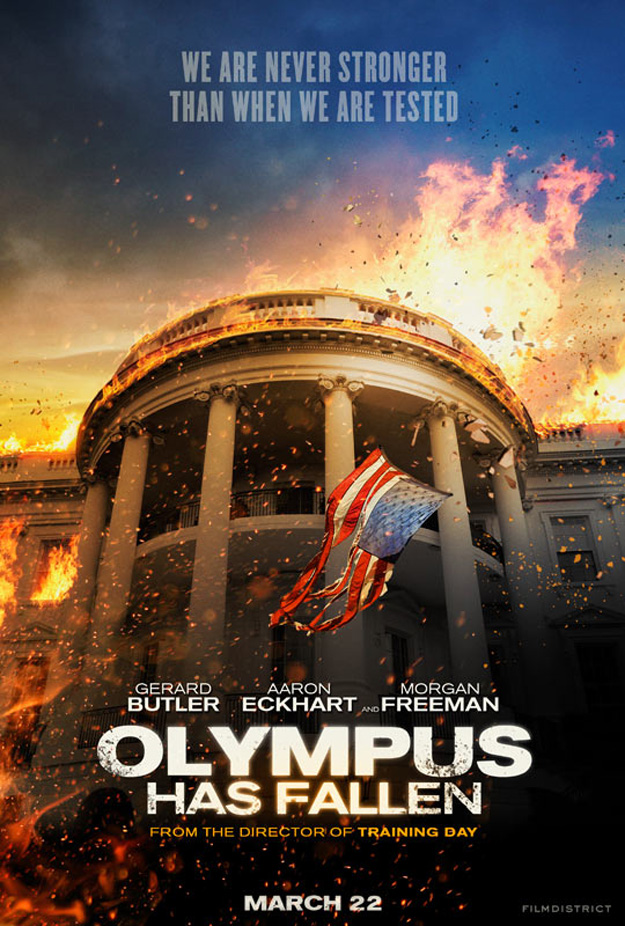
OLYMPUS HAS FALLEN


So here’s the thing about action movies: ever since Die Hard, Hollywood has been trying to make another Die Hard. They’ve done every variation of hostage situation including several more office buildings, they’ve done every type of non-American villain except Canadian, and they’ve given every macho leading man from Harrison Ford to Alec Baldwin (in 1990) a shot at the title. But even Bruce Willis as John McClane fighting Russian terrorists in A Good Day to Die Hard couldn’t recapture the magic. Now it’s Antoine Fuqua’s chance to direct, and Gerard Butler’s chance to play the hero. Are the elements that make up the bones of Die Hard present? Yes. Do they work? No.

Secret Service agent Mike Banning (Butler) is kicked off the President’s detail when he fails to save the First Lady from a car crash. Eighteen months later and he is working at the Treasury Department on the day that the South Korean delegation is visiting President Asher (Aaron Eckhart). Then a gunship bomber flies over DC and starts shooting at anything and anyone, tourist groups turn out to be heavily armed infantry, and part of the South Korean delegation turn out to be the bad guys. The fact that one of them is played by the diamond-faced villain from Die Another Day could have been a clue.

With the President and VP taken hostage and the White House occupied, the government is handed over to Speaker of the House Morgan Freeman. He has a character name, but all you need to know is he’s Morgan Freeman, which is good because that’s all the filmmakers give you. Party affiliations and character development have no place in action movies.

Something I hadn’t considered in my excitement to see Die Hard at the White House was that the whole “lone hero” scenario requires removing the other heroes. Washington DC has a lot of possible heroes to remove, and this means that the debut siege is a bloodbath. This sequence is one of the most original in the film, and it feels like the part that got the script the green light, but it resembles Saving Private Ryan more than anything from the Nakatomi Building.

It may be unfair for me to constantly compare this film to Die Hard, but I can easily see Gerard Butler’s character going home to watch the Bruce Willis classic and saying, “Why doesn’t he just shoot them in the head? He should just shoot them in the head. Do you think he considered just shooting them in the head?” I didn’t even try to count how many Full Metal Jacket brain splatters were the result of Butler firing a perfectly-aimed shot.

An essential part of the lone hero action film is the hero’s motivation. It’s not good enough that he wants to be a good guy and save everyone. John McClane would have left the building if his wife weren’t in the hostages. The same goes for Harrison Ford in Air Force One. Gerard Butler’s only motivation seems to be doing his job, which is fairly weak as far as action movies go.

But, at the halfway point, the film did not deserve much scorn. It succeeded in delivering what the trailers promised, which was a lot of action in the relatively new setting of the White House. However, in the second half, there is a device introduced that rises to Dr. Strangelove levels of stupidity solely for the purpose of raising the stakes higher than they needed to go. Nothing is easier to mock than a ticking clock, and a couple of plot contrivances leading up to it doesn’t help the believability.

As far as action movies go, there have been plenty worse, and if you don’t mind blood this was a worthy popcorn flick. It’s not challenging or particularly well-crafted, but it does what it set out to do.
By the way, if Olympus Has Fallen sounds interesting, but the theaters drop it before you get a chance to go, don’t worry. Roland Emmerich is remaking it with Channing Tatum and Jamie Foxx. White House Down opens June 28.


Friday, March 8, 2013

OZ: THE GREAT AND POWERFUL


The great debate over 3D rages on, and Oz the Great and Powerful is the latest battleground. The critics are split; some say 3D should be innocuous and intended to build on quality storytelling, but some say that 3D should remember its roots as a 1950s novelty and throw things out of the screen. Oz falls into the second category with spears, flying monkeys, carnivorous trees, and bubbling fog all flying out to the audience. I decided to save a few bucks and went to the 2D, which may have been a mistake. From the animated credits it was clear that Sam Raimi was playing to the 3D crowd next door. Also it was an afternoon show, so my seat was being kicked and a small blonde child was practicing the hundred meter dash in the aisle (I thought I should mention that in case my review sounds bitter).

The movie opens in black and white Kansas with the frame cut off at the old 4:3 ratio. Oz (James Franco) is a magician working in a traveling circus. He is selfish, deceitful, and as much of a womanizer as children’s films allow. Plenty of great films have sleazy leading men who see the error of their ways, but this opening sequence is missing any kind of villain to contrast with the charming hero. When Rick first appears in Casablanca we like him not because he’s a sharp-tongued rogue, but because he’s a sharp-tongued rogue outwitting Nazis. Here, Franco is just the least honest man in a room of nice country people, and the intro sequence suffers as a result.

When Oz’s hot air balloon is tossed around by a tornado the visuals kick in. Broken fence posts stab at Oz through the floor and wagons crash into the screen as the noise rages on. Finally calm air returns and the screen transforms into panoramic colour. One thing that cannot be faulted is the film’s production design. The look of the original 1939 film is recreated and expanded very effectively. Although the movie is claimed to be based on the books, it is clearly inspired most by the original musical.

References to The Wizard of Oz imagery are everywhere. Rainbow arcs appear in clouds and tree branches through the whole film to the point of overkill. In one respect Raimi did hold back, which is referring to the original film’s trio of characters. A lion makes a fun appearance, and we meet a man who makes scarecrows, but other than these little nods the film is mostly concerned with the love triangle (or square?) of Oz and the three witches.

Michelle Williams is the bubble-powered Glinda, Rachel Weisz is the uncomplicated evil witch Evanora, and Mila Kunis is the naive Theodora. The relationships of these three with Oz appear a little one-sided, and are only marginally better than Twilight in terms of inspiring female role models. Also, since this is essentially a prequel, the original film’s ending is given a depressing new twist with Oz abandoning Glinda to return to Kansas with a younger woman. But, all that aside, the three leading women are all great actors and they are performing in the slightly exaggerated style that classic Hollywood and children’s films demand.

When Glinda brings Oz into her protected kingdom there is a sequence where a bunch of townspeople explain exactly what they do; someone sews, someone makes bread, someone builds scarecrows, etc. Unfortunately this is not the only scene where people voluntarily say exactly what they do. The script is filled with exposition where characters simple state their intentions. If this weren’t aimed at children I’d say it was criminally lazy writing, but I have to remind myself again that this is targeted at kids who have recently hit the age where The Wizard of Oz is first experienced. Clarity is expected.

Without the dazzle of 3D I was left to look at the quality of the story, the script, and the acting, none of which are the film’s strength. It’s worth looking at for the visuals of the production design. I wouldn’t say that it is a terrible otherwise, since it easily outdoes other revisitations of children’s classics (Charlie and the Chocolate Factory comes to mind), but it isn’t great, and unless you’re under 10 it isn’t powerful.


Friday, February 1, 2013

WARM BODIES

Nicholas Hoult plays R, a zombie who cannot remember his full name. He shuffles around an airport with dry, witty narration filling his thoughts. M (Rob Corddry) is his best friend, and sometimes they get hungry and team up to go look for brains. During one of these meals out, R eats the brains of Perry (Dave Franco), and R finds Perry’s feelings for his girlfriend Julie (Teresa Palmer) becoming his own. R then saves Julie and hides her in his Wall-E like shelter full of the remains of human society.

Director Jonathan Levine made the indie coming-of-age film The Wackness, which was reasonably entertaining if not very original. His follow-up feature was the terrific 50/50, which was a great convergence of actors and script. Warm Bodies ends up somewhere between the two. The highlight of the film in terms of both actor and script is Nicholas Hoult. His depressed narration includes most of the best lines and Hoult manages to get across a lot of emotion despite sticking to the grey, dead features of the classic Hollywood zombie.

The supporting cast fits the film, but no one is trying too hard to make Warm Bodies a very serious film, which for a Rom-Zom-Com is the best choice. Rob Corddry just plays himself, Teresa Palmer is a beautiful and relatable lead, and John Malkovich agreed to be in this movie, which is less impressive now that his recent work has included Transformers: Dark of the Moon and Jonah Hex.

As for the story itself, if R and Julie wasn’t enough of a hint, Perry sounds like Paris, R’s best friend is M, and Julie’s best friend wants to be a nurse. The star-crossed connections become painfully clear when R approaches Julie at her balcony, and this is the main flaw of the film. Director Jonathan Levine keeps the focus on the Shakespeare romance instead of on the zombie comedy. This is only a problem because it places the audience in the awkward position of rooting for necrophilia, an obstacle that even the most dedicated romantic would have trouble overcoming.

Warm Bodies is an entertaining riff on Romeo and Juliet that seems very original at the start, but soon reveals its conventional side. It’s not gory enough to be a zombie classic, but it’s good enough to be the first worthwhile film of 2013.


Friday, January 11, 2013

ZERO DARK THIRTY


If you were thinking that two years is a bit soon to be making a film about the assassination of Osama Bin Laden, I have news for you: the film has actually been in production since 2009, two years before Bin Laden was killed.

Mark Boal won many accolades for the accuracy he brought to the screenplay of The Hurt Locker, and after he and director Kathryn Bigelow scored big wins at the 2009 Oscars they planned to work together on a follow up. At that time, Boal, through his military contacts, was following a Navy SEAL team's operations. As luck would have it that SEAL team ended up being involved on the raid that killed Osama Bin Laden. Within two days of the assassination, Bigelow announced they were re-working Boal's Black Ops script into the film that is now Zero Dark Thirty.

So, how does a "based on true events" story turn out when the events and the film production ran parallel? Actually, quite well. The film, which is up for 5 Oscars including Best Picture, is a string of events filmed in the still-popular handheld fashion that the Jason Bourne series used to excess. It is one third torture and interrogation, one third spy bureaucracy, and one third Call of Duty.

Central to the CIA investigation is Maya (Jessica Chastain) and her evolution from naive young agent to heavily-disguised operative. If this film wins anything at the February 24 ceremony it will be for Chastain's performance. She has given several great performances in ensembles over the last few years with The Help being a standout, but in Zero Dark Thirty she stands above a cast that includes a dozen recognizable faces including James Gandolfini. As the investigation drags on, her patience thins, and Chastain turns into the female equivalent of Daniel Day-Lewis in There Will Be Blood. To put it simply, she is the strongest female lead Hollywood has put out in a long time.

As the story progresses through the many terrorist attacks that have occurred in the past decade the tension continues to mount, and Bigelow succeeds in the same way Ben Affleck did in Argo, or Ron Howard did in Apollo 13. Even though everyone knows how the story ends, tension and suspense build out of the relationship that is built between the audience and the characters. It is a terrific feat of visual storytelling and performance that makes this a highly recommended film.