The id, Freud’s name for subconscious desires, and the superego, which is the subconscious limiting of those desires to conform to society, are weighed by the conscious ego. This balancing act of fantasy and repression is what Freud considered the baseline of someone’s personality. With a career spanning fifty years and a filmography that crosses all genre boundaries, Stanley Kubrick achieved status as a master filmmaker with particular skill in bringing to the screen stories and personalities that defy single interpretations. Through open narratives and careful use of the alienation effect Kubrick’s films remain compelling reasons to apply psychoanalytical theory to modern ideas of fantasy, personality, and desire in both films and real life.

Dr. Strangelove, or: How I Learned to Stop Worrying and Love the Bomb (1964) was the critical and commercial success that allowed Kubrick to make his ambitious science fiction masterpiece 2001: A Space Odyssey (1968). Eyes Wide Shut (1999), based on Arthur Schnitzler’s Dream Story, was originally intended by Kubrick to be his follow up to 2001, but he pursued other projects until thirty years later when it became his final film. Eyes Wide Shut is an overtly sexual drama while Dr. Strangelove is, on its surface, a cold war satire. Both films use sexual fantasy and repression - a pendulum swing of inner desire and social conformity - to expand on their abstract themes; Eyes Wide Shut explores modern theories of love and sexuality while Dr. Strangelove explores the madness of the cold war.
The “odyssey” that Dr. Harford (Tom Cruise) goes on in Eyes Wide Shut is triggered by his wife Alice’s (Nicole Kidman) confession to fantasizing about an extra-marital affair. This is a blow to his self-esteem and his monogamous security. In response, Dr. Harford explores his own desires and fantasies as he agonizes over the imaginary infidelity. Eventually he finds his way back to his wife and to the discovery of a new interpretation of their sexual relationship. The trigger of the female fantasy leads to a series of confrontations that interchange sex with death, commerce, and love (Deleyto 31).

A similar, but inverted, connection of fantasy and nightmare occurs in Dr. Strangelove. In a film where the only female character is a secretary and sexual partner named Miss Scott (but only addressed by Gen. Turgidson as “Baby”), the male characters are given free rein to plan their fantasies. When the doomsday device has been triggered and the nuclear apocalypse is upon them, the men in the war room listen to the Nazi Dr. Strangelove and his plan for them to survive in mine shafts with a ratio of ten women for each man:
I hasten to add that since each man will be required to do prodigious service along these lines, the women will have to be selected for their sexual characteristics, which will have to be of a highly stimulating nature.
- Dr. Strangelove (Peter Sellers)
This new world imagined by the doctor is a genetically pure culture, a Nazi fantasy, and it is such an exciting idea that the wheelchair-bound Dr. Strangelove stands up (becomes erect) and declares, “Mein Fuhrer! I can walk!” But the male fantasy of this future would be less-than-ideal for its female population. As much as Eyes Wide Shut reveals a man’s sexual nightmare resulting from a woman’s fantasy, Dr. Strangelove shows a woman’s nightmare resulting from male fantasies.
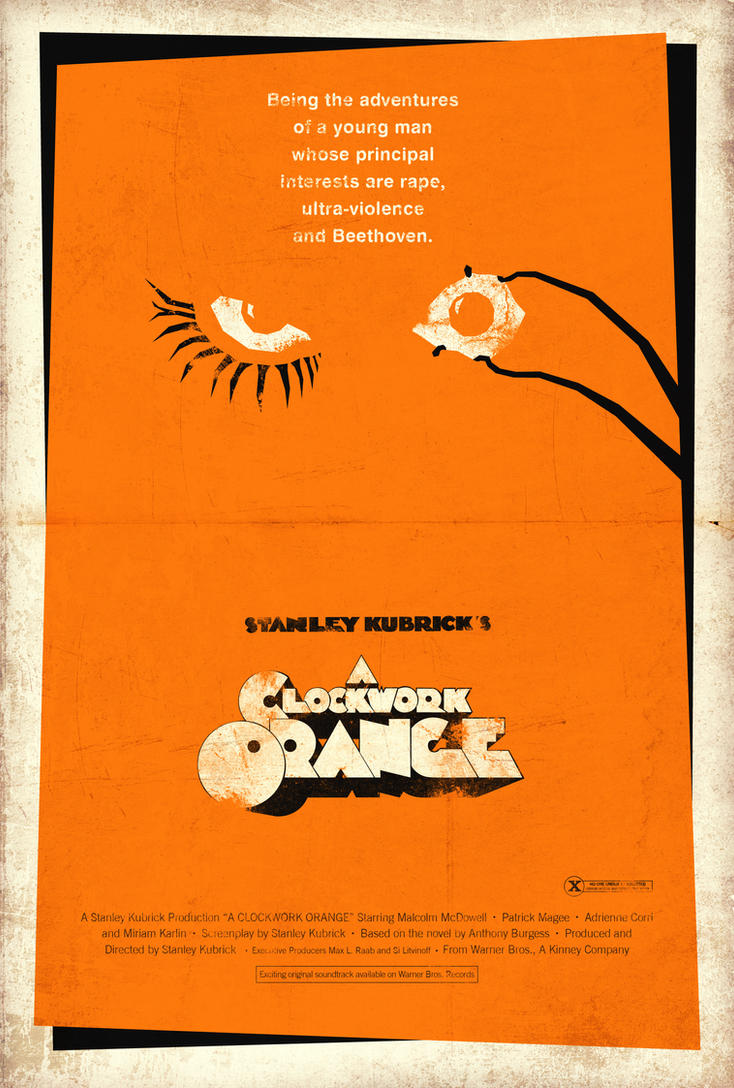
A pivotal film in Kubrick’s career was his follow-up to 2001: A Space Odyssey, which was an adaptation of Anthony Burgess’s novel about anarchy and social conditioning through science, A Clockwork Orange (1971). The main character, Alex (Malcolm McDowell), is the psychotic leader of a gang of violent teenagers. His life is completely unrestricted, and he satisfies every urge he has through violence, sex, murder, and music. When he is betrayed by his gang, Alex is sent to prison and then into a rehabilitation program. Through chemical psychotherapy, Alex develops a false superego, a debilitating nausea that appears when he comes into contact with his socially unacceptable desires. It is this treatment that has turned him into “a clockwork orange,” which leaves him with a natural exterior but with nothing underneath except the psycho-chemical constraints. When Alex is returned to his violent self at the end it is presented as a positive event because it means that - although he is violent and destructive - he is back to being human.

Freudian characters like Alex populate many of Kubrick’s films. In Eyes Wide Shut, Dr. Bill Harford is a man who, unlike Alex, appears to be in complete control of his emotions and desires. When his wife accuses him of lusting after his female patients, Bill reacts calmly and clinically. He explains that there is a female nurse present, that the situation is completely free of any romantic elements, and then he tries to calm her down by diagnosing the source of her anger: “Let’s just relax, Alice. This pot is making you aggressive.” The doctor’s veneer of honest professionalism is undermined in a number of scenes. For example, he reassures his wife that he would never lie to her in one scene, but in the next he lies about his reasons for staying out late. Bill is driven by his subconscious desires or a sense of guilt for much of the film, and it is only in short moments, such as when he leaves the prostitute’s apartment before having an affair, that his conscious sense of responsibility drives him away from making mistakes.
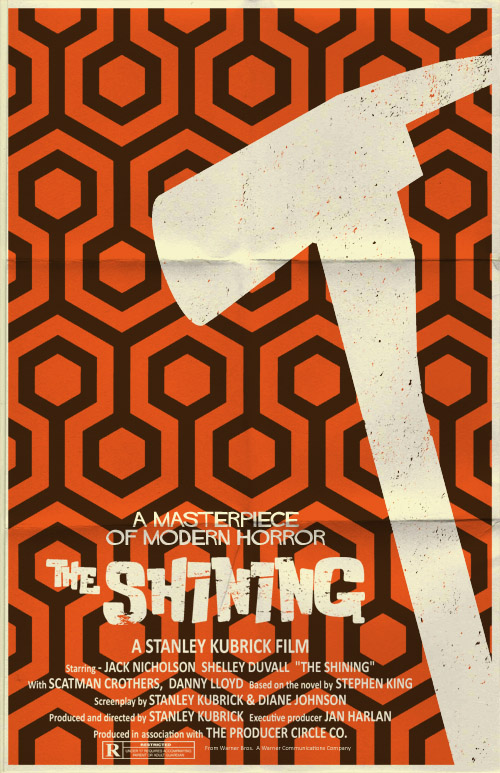
Another important character representing unleashed subconscious desires is Jack Torrence (Jack Nicholson), the familicidal caretaker in The Shining (1980). At the start of the film, Jack has restrained himself by repressing his destructive urges, such as drinking, and is introduced as a happy father, husband, and writer. His dark, unrestrained side is hinted at when his wife tells a doctor of the time when Jack dislocated his son’s shoulder in a moment of rage. When the family moves into the Overlook Hotel, Jack’s unrestrained self begins to take over. As with all of Kubrick’s films there are various ways to interpret Jack’s slow decline into madness. The “evil” hotel, disturbed ghosts, schizophrenia, or cabin fever are all defendable explanations for Jack’s psychosis; however, the evidence for his decline is rooted in the Freudian tug-of-war that Kubrick shows Jack going through. His hallucinations (or visits from ghosts) are slowly developed until the final chase when all the horrors of the hotel are revealed. Jack does not step away from reality in a single moment, and his growing frustration with his wife and distance from his son are mixed with moments of tenderness or protective behaviour. The character arcs in The Shining were so central to Kubrick’s story that he insisted on filming in sequence so the actors would not be forced to revert to an earlier, more restrained point of view (Duncan 166).
Although the central character representing the audience’s point of view in The Shining is Danny, the film’s main character is the killer, Jack. In A Clockwork Orange the main character is the psychotic Alex. These extreme personalities are not alone in Kubrick’s filmography. Many of his films include central characters with extreme personalities like the murderous computer HAL 9000 in 2001, the pedophiliac Professor Humbert Humbert (James Mason) in Lolita (1962), the amoral social-climber Redmond Barry (Ryan O’Neal) in Barry Lyndon (1975), or the ensemble of broken eccentrics in Full Metal Jacket (1987). These characters illustrate Freud’s theory of personalities resulting from the id/ego/superego balance as much as they show Kubrick’s careful attention to character development.
The scene at the center of both Eyes Wide Shut and Schnitzler’s Dream Story is a masked “orgy” in a country mansion infiltrated by the main character. In the film version, Dr. Harford’s curiosity is peaked by an old friend who claims to play piano blindfolded for a secret group. Using what little his friend tells him, the doctor gets an appropriate costume and hires a taxi to get to the mansion. The masked characters move slowly, never speak, and remain anonymous throughout the strange sequence. When Dr. Harford is discovered he is made to remove his mask and expose his identity, which in the book the character thinks would be far worse than to be naked when everyone else is clothed. This humiliation is interrupted by a masked woman who “saves” him by volunteering to take his place, and this comes at the end of an evening that included several insults to Dr. Harford’s perception of his own masculinity. While walking the streets the doctor is physically assaulted by a group of frat boys who throw homophobic insults as they walk away, which bothers the doctor and leads directly to his nervous acceptance of a prostitute’s invitation to her home. Dr. Harford’s sexual desire or curiosity leads him through the first half of the film until his discovery at the party. In the second half it is his curiosity about the night before that continues to drive him to seek out answers. What he finds is that the prostitute he nearly slept with is HIV positive, that the woman who “saved” him has died mysteriously, and that his friend, the piano player, has disappeared from his hotel. Each of these incidents are taken by Dr. Harford to be his fault, and his building guilt drives him on to seek more answers. Despite warnings from the secret society behind the masked party, Dr. Harford continues his quest until he is confronted by an old friend who is revealed to have witnessed his unmasking. The masked party is the turning point where Dr. Harford’s character shifts from following his desires (his id) to following his guilt (his superego). Only when both have been taken to the extremes does Bill finally break down, weep, and confess everything to his wife.
In confessing to his wife, just as she had confessed to him at the start, Dr. Harford comes to a place of balance. The final scene shows the couple in a toy store with their daughter, shopping for Christmas, and their final discussion opens with Bill asking his wife, “What do you think we should do?” She slowly answers, “Maybe I think we should be grateful. Grateful that we’ve managed to survive through all of our adventures. Whether they were real or only in a dream.” Neither of them has a complete answer. They cannot confirm what the purpose of their story has been, how they will handle the future, or if they will remain together. But the fact that they are together, shopping with their daughter, talking to each other, and confessing their desires and concerns show the psychological balance they have come to.
Bill tries to affirm his commitment, “Forever,” he says, but she replies, “Let’s not use that word. It frightens me.” At this point the film, like the novel, comes to Freud’s conclusion that a balance of desire and guilt is necessary for a healthy personality, but that nothing can be predicted to last “Forever.” Kubrick, however, goes one step further. In the final seconds of the film the exchange between Bill and Alice expands the argument to include a balance of psychological desire with physical expression, which is Kubrick’s truly modern addition to Schnitzler’s story and Freud’s theory:
Alice: “But I do love you, and you know there is something very important that we need to do as soon as possible.”
Bill: “What’s that?”
Alice: “Fuck.”
- Final lines of Eyes Wide Shut
Despite working as a director for over fifty years, Stanley Kubrick only wrote and directed twelve feature films. The extent to which his films can be reinterpreted and analyzed is a testament to Kubrick’s skill, ambition, and understanding of the psychological effects of film. It is fitting that Kubrick’s final film was based on a novel by the Viennese writer Arthur Schnitzler, whose work was highly respected by Sigmund Freud for its psychological insight (Cocks 36). Many have argued that Kubrick’s slow working method deprived the world of further Kubrick films, and even Stanley Kubrick himself expressed dismay at failing to create more. But, in Stanley Kubrick: A Life in Pictures (2001), Martin Scorsese responded by saying, “I wish he’d made more, but these are enough. Because there is so much in each one… It’s like watching a different movie every time you see it.”
2001: A Space Odyssey. Dir. Stanley Kubrick. Perf. Keir Dullea, Gary Lockwood, William Sylvester, and Douglas Rain (voice). MGM, 1968. Blu-ray.
A Clockwork Orange. Dir. Stanley Kubrick. Perf. Malcolm McDowell, Patrick Magee, and Michael Bates. Warner Brothers, 1971. DVD.
Barry Lyndon. Dir. Stanley Kubrick. Perf. Ryan O’Neal, Marisa Berenson, and Patrick Magee. Warner Brothers, 1975. DVD.
Cocks, Geoffrey. "Stanley Kubrick's Dream Machine: Psychoanalysis, Film, and History." The Annual of Psychoanalysis 31 (2003): 35. Print.
Danckwardt, Joachim F. "From Dream Story (Schnitzler) to Eyes Wide Shut (Kubrick) from Identity through Meaning Formation to Identity through Excitation." The International Journal of Psychoanalysis 88.3 (2007): 735-51. Print.
Deleyto Alcalá, Celestino. “1999, a Closet Odyssey: Sexual Discourses in Eyes Wide Shut." Atlantis: Revista de la Asociación Española de Estudios Anglo-Norteamericanos 28.1 (2006): 29-43. Print.
Dr. Strangelove or: How I Learned to Stop Worrying and Love the Bomb. Dir. Stanley Kubrick. Perf. Peter Sellers, George C. Scott, Sterling Hayden, Slim Pickens, and James Earl Jones. Columbia, 1964. DVD.
Duncan, Paul. Stanley Kubrick: The Complete Films. Koln: Taschen, 2011. Print.
Eyes Wide Shut. Dir. Stanley Kubrick. Perf. Tom Cruise, Nicole Kidman, and Sydney Pollack. Warner Brothers, 1999. DVD.
Falsetto, Mario. Stanley Kubrick: A Narrative and Stylistic Analysis. Westport, Conn: Praeger, 2001. Print.
Full Metal Jacket. Dir. Stanley Kubrick. Perf. Matthew Modine, Adam Baldwin, Vincent D’Onofrio, and R. Lee Ermy. Warner Brothers, 1987. DVD.
Lolita. Dir. Stanley Kubrick. Perf. James Mason, Shelley Winters, Sue Lyon, and Peter Sellers. MGM, 1962. DVD.
Shining, The. Dir. Stanley Kubrick. Perf. Jack Nicholson, Shelley Duvall, Danny Lloyd, and Scatman Crothers. Warner Brothers, 1980. DVD.
Spartacus. Dir. Stanley Kubrick. Perf. Kirk Douglas, Laurence Olivier, Charles Laughton, Peter Ustinov, Jean Simmons, and Tony Curtis. Universal, 1960. DVD.
Stanley Kubrick: A Life in Pictures. Dir. Jan Harlan. Perf. Tom Cruise, Woody Allen, Martin Scorsese, Malcolm McDowell, and Sydney Pollack. Warner Brothers, 2001. DVD.
Helmetag, Charles H. "Dream Odysseys: Schnitzler's Traumnovelle and Kubrick's Eyes Wide Shut." Literature/Film Quarterly 31.4 (2003): 276. Print.
Schnitzler, Arthur. Dream Story (Traumnovelle). London: Penguin, 1999. Print.

 In any film genre I can usually find enough solace in the five-star classics to make up for the two-star clones that follow. This is becoming less and less the case with romantic comedies. Crazy, Stupid, Love. was terrific and surprising, and Friends With Benefits had Aaron Sorkin levels of witty dialogue, but there were a dozen films like The Switch in between.


