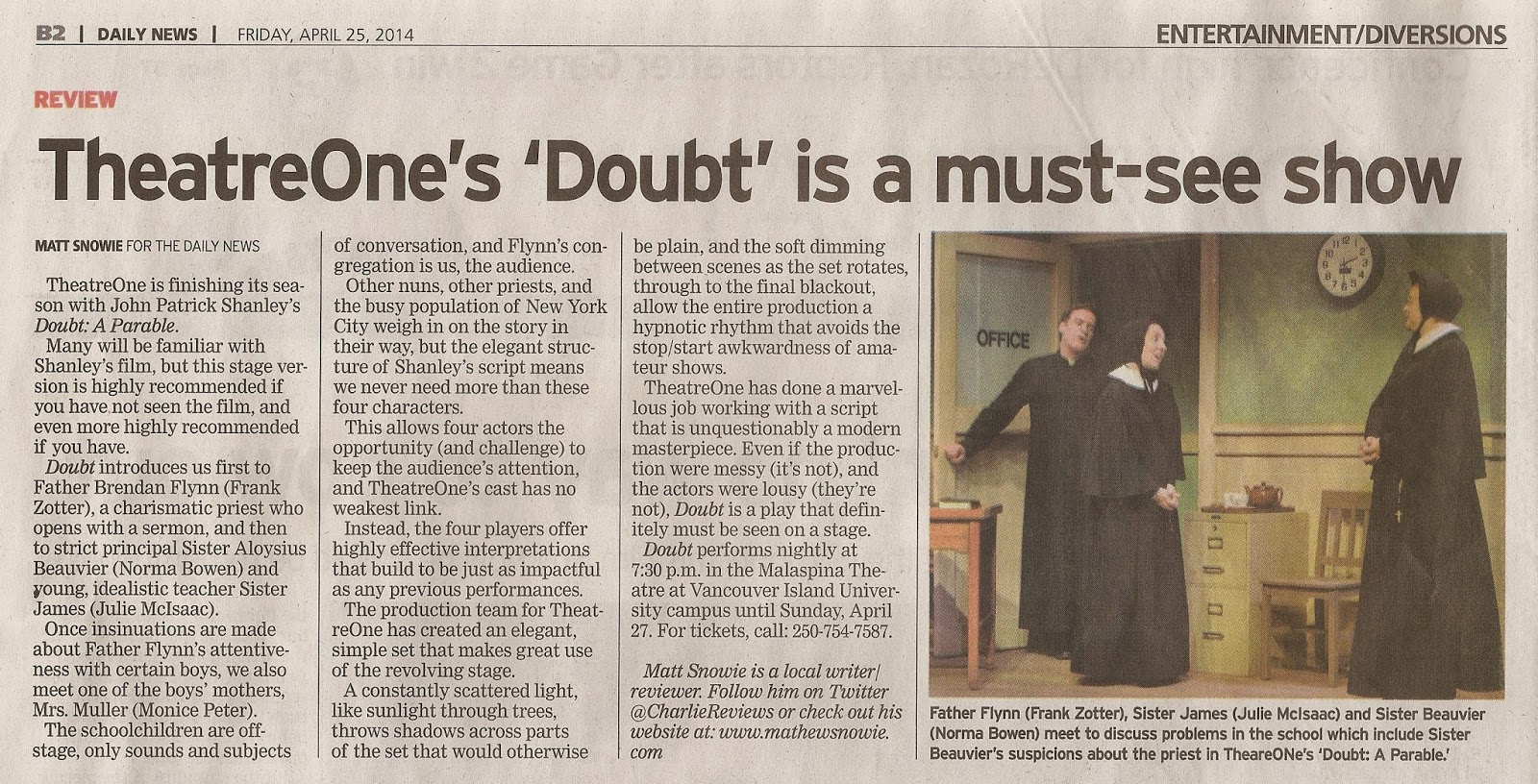
Friday, April 25, 2014

TheatreOne's Doubt: A Parable


TheatreOne is finishing its season with John Patrick Shanley’s Doubt: A Parable.

Many will be familiar with Shanley’s film, but this stage version is highly recommended if you have not seen the film, and even more highly recommended if you have.

Doubt introduces us first to Father Flynn (frank Zotter), a charismatic priest who opens with a sermon, and then to strict principal Sister Beauvier (Norma Bowen) and young, idealistic teacher Sister James (Julie McIsaac).

Once insinuations are made about Father Flynn’s attentiveness with certain boys, we also meet one of the boys’ mothers, Mrs. Muller (Monice Peter).

The schoolchildren are off-stage, only sounds and subjects of conversation, and Flynn’s congregation is us, the audience.

Other nuns, other priests, and the busy population of New York City weigh in on the story, but the elegant structure of Shanley’s script means we never need more than these four characters.
This allows four actors the opportunity (and challenge) to keep the audience’s attention, and TheatreOne’s cast has no weakest link.

Instead, the four players offer very effective interpretations that build to be just as impactful as any previous performances.

The production team for TheatreOne has created an elegant, simple set that makes great use of the revolving stage.

A constantly scattered light, like sunlight through trees, throws shadows across parts of the set that would otherwise be plain, and the soft dimming between scenes as the set rotates, through to the final blackout, allow the entire production a hypnotic rhythm that avoids the stop/start awkwardness of amateur shows.

TheatreOne has done a marvellous job working with a script that is unquestionably a modern masterpiece. Even if the production were messy (it’s not), and the actors were lousy (they’re not), Doubt is a play that must be seen on a stage.


Doubt performs nightly at 7:30 in the Malaspina Theatre at VIU until Sunday, April 27. For tickets, call: 250-754-7587.


Originally published in the Nanaimo Daily News and Harbour City Star

Tuesday, February 18, 2014

What if James Bond was American?

Inspired by BuzzFeed's clever What If "Doctor Who" Was American? column, I decided to consider that other 50-year-strong British franchise.

1. Paul Newman


The one and only original Bond, James Bond. Winning the part over Fleming-favorite Robert Redford, Newman made the role iconic and cemented his career as a leading man for decades to come. The elements that make the Bond films what they are were all established during Newman's tenure including the classic Ford Torino GT and Ernest Borgnine as Q.

2. Warren Beatty


Although he only played Bond in one film, Beatty managed to prove that the franchise didn't have to end with Newman's retirement. And with the tragic death of Tracy Bond (Faye Dunaway), 1969's On the People's Secret Service remains one of the series' most emotional films.

3. James Garner


Originally expected to take over after Newman, James Garner signed up for another season of Maverick and was unable to take the role until 1973's Live and Let Die. Garner's lighter persona proved popular, and he became the longest-running Bond with 7 films between 1973 and 1985.

4. Michael Keaton


Michael Keaton was a return to the darker, more violent Bond films of the Newman era, bringing back the physicality that had been lost with Garner's increasing age. After 1989's Licence to Kill, Keaton decided not to return.

5. Kevin Costner


In a post-Cold War world, Kevin Costner became known as the best Bond since Newman. He saw Bond into the modern era of computers and terrorism in 4 films between 1995 and 2002. Costner's Bond was under the command of the first female M (Meryl Streep), and he was the last Bond to work with Ernest Borgnine's Q before he retired in The World is Not Enough and replaced by Bill Murray.

6. Johnny Depp


For the 21st Bond film it was decided the franchise would reboot with a young Bond at the start of his career in Casino Royale. Skyfall, Depp's third film as Bond, saw a new Q (Joseph Gordon-Levitt), a new M (Bryan Cranston), and new Miss Moneypenny (Zoe Saldana) usher in a return to the classics.

Saturday, February 8, 2014

THE COOK, THE THIEF, HIS WIFE & HER LOVER

Dinner. Sex. Murder. Dessert. Stabbing. Abuse. Singing. Rape. Cannibalism. Cooking. This is the world of Peter Greenaway’s graphic, rhythmic and haunting film starring Helen Mirren and Michael Gambon.

Albert Spica (future Dumbledore Michael Gambon) returns each night to the same restaurant with his unflappable wife, Georgina (Helen Mirren), and his gang of thugs. He boisterously announces every thought in his head, punctuated by profanity and verbal abuse of everyone around him. Meanwhile, his wife begins an affair with the bookish Michael sitting at a nearby table.

The cook, French chef Richard Borst, is the arbiter of Georgina and Michael’s affair, hiding them in pantries and meat lockers to protect them from her gangster husband. He and his eclectic staff of cooks, dishwashers and servers suffer the brunt of Albert’s verbal abuse, but soon witness the escalating violence that this so-called marriage has brought down on them.

It’s difficult to say which is more unearthly or evocative: the set design or Michael Nyman’s orchestral score. The restaurant, kitchen and loading dock are where 90% of the film takes place, and the vaulted ceilings, broad corridors and colourful lights are like sets out of “Blade Runner” or “Brazil”. At the same time, the music is as epic and overbearing for a climactic fight as it is for the serving of desert.

Extreme elements, from the words and actions of the villain to the alienating score and sweeping movement of the camera, boil over and drown the audience in ways that few films dare to do. The emotional impact of this film could be compared to “Requiem for a Dream” or “A Clockwork Orange”. Extreme adult content in a powerful narrative can leave the right audience stunned and fascinated.


It is likely the film’s X rating that kept it from gaining wider acclaim in the way that Stanley Kubrick’s film have (and this is a very Kubrickian film), and the same can be written for Michael Gambon’s character. Albert Spica may have missed out on the AFI’s Top Villains list, but when he makes appearances on similar lists, he’s at the top.


As published on Examiner.com