Showing posts with label 5 Stars. Show all posts

Friday, January 11, 2013

ZERO DARK THIRTY


If you were thinking that two years is a bit soon to be making a film about the assassination of Osama Bin Laden, I have news for you: the film has actually been in production since 2009, two years before Bin Laden was killed.

Mark Boal won many accolades for the accuracy he brought to the screenplay of The Hurt Locker, and after he and director Kathryn Bigelow scored big wins at the 2009 Oscars they planned to work together on a follow up. At that time, Boal, through his military contacts, was following a Navy SEAL team's operations. As luck would have it that SEAL team ended up being involved on the raid that killed Osama Bin Laden. Within two days of the assassination, Bigelow announced they were re-working Boal's Black Ops script into the film that is now Zero Dark Thirty.

So, how does a "based on true events" story turn out when the events and the film production ran parallel? Actually, quite well. The film, which is up for 5 Oscars including Best Picture, is a string of events filmed in the still-popular handheld fashion that the Jason Bourne series used to excess. It is one third torture and interrogation, one third spy bureaucracy, and one third Call of Duty.

Central to the CIA investigation is Maya (Jessica Chastain) and her evolution from naive young agent to heavily-disguised operative. If this film wins anything at the February 24 ceremony it will be for Chastain's performance. She has given several great performances in ensembles over the last few years with The Help being a standout, but in Zero Dark Thirty she stands above a cast that includes a dozen recognizable faces including James Gandolfini. As the investigation drags on, her patience thins, and Chastain turns into the female equivalent of Daniel Day-Lewis in There Will Be Blood. To put it simply, she is the strongest female lead Hollywood has put out in a long time.

As the story progresses through the many terrorist attacks that have occurred in the past decade the tension continues to mount, and Bigelow succeeds in the same way Ben Affleck did in Argo, or Ron Howard did in Apollo 13. Even though everyone knows how the story ends, tension and suspense build out of the relationship that is built between the audience and the characters. It is a terrific feat of visual storytelling and performance that makes this a highly recommended film.


Friday, November 16, 2012

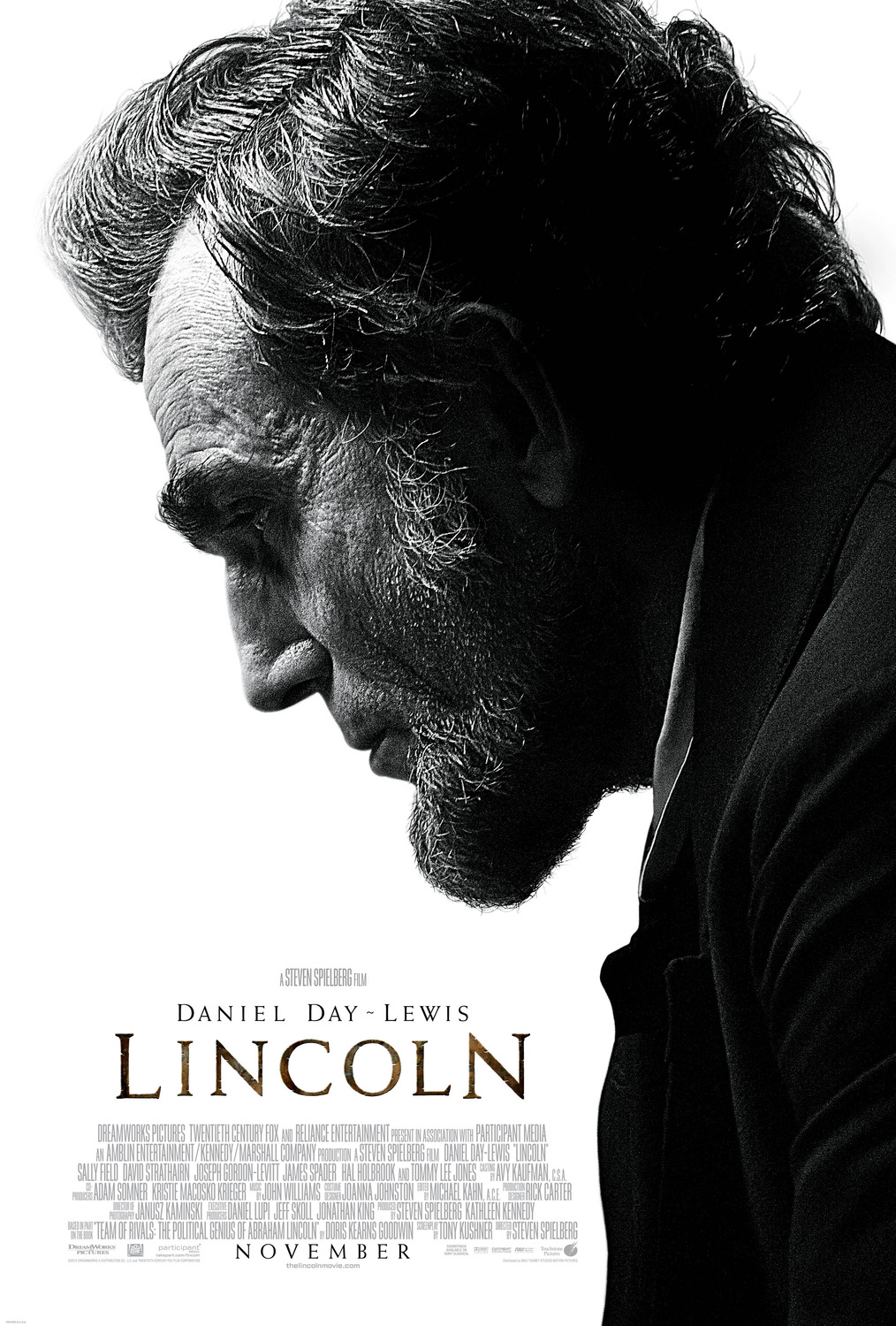
LINCOLN

History can sometimes weigh on a film like an albatross around its neck. The importance of getting things right while being entertaining while making something respectable while making it broad enough to get an audience to justify the larger budget for period sets can be overwhelming. When the subject matter is the man on the US penny, and his fight to pass one of the most important pieces of legislation in US history, that weight of history could easily turn any film into a dusty textbook. But Steven Spielberg does not make dusty textbooks, and Lincoln is possibly his best addition to Hollywood’s collection of history on film.

At the end of 1865, Abraham Lincoln has won re-election, the Civil War is in its final year, and the President has decided that the time has come to pass the 13th Amendment to end slavery. With a trio of proto-lobbyists and the Radical Republican Thaddeus Stevens (Tommy Lee Jones), Lincoln and his Secretary of State (David Strathairn) play politics with Congress while continuing to fight the Confederacy.

A film about Abraham Lincoln directed by Steven Spielberg was inevitable. He has been planning it for more than a decade. Scripts and screenwriters have come and gone as the centerpiece of the story shifted from Lincoln’s early days to the Civil War. Finally Tony Kushner (Angels in America, Munich) was hired to adapt Doris Kearns Goodwin’s Team of Rivals, with the focus on Lincoln’s final years. The script that resulted is easily one of the best historical adaptations I’ve seen. It achieves the delicate task of creating dialogue for cultural icons, balancing fact with entertainment, and creating suspense where none exists. Like Apollo 13 or Titanic, there is no mystery about the conclusion, but there is so much drama to be found along the way. History adaptations are interesting for all the details that are not widely known, and unless the audience has studied the source materials, there are plenty of surprises in Lincoln.

In one of Spielberg’s earlier versions he had cast Liam Neeson as the President when Daniel Day-Lewis passed. That production was put aside and Day-Lewis was eventually persuaded to join. Good that he did because the performance he gives is nothing short of astounding. Everything, from his posture to his voice, appears completely natural; he isn’t playing Lincoln, he is Lincoln. It’s a cliche, but it’s true: Daniel Day-Lewis completely disappears into this role.

Part of Day-Lewis’ impressive performance comes from his supporting cast. Spielberg is the most powerful director in Hollywood, so he can get anyone he wants. Everywhere in Lincoln there are familiar faces wearing false beards or Gone With The Wind dresses. Sally Field is a standout as Mary Todd Lincoln, and Joseph Gordon Levitt as her son, Robert. James Spader plays a 19th Century version of his Boston Legal persona named W. N. Bilbo. And Watchmen’s Rorschach, Jackie Earle Haley, plays the Vice-President of the Confederacy, Alexander Stephens. The recognizable cast echoes JFK or The Aviator, where modern celebrity is used to make up for the diminished notoriety of the real people. It’s an elegant and old-fashioned strategy to make lesser historical figures relevant to a modern audience. But, among this celebrity cast, Daniel Day-Lewis still disappears under Abraham Lincoln’s face, which makes his performance even more amazing.

An important aspect of Lincoln’s power is the cast of antagonists. The democratic leaders, the Confederacy diplomats, and the average white farmers who fear mass murder at the hands of freed slaves are strangely humanized despite their views. A combination of script and performance makes clear their arguments as to why ending slavery is bad. Their logic is broken and their views are obviously wrong, but it is not difficult to understand how and why they hold the views they do. This gives the opposition to the amendment real credibility, which aids the suspense in the voting sequence.
The climax of the film, much like the title moment of The King’s Speech, is played almost verbatim as it would have happened. The roll is called and one by one the congressmen vote; focus jumps around to all the characters in the film, and slowly the tally is taken until the results are announced. It seems odd that something so methodical and bureaucratic could be so exciting, but that is the curious power that this film wields. Spielberg has put together a tremendously balanced film. It is witty, engaging, and never feels too long. Essentially, it’s a 19th Century episode of The West Wing, which any fan of the show will tell you sounds amazing.


Friday, November 9, 2012

SKYFALL


Connery. Lazenby. Moore. Dalton. Brosnan. Now Craig. Casino Royale introduced us to Craig as “The New Bond”. Quantum of Solace may have stumbled, but he was still “A Bond”. Now Skyfall shows us that Craig is “The Bond”. Perhaps it is because Craig is more actor than movie star; perhaps it is because he has, in Sam Mendes, been given a great drama director rather than just a great action director; or maybe it is because Skyfall has combined some of the best Bond story elements with a touch of The Dark Knight. No matter which reason is cited most, it is very clear that Skyfall has left Craig standing shoulder-to-shoulder with Sean Connery as the best James Bond.

Skyfall opens with a breakneck sequence on par with Casino Royale’s parkour foot chase, which sees Bond racing through the markets of Istanbul with fellow agent Eve (Naomie Harris). A decision from M (Judi Dench) leaves 007 missing, presumed dead, and the titles play with the new theme from Adele. The best Bond themes have, with the exception of Live and Let Die, been sung by powerful female vocalists like Shirley Bassey or Tina Turner. Adele fits in better than the previous few singers, and the song is a terrific single with lyrics worth hearing again after seeing the film.

As the story gets going there is the foreboding absence of a villain. We meet the charming new Q (Ben Whishaw), and the mysterious bureaucrat Gareth Mallory (Ralph Fiennes). Bond gets his handprint-identifying gun back from Licence to Kill, and a radio transmitter very similar to one he received in Goldfinger. References to the classic films carry on throughout with a familiar car making an impressive comeback. But nearly half way through the film and still no villain. He is hinted at, he is described, but he is not shown. Like the shark in Jaws, he is held out of sight for as long as possible so that his entrance can be more powerful.

The scene were we are finally introduced to Raoul Silva (Javier Bardem) may be the greatest confrontation of Bond and villain ever put to screen. The dialogue is so tightly woven and beautifully played; it is just short of, “No, Mr. Bond, I expect you to die.” The scene, and Bardem’s performance, are comparable to the kitchen confrontation between the Joker and the mob in The Dark Knight.

Echoes of Christopher Nolan’s Batman masterpiece are throughout, and in every way these echoes add to and improve the Bond formula. A major element of the villains plan is lifted directly from the Joker’s plot, and the pitting of an “unstoppable force against an immovable object” drives Skyfall in a powerful way. It seems things have come full circle since Nolan has cited Bond’s films as being formative to his technique.

Beyond the story and character details that make Skyfall so engaging, and standing behind Sam Mendes on the creative team, is the film’s cinematographer Roger Deakins. His name might not be familiar, but he has nine Oscar nominations for such films as True Grit, No Country For Old Men, Fargo, and The Shawshank Redemption. His work behind the lights and lenses of Skyfall make it the best-looking Bond film ever. The constantly changing neon world of Shanghai, the foggy highlands of Scotland, and the red haze of a massive fire are brilliantly captured. Combined with Sam Mendes’ sure direction, which avoids the fast and shaky editing of Quantum or the Bourne films, Skyfall has an elegant clarity that has been missed from modern action films.

Returning Bond to the clear film style and classic formula is at the heart of Skyfall’s goal for the franchise. It is, as Empire Magazine put it, as if Daniel Craig was introduced as Bond in Casino Royale and Quantum, and has in the intervening time been through all of his previous adventures. He is older, wiser, and is more like the character we were introduced to fifty years ago. The re-introduction of formula standards like Q make it clear by the end that when Bond returns he will have all the elements that make a Bond film with him.

Unlike Craig’s first three pictures, Bond 24 will, I hope, open with a gun barrel and that classic Monty Norman theme. Skyfall teases the famous theme music, and holds back from using the full riff until well over half way, but by the time the guitar notes hit the film has already stepped into place as one of the greatest Bond films in the franchise’s fifty-year history. With Skyfall achieving 92% on Rotten Tomatoes and leading Quantum of Solace by $60 million to be the most successful of the franchise, further Bond can only be a good thing, and 2014 is eagerly awaited.


Friday, January 20, 2012

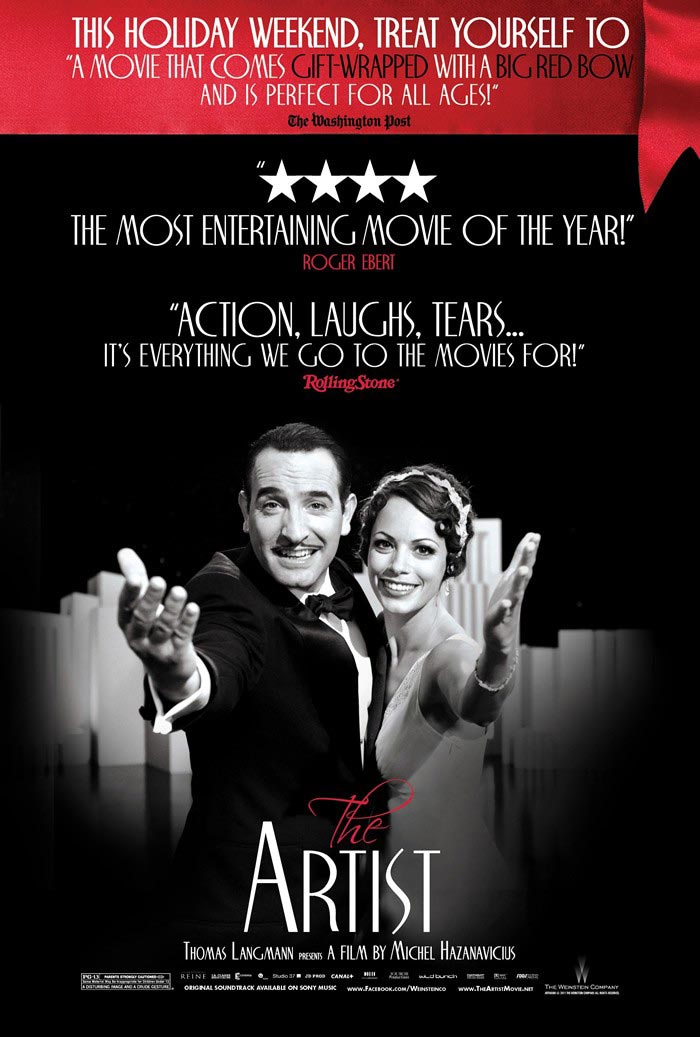
THE ARTIST


Most people do not watch silent films. In fact, most people do not watch black and white films. Judging by the box office lately it seems people are even giving up on theatrical 2D. So I know I have my work cut out for me when I say you must go see The Artist as soon as possible. It is silent, black and white, 2D and not even in widescreen. And it is going to be crowned the Best Picture of the year by the Academy Awards; if it doesn’t I will have serious reservations about defending the Oscars’ integrity.

It is the story of George Valentin (Jean Dujardin), a silent film star who is pushed aside at the start of the sound era; the classic rouge hero is quickly forgotten as new star Peppy Miller (Bérénice Bejo) takes center stage working for Al Zimmer (John Goodman) and the Kinograph Studios.

All of the performances, with Dujardin and Bejo at the center, make this an extremely relatable film. Even modern audiences expecting to be frustrated by the lack of dialogue will be surprised by the expressive storytelling power that this film delivers. An equal partner to the actors is the film’s score by Ludovic Bource, and director Michel Hazanavicius uses the music or removes the music with elegant ease.

Many will claim it is for filmmakers and cinephiles only, but that is not true. Filmmakers and cinephiles are just at the head of the pack because they already watch silent films and understand that they should not be treated differently. A moment of silence will bring a hush to the audience, as it should, but that is no different than any other modern film. When a joke is funny, you can laugh. When a shock surprises you, you can gasp. A great film is a great film, and this uses every trick developed in a century of filmmaking to tell the most beautifully realized love letter to cinema I have ever seen. Only Hugo and Cinema Paradiso have come this close to recreating the exhilaration I remember from seeing my first movies.

This silent, black and white, full-frame movie is a delight. I will be going back to see it again. I will buy it on blu-ray. I will make everyone I know watch it because, believe me, it is breathtaking.


Friday, January 6, 2012

TINKER TAILOR SOLDIER SPY


Tomas Alfredson is the latest European director to make an English-language debut. Following his success with Let the Right One In, Alfredson has taken the classic spy thriller by John le Carré and put together one of the finest British casts ever assembled outside of Harry Potter. The result is a stunning and suspensful drama set in the 1970s at the top of British Intelligence.

Gary Oldman is George Smiley, the aging spy who was forced into retirement alongside his boss, played by John Hurt, following a botched operation in Budapest. When rogue agent Ricky Tarr (Tom Hardy) appears to have information about a mole at the top of the organization George Smiley is brought back to find the leak.

The script is a tight adaptation of the original book, and it will be the one to beat at this year’s Oscars. The shuffled timeline and regular flashbacks are all easily understood despite the lack of on-screen text to state the time and place. The 1979 adaptation of the novel was a television mini-series, so it was not restrained by a two-hour running time. Yet this version leaves out very little and is generally a far more effective thriller.

It is impossible to consider any element of the film being more important to its success than its cast. Gary Oldman is the center of the film, but Benedict Cumberbatch also shines as Smiley’s second-in-command. In this world of secrets and polite society the smallest gestures become important, and moments of insight are handled with a sure directorial hand by Alfredson who holds on a close-up or sustains a scene of emotional distress for just the right length of time.

Tinker Tailor Soldier Spy has been nominated for three Academy Awards this year. As well as the screenplay it is nominated for Alberto Iglesias’ musical score, which is an exceptionally important part of the tension and mystery. The third is Gary Oldman for Best Actor. Oldman has never been nominated before despite numerous great performances since he came into the spotlight in the early 90s. If he manages to beat Jean Dujardin (The Artist) it will be the result of an Oscar-worthy performance by an actor who is long-overdue for a win.


Sunday, January 1, 2012

SHERLOCK: Series 2


Another series of the BBC’s Sherlock has concluded. This brings the grand total of all the episodes to six. For those of you who have not yet watched this brilliant show it is the modern retelling of Sir Arthur Conan Doyle’s famous detective stories. Martin Freeman (coming soon as Bilbo in The Hobbit) plays Dr. John Watson, a former army doctor, and Benedict Cumberbatch plays the immortal Sherlock Holmes. Robert Downey Jr’s performance in his two films is a terrific and entertaining Holmes, but it is Cumberbatch who best-walks the thin line between genius and smart-ass.

Episodes one and three were, as in season one, the best. Episode one is possibly the best episode of the whole series. A Scandal In Belgravia introduces a new take on Irene Adler. Played by Rachel McAdams in the feature films, Irene is played in the series by Lara Pulver who takes the role to new levels. Irene is a femme fatale in the best ways, and without her presence the rest of the season just cannot compete.

Episode two this time around is a variation on “The Hound of the Baskervilles”. It is a reasonably good mystery, but like its season one counterpart (The Blind Banker) it is heavy on plot and light on the Watson/Holmes dynamic that makes this series so brilliant.

Episode three is the terrific finale The Reichenbach Fall, which fans of Doyle will notice was based on a very important story in Holmes’ history. It gives lots of screen time to the wonderfully insane Jim Moriarty, Holmes is put into plenty of difficult situations, brilliant dialogue is said, mysteries are solved, and once again it leaves me wishing that the BBC made longer seasons.

The Holmes and Watson dynamic has been done so many times (IMDb lists 255 going back to 1900) that you would think it would be worn out. But Mark Gatiss and Steven Moffat have created a true original with Benedict Cumberbatch (best name ever)  and Martin Freeman as the best Sherlock Holmes and Dr. Watson we are likely to see for a long time.

If you have not seen this series I cannot recommend it enough.


Wednesday, November 30, 2011

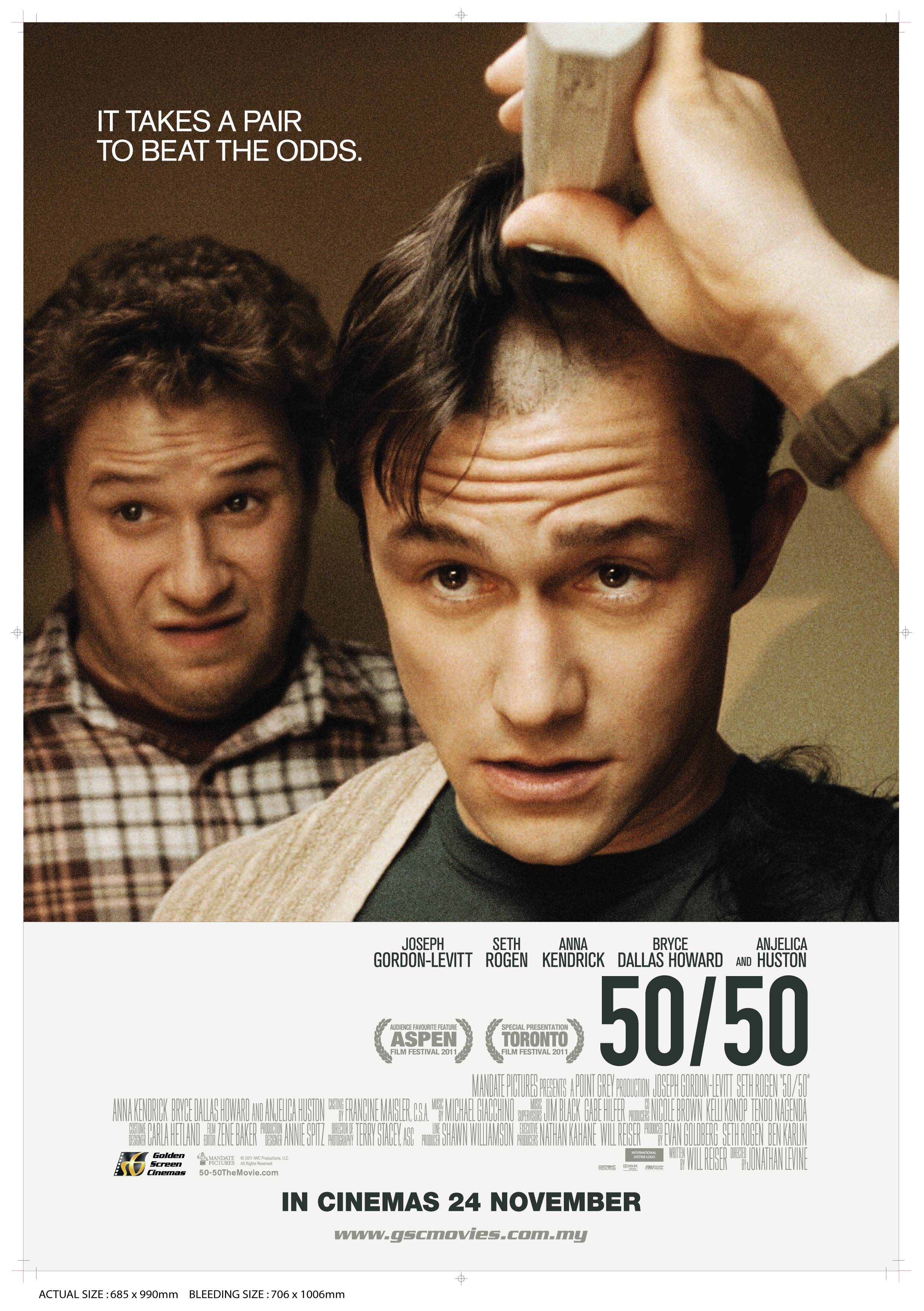
50/50


Joseph Gordon-Levitt plays Adam and Seth Rogen is his best friend Kyle. Adam and Kyle are the central pair of a perfect cast of characters played by Anna Kendrick, Bryce Dallas Howard, Matt Frewer, Philip Baker Hall, and Anjelica Huston. Adam works for Seattle Public Radio with Kyle, spends time with his artist girlfriend Rachael, and doesn’t call his mother as much as he should. He has an average, good life. But after a back ache sends him to the doctor, Adam is told he has a rare form of cancer.

The story of 50/50 is the semi-autobiographical work of Will Reiser, a friend of Seth Rogen’s, who wrote the screenplay as a part of the healing process. The film is as honest and personal as Little Miss Sunshine and Juno, both of which were written by unknowns and went on to score Oscars for Best Original Screenplay and nominations for Best Picture. Particularly now that there can be up to ten Best Picture nominees it is not out of line to suggest 50/50 will appear in both categories. Following other terrific performances in Mysterious Skin, Brick, The Lookout, and Inception, Joseph Gordon-Levitt has proven again that he is a future A-list actor.

No matter what awards 50/50 does or does not get, it is a true, honest, entertaining film. Often screenplays forget to keep the focus on the main character and the resulting films are unfocused and sloppy. Although there are half a dozen good characters played by great actors there are no dragging moments where a subplot is given too much screen time or a supporting character is made more important than Adam.

The balance between characters is true for the various supporting parts as well. Adam’s crumbling relationship with Rachael is balanced against his long-lasting friendship with Kyle, his new experiences with his therapist, his distant relationship with his parents, and his budding friendships with fellow cancer-patients Mitch and Alan. Each relationship changes with Adam as he shaves his head, starts chemotherapy, and attempts to understand his new situation.

Despite all of the drama and tragedy associated with cancer, 50/50 remains one of the funniest films of the year. This is a film that uses the intimacy and awkwardness of its subject matter to draw laughter from its audience. The most appropriate comparison would be to Garden State or Almost Famous, which both accomplished a similar melancholy comedy.

Taking the comparison further, 50/50 manages, like Almost Famous, to have a great soundtrack with an appropriate mix of Radiohead, Pearl Jam, The Bee Gees, The Jacuzzi Boys, and others. Director Jonathan Levine sometimes uses a song to comment on a particular moment of the movie, but often the music is just a great choice for the background to a scene without dialogue.

The Verdict: It may be rated 14A for profanity, sexual content, and drug use, but 50/50 is a film that can be enjoyed by anyone who doesn’t wall themselves off to mature content. It is modern, relatable, and very human.


Wednesday, November 23, 2011

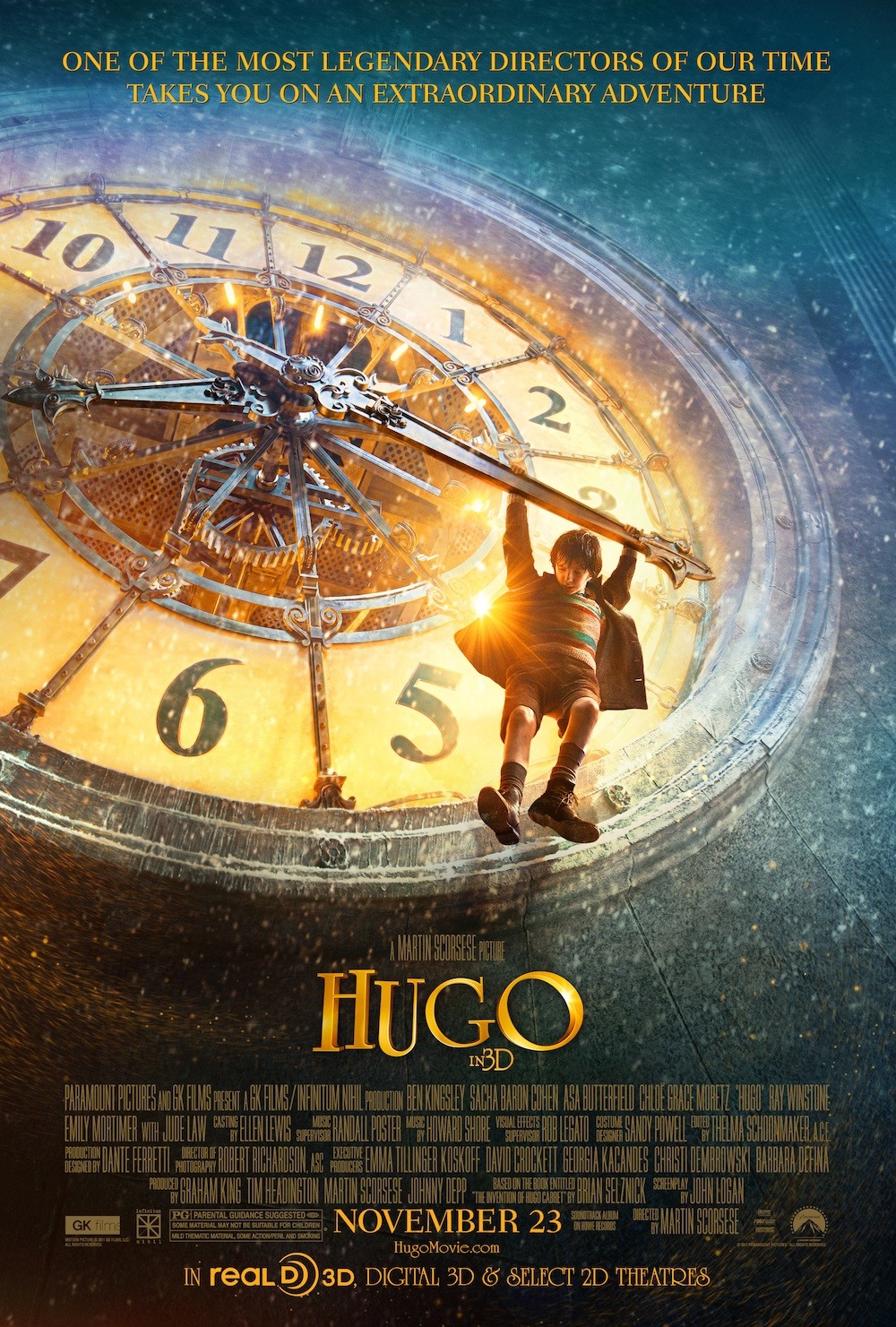
HUGO


Martin Scorsese’s first experiment with family filmmaking is combined with his first attempt at 3D, and the results are (because there is no better word) magical. Based on the highly-recommended novel “The Invention of Hugo Cabret” by Brian Selznick, Hugo is the story of an orphan living in the walls of a Paris train station in the 1930s. Hugo Cabret winds the clocks, steals food, dodges the troublesome station inspector (Sacha Baron Cohen), and works in secret to repair a mysterious automaton.

In his exploration of the automaton’s origins, Hugo discovers that the old man in the train station toy shop is actually Georges Méliès (Ben Kingsley), the filmmaker behind the famous image of the rocket hitting the man in the moon. But now he is forgotten by the filmgoing public. Bitter and angry at the world, Méliès catches Hugo attempting to steal parts for his automaton, and Méliès puts the boy to work in the toy shop to pay back what he owes.

Considering the films Martin Scorsese is famous for it may seem odd to say this is the perfect combination of artist and material, but there really is no other major filmmaker who could have given Selznick’s book the appropriate respect. The novel uses a combination of text with full-page pencil sketches to tell the story like an early film. This is captured beautifully by Scorsese in many sequences where dialogue is not required and therefore is not used. It is easy to imagine some directors being less comfortable with visual storytelling, and as a result they would have made a film that failed to capture the magic of silent films.

A love of movies is present throughout. Hugo takes his friend Isabelle (Chloë Grace Moretz) to see Safety Last!, Harold Lloyd’s 1923 comedy. The classic clock tower stunt brings gasps to the film audience (and brought a few to the theatre I was sitting in as well). Moments like these are peppered throughout and build to the celebratory climax.

Scorsese’s first attempt at 3D is anything but amateur. The depth of the images is used to beautiful effect. An opening crane shot through the crowds of the train station and up to Hugo’s face is a perfect rendering of the same sequence from the novel. Other scenes, such as a chase up the clock tower or a train crash, make further use of the power of 3D to enhance the experience.

A good critic should remain outside the review and judge on the merits of the production, but I have to step in at this point to say that the use of 3D conversion on some of the silent scenes shown from Méliès’ films made me giddy. I’ve been a fan of silent films since I first saw Charlie Chaplin’s The Gold Rush when I was a kid, and ever since the 3D trend started I’ve wanted to see exactly what Martin Scorsese showed me in this film. By converting the images to 3D he brought back the magic that so many people overlook when they see a silent film.

Of course the key to any good movie - silent and monochrome or talkie and colourful 3D - are the actors. Supporting parts played by Ray Winstone, Richard Griffiths, Frances de la Tour, Jude Law, Emily Mortimer, and the great Christopher Lee are all perfectly fitted into the story without taking anything away from the lead performances. Ben Kingsley gives another high-class performance, and Chloë Grace Moretz proves again that she will not disappear like some child actors have. But the true gem in this film is Asa Butterfield as Hugo. Butterfield has appeared in a few supporting roles, and would be most recognized as Bruno in The Boy in the Striped Pajamas, but in Hugo he is infinitely watchable as the frightened yet unyielding hero. Like many others I have been skeptical about the upcoming film of Orson Scott Card’s “Ender’s Game,” but now that Butterfield has been announced as the lead my hopes are significantly improved.

The Verdict: A beautiful, immersive, magical, and powerful film about the power, magic, and immersive beauty of silent cinema. A perfect coming-of-age adventure.