Friday, December 14, 2012

HITCHCOCK


Two brothers are digging a hole outside a farmhouse. After a disagreement about their mother, one of them walks out of frame. He returns a moment later to bash his brother over the head with a shovel and the camera pans to the side where Alfred Hitchcock (Anthony Hopkins) is watching, just like an audience member at a theatre. He turns to the camera and delivers the first charming quip (of which there will be many) to his audience about Ed Gein and how he inspired Psycho. And so begins the entertaining, somewhat lightweight look at one of the most famous directors in history, and the production of his most-famous film.

When it was released in 1960, Psycho made a huge impact on Hollywood that affects movies to this day. It was near the end of the censor’s reign, which had held films back from including content that would get anything beyond a PG rating by modern standards. It was also at a time when television was stealing audiences, and filmmakers were looking for new ways to lure people to the theatre. Hitch created a pre-release buzz that was unheard of, but has since become standard. In the 60s a film could open in a couple of theaters and play for months before finding an audience and becoming a nationwide success; today studios release films in thousands of theaters, and if they don’t make the top three on their opening weekend they are considered flops.

But all of this history is secondary to the real purpose of Hitchcock.

Under all the film trivia, the focus of the story is Alfred (“Just call me Hitch, drop the cock.”) and his wife Alma Reville (Helen Mirren). They are a couple heading into their golden years together, and comfortable performances from Hopkins and Mirren make their long-lasting love affair very believable. Running gags with Alma trying to make Hitch eat better food, and Hitch trying to hide his drinking, play out in scenes of Hollywood negotiations and production stress to bring these two characters firmly to life.

This care and attention given to develop the two lead characters is great for them, but it leaves most of the supporting cast underdeveloped. In the lead up to the production a series of short scenes introduces characters who are offered up like garnish; they look great, but they have little substance. Ralph Macchio plays the psychiatry-obsessed screenwriter Joseph Stefano, Kurtwood Smith is the hardliner censor who hovers over the script with a red pen, and James D’Arcy is Anthony Perkins,  the actor playing the titular psycho. D’Arcy’s performance seems to avoid any of the complexity of the real Perkins in favor of his character in the film, Norman Bates.

A supporting part that actually does get some development is serial killer Ed Gein  (Michael Wincott) who haunts Hitch’s dreams like a psychotic muse. There are times it seems that Gein might have more influence over the director than his long-suffering wife. Gein is one characters who, along with beautiful blonde Janet Leigh (Scarlett Johansson) and slick writer Whitfield Cook (Danny Huston), starts to come between Hitch and Alma, and his appearances are some of the only real insights given to Hitch’s thoughts.

By the end, with a great reference to Hitchcock’s next film, the piece that will be remembered most is Hopkins’ performance. His makeup is perfect and he uses the fat suit and prosthetic lips to make Hitch be the charming, troublesome, childish genius he is known to have been. He has some great lines, but it is his physical reaction to the first audience seeing the shower scene that makes him a likely contender for this year’s awards. Standing outside the door he conducts their screams like Amadeus and stabs the air with an invisible knife.

The simple supporting parts, all of them brilliant impersonations, and Hopkins’ easy-to-like lead create the film’s simple, tongue-in-cheek style. It is the sort of biopic that Hitch himself would have enjoyed because it has the bare minimum of personal insights and regularly choses entertainment over historical accuracy. We can never know exactly what went on with all these people during the making of the film, and we can never know exactly what Hitch and Alma’s relationship was like, so having a lot of talented actors performing an entertaining script is really all we can hope for, and Hitchcock delivers. It might not be perfect, but, after all, “It’s only a bloody movie.”


THE HOBBIT (at 48 FPS)


This isn't exactly a review of The Hobbit: An Unexpected Journey since fans will go see it no matter what is said, and Peter Jackson has offered up something far more interesting to talk about: High Frame Rate 3D. I plan to go back to see a 2D or regular 3D show so I can watch the movie and not the technology, but, as far as new technology goes, it is worth experiencing.

The new format took almost an hour for my mind to adjust, and until then the picture appeared to be on fast-forward. This was not helped by the film’s clunky prologue, but Martin Freeman soon arrived to save me from Ian Holm and Elijah Woods’ bizarrely bad performances.

The format allows for extremely detailed high-def images and it removes motion blur entirely. This leaves the action on screen looking as close to reality as is possible. This would be spectacular for a filmed stage play, or really for any film that doesn’t include giant wolves, orcs, and goblins. Every time a CG element appeared on screen it stuck out like a red flag. The doubled frame-rate doubled the standards for visual accuracy, and it felt like seeing something made in the early 90s.

The one saving grace of the film’s CG cast was Andy Serkis playing Gollum. This is likely a combination of a great actor and a familiar character. I know what Gollum looks like, so I didn’t feel myself analyzing his character design like I did for the Goblin King. I accepted his reality in the (brilliantly-scripted) scene. And this gave me hope for the new technology.

I think that the HFR Hobbit is a sacrificial lamb, a bit like The Dark Knight was with its use of IMAX. There was no way that Christopher Nolan’s blockbuster was going to fail to sell on Blu-ray, but the screen changes sizes between the different camera types, which is somewhat annoying. It still sold, though, because the technology cannot damage what is a great film. This has resulted in IMAX gaining wider use in Hollywood, which is good because IMAX offers unparalleled image quality. The Hobbit was going to make a lot of money even if it was horrible (it isn’t), so to introduce the HFR on a sure-thing means that the technology will proliferate sooner instead of dying on arrival. And despite how much I disliked it for this film (a lot) I think that the HFR format, just like IMAX, should be used again.
So what purpose does it have? I mentioned before that it would work for a filmed stage play, and I think that is a key scenario. But it can’t be filmed like a movie. Peter Jackson tried to have his cake and eat it too. He used his new technology to heighten the reality of his film, but he also framed his shots and edited his scenes like he did in The Lord of the Rings. All the 3D film directors have been doing the same thing, but the HFR has brought more attention to it.

No matter how innovative or edgy or Quentin Tarantino a director may be, there is a basic form of framing and editing that all films share. Dialogue scenes generally have establishing shots and move closer to the actors through a series of different angles cutting between the speakers. This is the language of film that audiences understand and follow best. When filmmakers start on an extreme close up or on an empty set with people talking off-camera they are playing with that language for a particular effect. This language exists to guide the audience’s thoughts and emotions into believing in a world that exists only as a flat image on the wall.

3D shares elements of 2D film language, but its ability to reach out into the audience or back into the depths of the image has altered what is possible. Fast cutting between close-ups is not as effective in 3D as having a pair of actors on screen, in focus, together. The director cannot point our eye exactly where he wants in the same way when, instead of a photograph, we are looking through a window. 3D’s similarity to reality means we are less willing to hand our eyes over to a director who wants us to focus on something specific, and our mind is slower to re-adjust when a cut takes us from one location to another.

It is understandable, therefore, that many critics writing about the HFR have praised the “Riddles in the Dark” sequence with Bilbo and Gollum. It is the best scene in the film in terms of performance, motion capture technology, script, and story. But it is also the best for 3D because it is an extended scene in a single location that uses long takes and shows most of the character in the frame. It is a stage play. And for this reason it feels more real than anything else in the movie.

Now imagine a feature film that is entirely made of scenes like this. No extravagant special effects to scrutinize and no fast-cutting action scenes. Just quality performances with a smart script, high story stakes, and an immersive HFR 3D picture offering absolutely realistic images. It could be the ultimate combination of film and live theatre.

3D is here to stay. That was clear the moment Avatar passed two billion dollars worldwide. But we are still in the experimental period where new language is being discovered. Like the 1930s adjusting to sound, the time is soon approaching when films like It Happened One Night, All Quiet on the Western Front, and M will show audiences how new technology can be used to tell a story instead of just showing off how new it is.


Friday, November 16, 2012

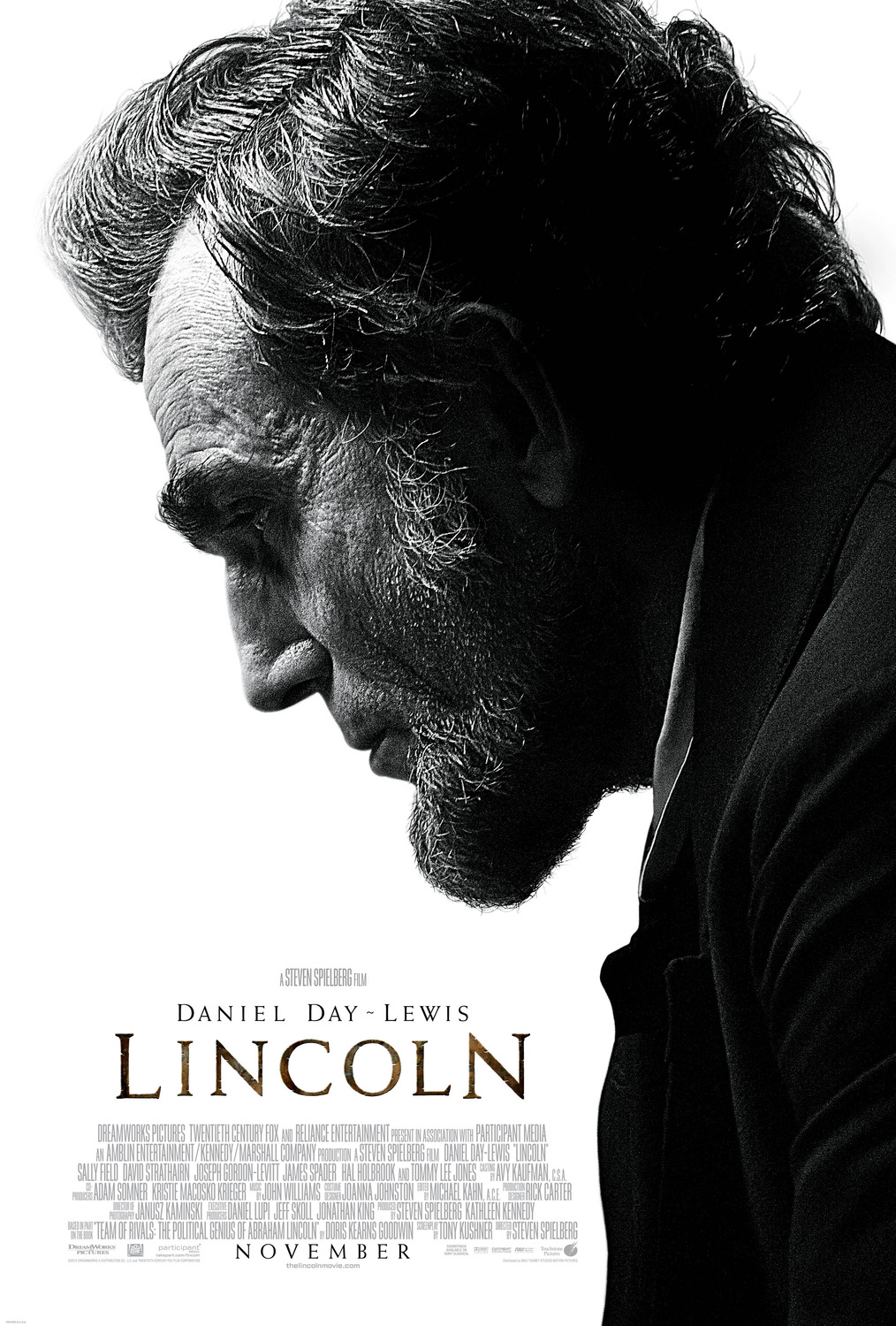
LINCOLN

History can sometimes weigh on a film like an albatross around its neck. The importance of getting things right while being entertaining while making something respectable while making it broad enough to get an audience to justify the larger budget for period sets can be overwhelming. When the subject matter is the man on the US penny, and his fight to pass one of the most important pieces of legislation in US history, that weight of history could easily turn any film into a dusty textbook. But Steven Spielberg does not make dusty textbooks, and Lincoln is possibly his best addition to Hollywood’s collection of history on film.

At the end of 1865, Abraham Lincoln has won re-election, the Civil War is in its final year, and the President has decided that the time has come to pass the 13th Amendment to end slavery. With a trio of proto-lobbyists and the Radical Republican Thaddeus Stevens (Tommy Lee Jones), Lincoln and his Secretary of State (David Strathairn) play politics with Congress while continuing to fight the Confederacy.

A film about Abraham Lincoln directed by Steven Spielberg was inevitable. He has been planning it for more than a decade. Scripts and screenwriters have come and gone as the centerpiece of the story shifted from Lincoln’s early days to the Civil War. Finally Tony Kushner (Angels in America, Munich) was hired to adapt Doris Kearns Goodwin’s Team of Rivals, with the focus on Lincoln’s final years. The script that resulted is easily one of the best historical adaptations I’ve seen. It achieves the delicate task of creating dialogue for cultural icons, balancing fact with entertainment, and creating suspense where none exists. Like Apollo 13 or Titanic, there is no mystery about the conclusion, but there is so much drama to be found along the way. History adaptations are interesting for all the details that are not widely known, and unless the audience has studied the source materials, there are plenty of surprises in Lincoln.

In one of Spielberg’s earlier versions he had cast Liam Neeson as the President when Daniel Day-Lewis passed. That production was put aside and Day-Lewis was eventually persuaded to join. Good that he did because the performance he gives is nothing short of astounding. Everything, from his posture to his voice, appears completely natural; he isn’t playing Lincoln, he is Lincoln. It’s a cliche, but it’s true: Daniel Day-Lewis completely disappears into this role.

Part of Day-Lewis’ impressive performance comes from his supporting cast. Spielberg is the most powerful director in Hollywood, so he can get anyone he wants. Everywhere in Lincoln there are familiar faces wearing false beards or Gone With The Wind dresses. Sally Field is a standout as Mary Todd Lincoln, and Joseph Gordon Levitt as her son, Robert. James Spader plays a 19th Century version of his Boston Legal persona named W. N. Bilbo. And Watchmen’s Rorschach, Jackie Earle Haley, plays the Vice-President of the Confederacy, Alexander Stephens. The recognizable cast echoes JFK or The Aviator, where modern celebrity is used to make up for the diminished notoriety of the real people. It’s an elegant and old-fashioned strategy to make lesser historical figures relevant to a modern audience. But, among this celebrity cast, Daniel Day-Lewis still disappears under Abraham Lincoln’s face, which makes his performance even more amazing.

An important aspect of Lincoln’s power is the cast of antagonists. The democratic leaders, the Confederacy diplomats, and the average white farmers who fear mass murder at the hands of freed slaves are strangely humanized despite their views. A combination of script and performance makes clear their arguments as to why ending slavery is bad. Their logic is broken and their views are obviously wrong, but it is not difficult to understand how and why they hold the views they do. This gives the opposition to the amendment real credibility, which aids the suspense in the voting sequence.
The climax of the film, much like the title moment of The King’s Speech, is played almost verbatim as it would have happened. The roll is called and one by one the congressmen vote; focus jumps around to all the characters in the film, and slowly the tally is taken until the results are announced. It seems odd that something so methodical and bureaucratic could be so exciting, but that is the curious power that this film wields. Spielberg has put together a tremendously balanced film. It is witty, engaging, and never feels too long. Essentially, it’s a 19th Century episode of The West Wing, which any fan of the show will tell you sounds amazing.