Wednesday, November 30, 2011

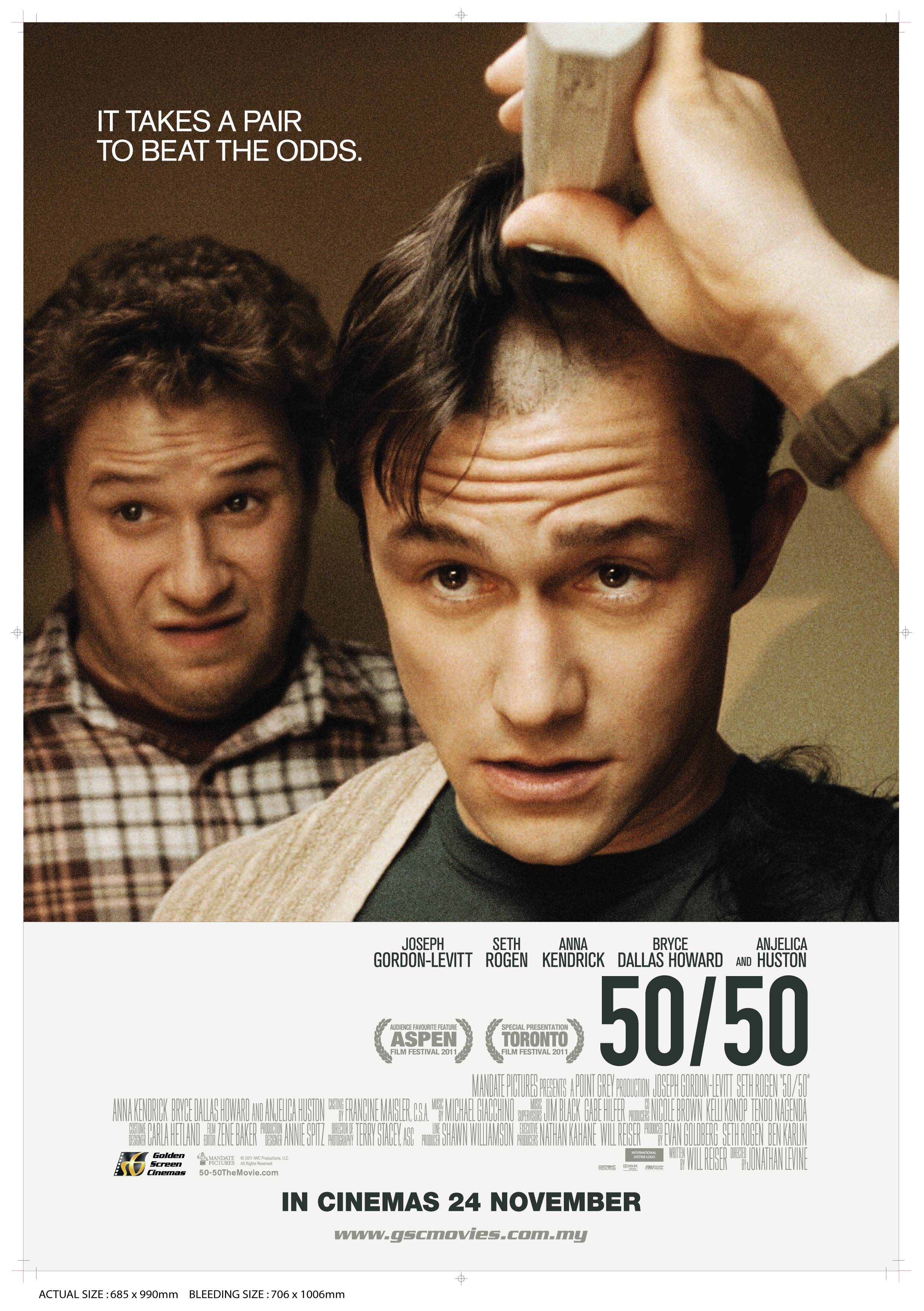
50/50


Joseph Gordon-Levitt plays Adam and Seth Rogen is his best friend Kyle. Adam and Kyle are the central pair of a perfect cast of characters played by Anna Kendrick, Bryce Dallas Howard, Matt Frewer, Philip Baker Hall, and Anjelica Huston. Adam works for Seattle Public Radio with Kyle, spends time with his artist girlfriend Rachael, and doesn’t call his mother as much as he should. He has an average, good life. But after a back ache sends him to the doctor, Adam is told he has a rare form of cancer.

The story of 50/50 is the semi-autobiographical work of Will Reiser, a friend of Seth Rogen’s, who wrote the screenplay as a part of the healing process. The film is as honest and personal as Little Miss Sunshine and Juno, both of which were written by unknowns and went on to score Oscars for Best Original Screenplay and nominations for Best Picture. Particularly now that there can be up to ten Best Picture nominees it is not out of line to suggest 50/50 will appear in both categories. Following other terrific performances in Mysterious Skin, Brick, The Lookout, and Inception, Joseph Gordon-Levitt has proven again that he is a future A-list actor.

No matter what awards 50/50 does or does not get, it is a true, honest, entertaining film. Often screenplays forget to keep the focus on the main character and the resulting films are unfocused and sloppy. Although there are half a dozen good characters played by great actors there are no dragging moments where a subplot is given too much screen time or a supporting character is made more important than Adam.

The balance between characters is true for the various supporting parts as well. Adam’s crumbling relationship with Rachael is balanced against his long-lasting friendship with Kyle, his new experiences with his therapist, his distant relationship with his parents, and his budding friendships with fellow cancer-patients Mitch and Alan. Each relationship changes with Adam as he shaves his head, starts chemotherapy, and attempts to understand his new situation.

Despite all of the drama and tragedy associated with cancer, 50/50 remains one of the funniest films of the year. This is a film that uses the intimacy and awkwardness of its subject matter to draw laughter from its audience. The most appropriate comparison would be to Garden State or Almost Famous, which both accomplished a similar melancholy comedy.

Taking the comparison further, 50/50 manages, like Almost Famous, to have a great soundtrack with an appropriate mix of Radiohead, Pearl Jam, The Bee Gees, The Jacuzzi Boys, and others. Director Jonathan Levine sometimes uses a song to comment on a particular moment of the movie, but often the music is just a great choice for the background to a scene without dialogue.

The Verdict: It may be rated 14A for profanity, sexual content, and drug use, but 50/50 is a film that can be enjoyed by anyone who doesn’t wall themselves off to mature content. It is modern, relatable, and very human.


Wednesday, November 23, 2011

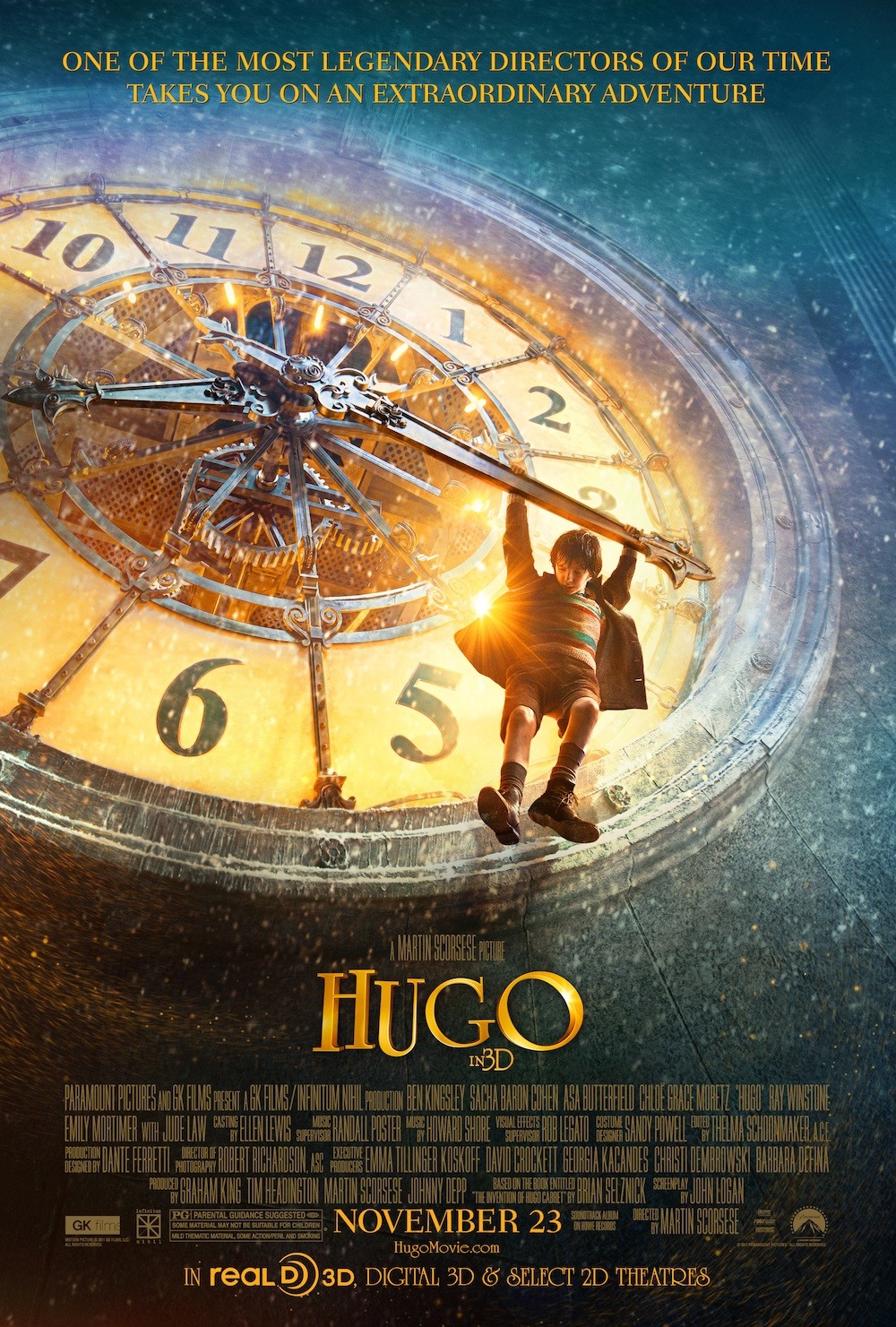
HUGO


Martin Scorsese’s first experiment with family filmmaking is combined with his first attempt at 3D, and the results are (because there is no better word) magical. Based on the highly-recommended novel “The Invention of Hugo Cabret” by Brian Selznick, Hugo is the story of an orphan living in the walls of a Paris train station in the 1930s. Hugo Cabret winds the clocks, steals food, dodges the troublesome station inspector (Sacha Baron Cohen), and works in secret to repair a mysterious automaton.

In his exploration of the automaton’s origins, Hugo discovers that the old man in the train station toy shop is actually Georges Méliès (Ben Kingsley), the filmmaker behind the famous image of the rocket hitting the man in the moon. But now he is forgotten by the filmgoing public. Bitter and angry at the world, Méliès catches Hugo attempting to steal parts for his automaton, and Méliès puts the boy to work in the toy shop to pay back what he owes.

Considering the films Martin Scorsese is famous for it may seem odd to say this is the perfect combination of artist and material, but there really is no other major filmmaker who could have given Selznick’s book the appropriate respect. The novel uses a combination of text with full-page pencil sketches to tell the story like an early film. This is captured beautifully by Scorsese in many sequences where dialogue is not required and therefore is not used. It is easy to imagine some directors being less comfortable with visual storytelling, and as a result they would have made a film that failed to capture the magic of silent films.

A love of movies is present throughout. Hugo takes his friend Isabelle (Chloë Grace Moretz) to see Safety Last!, Harold Lloyd’s 1923 comedy. The classic clock tower stunt brings gasps to the film audience (and brought a few to the theatre I was sitting in as well). Moments like these are peppered throughout and build to the celebratory climax.

Scorsese’s first attempt at 3D is anything but amateur. The depth of the images is used to beautiful effect. An opening crane shot through the crowds of the train station and up to Hugo’s face is a perfect rendering of the same sequence from the novel. Other scenes, such as a chase up the clock tower or a train crash, make further use of the power of 3D to enhance the experience.

A good critic should remain outside the review and judge on the merits of the production, but I have to step in at this point to say that the use of 3D conversion on some of the silent scenes shown from Méliès’ films made me giddy. I’ve been a fan of silent films since I first saw Charlie Chaplin’s The Gold Rush when I was a kid, and ever since the 3D trend started I’ve wanted to see exactly what Martin Scorsese showed me in this film. By converting the images to 3D he brought back the magic that so many people overlook when they see a silent film.

Of course the key to any good movie - silent and monochrome or talkie and colourful 3D - are the actors. Supporting parts played by Ray Winstone, Richard Griffiths, Frances de la Tour, Jude Law, Emily Mortimer, and the great Christopher Lee are all perfectly fitted into the story without taking anything away from the lead performances. Ben Kingsley gives another high-class performance, and Chloë Grace Moretz proves again that she will not disappear like some child actors have. But the true gem in this film is Asa Butterfield as Hugo. Butterfield has appeared in a few supporting roles, and would be most recognized as Bruno in The Boy in the Striped Pajamas, but in Hugo he is infinitely watchable as the frightened yet unyielding hero. Like many others I have been skeptical about the upcoming film of Orson Scott Card’s “Ender’s Game,” but now that Butterfield has been announced as the lead my hopes are significantly improved.

The Verdict: A beautiful, immersive, magical, and powerful film about the power, magic, and immersive beauty of silent cinema. A perfect coming-of-age adventure.


Friday, September 16, 2011

DRIVE

Drive is a crime thriller from the director of the violent art films Bronson and Valhalla Rising. It is the story of a Hollywood stunt performer, only credited as “Driver” (Ryan Gosling), who works evenings as a wheelman for anyone who can stick to his strict rules. When a simple heist goes wrong, the driver is tossed into a spiral of violence that threatens his safety and the life of his neighbour, Irene (Carey Mulligan).

Sound is the not-so-secret weapon employed by director Nicolas Winding Refn. A radio sports commentary competes with a police scanner in one scene of suspense. In another, an explosion of gunfire interrupts silence to jolt you like a driver popping his clutch to jolt a passenger. Combining these sounds with music at a high volume builds a pattern, like the shark theme in Jaws, that draws you in, dials up your pulse, and then either accelerates rapidly or punches you in the gut.

The original score by Cliff Martinez is inspired by ‘80s synth-pop and backed up by European electronic bands. However, the ‘80s style isn’t limited to the music; several sets echo designs seen in the 1980s. Even the plot, title and nameless main character of the film are variations on The Driver, a 1978 movie starring Ryan O’Neil.

When Bryan Cranston (who is a perfect fit for the corrupt mechanic Shannon) was interviewed by George Stroumboulopoulos on the CBC, Cranston mentioned that the script read like a standard crime thriller, and that the power of Drive was created in the editing room by Nicolas Refn. Throughout the film I was struck by how clear this was. Most of the emotional investment into the relationship between the driver and Irene is created in dialogue-free shots where the two characters stare at each other. Wanting to catch every detail of the performances draws you in, and you are forced to feel more intimately attached to the characters. Refn’s repeated use of staring eyes, watching eyes, and unblinking eyes builds this urge to hypnotic effect.

All of these techniques draw you in, mesmerize you, and cause you to become lost in the film, which is then put to the test when a shotgun blast introduces a new element: bloody violence. Do not forget that this film is rated 18A, and it earns that rating. Although the blood never reaches the levels it does in that first attack, the effects are felt long after. Again let me refer to the masterpiece of suspense, Jaws. The music warns you that the shark will soon appear, and it leaves you hanging in suspense and horror, a state of confusion, where you know ‘what’ but you don’t know ‘how’ or ‘when’. Drive uses a similar technique to keep you in a prolonged state of terror/suspense, which is something that Hollywood action films rarely try to do. Usually a buildup of suspense is followed by a cathartic release through comedy or a slower pace. Drive does none of that. The intensity, the violence, the volume, the anger, and the adrenaline are ratcheted up non-stop from the moment the robbery goes wrong.

The film’s violent power is part of the reason it has been so successful at the film festivals, and why it will likely make an appearance in several Oscar categories, but it is also why many people are turned away. Several scenes go well beyond the violence and gore present in the average thriller. In this way Drive reminded me of The Departed. Not an easy film to pin down to any category or rating, Drive is a unique mix of car action, crime violence, art film photography, and horror movie editing. For one reason or another expect Drive to continue to appear in film discussions until well after this awards season concludes.

The Verdict: It is not for everyone. A harsh new type of crime thriller that we will only see more of in the next few years.